The Vertical Cinematographer: Why 2026 Webtoons are Adopting Film Language
The line between comics and cinema is blurring as 2026 studios hire 'Vertical Cinematographers' to manage lighting, depth, and camera movement within the scroll. This shift marks the professionalization of visual pacing for a mobile-first audience.
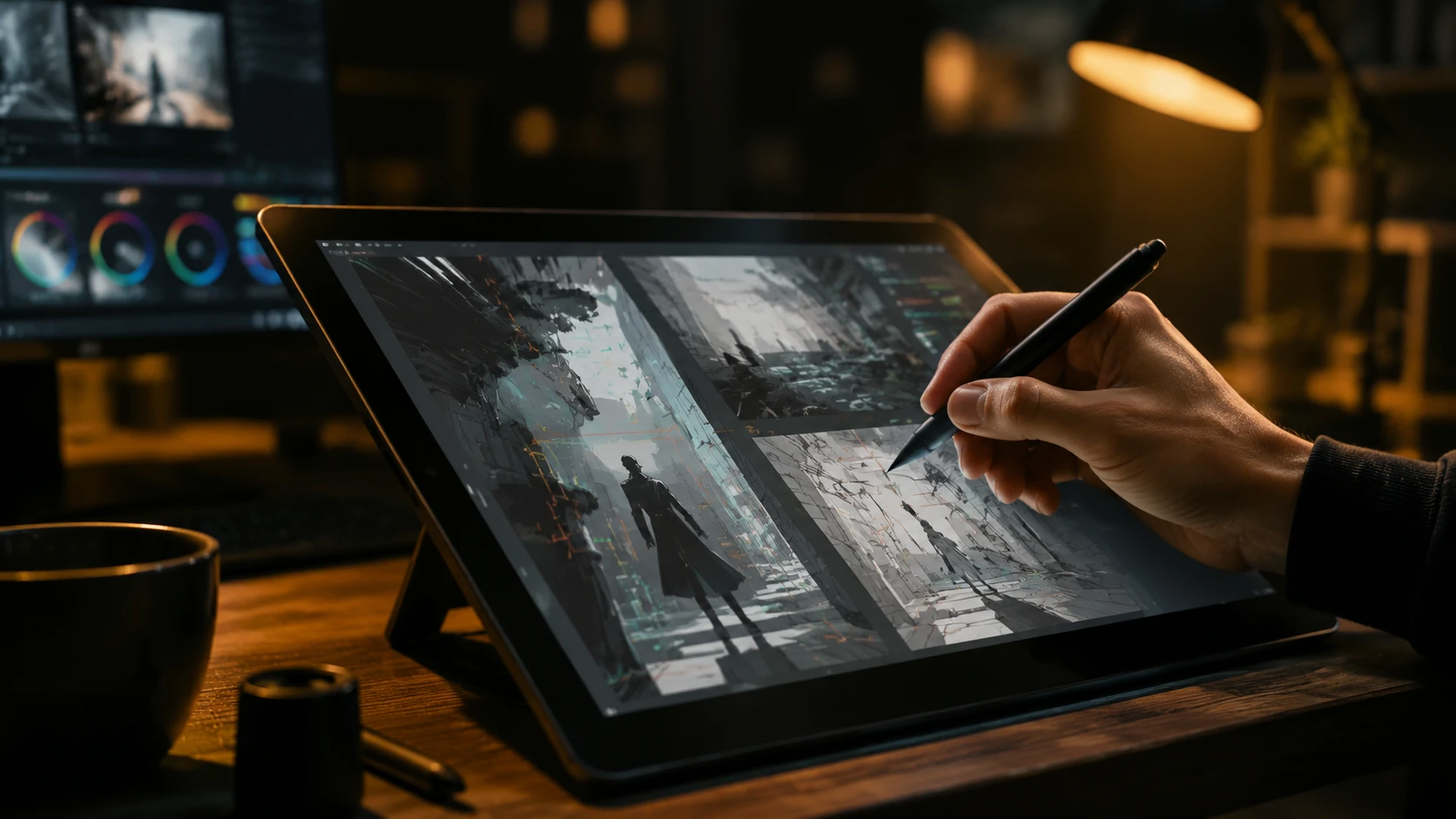
The year 2026 has witnessed a fundamental shift in how digital comics are produced. No longer content with simple 'panels on a page,' the industry is pivoting toward a discipline previously reserved for the silver screen: cinematography. As the webtoon market saturates, elite studios are distinguishing their intellectual property by applying high-end film language to the vertical scroll. This evolution has birthed a new role in the creative pipeline—the Vertical Cinematographer. This professional doesn't just draw panels; they direct the reader's eye through lighting scripts, simulated lens effects, and strategic 'camera' placement that turns a static reading experience into a dynamic visual journey. For creators and publishers, mastering this cinematic shift is no longer a luxury; it is the new baseline for capturing the dwindling attention spans of a mobile-first global audience.
The Infinite Canvas as a Single Continuous Shot
In traditional comics, the 'gutter' acts as a pause. In 2026, the vertical scroll is treated as a 'long take' or a sequence shot. Vertical Cinematographers are using seamless background transitions to maintain a sense of physical space that traditional panelling often breaks. By treating the entire chapter as a single fluid camera movement, creators can build tension more effectively than through static transitions. This technique requires a deep understanding of spatial consistency—ensuring that the reader feels the 'camera' is moving down a hallway or descending a staircase alongside the characters. The goal is to eliminate the cognitive friction of turning pages, replacing it with the immersive pull of a cinematic sequence.
Volumetric Lighting and Emotional Tone
One of the most visible indicators of the cinematic shift is the move away from flat, illustrative coloring toward volumetric lighting. High-budget webtoons in 2026 use 'lighting scripts'—documented plans for how light sources interact with characters across a scene. This isn't just about aesthetics; it's about narrative clarity. Using rim lighting to separate a hero from a dark background or utilizing 'God rays' through a window to signal hope are cinematic tropes that are now being meticulously mapped out in pre-production. This level of detail ensures that even when a reader is scrolling quickly, the emotional tone of the scene is communicated instantly through color temperature and shadow density.
Implementing the 2026 Lighting Workflow
- Light Mapping: Defining primary, secondary, and bounce light sources for every major location.
- Color Scripting: Using a consistent palette to signal shifts in time, mood, or character internal state.
- Atmospheric Effects: Adding digital 'haze' or 'dust motes' to create a sense of three-dimensional depth in a 2D space.
- Shadow Consistency: Ensuring shadow angles align with the perceived light source across 50+ panels of a single chapter.
Lens Effects: Controlling Depth of Field
In film, the focus of the lens tells the audience what to look at. Webtoon creators are now simulating these lens effects to manage 'visual hierarchy.' By blurring the foreground or background (bokeh), creators can force the reader's eye to land exactly on a character's expression or a crucial plot item. This technique is particularly effective on mobile screens, where the limited real estate makes cluttered panels difficult to parse. In 2026, 'Focus Pulling'—changing the focus point from one character to another within the same scroll sequence—has become a standard way to handle dialogue-heavy scenes without relying on repetitive 'talking head' shots.
The 'Edit' vs. The 'Scroll': Mastering Pacing
Cinematography is inseparable from editing. In the vertical format, the reader is the editor, controlling the speed of the cut. However, the Vertical Cinematographer can influence this by manipulating the 'white space' or negative space between panels. Large gaps act as slow-motion sequences or dramatic pauses, while tight, overlapping panels simulate high-speed action. In 2026, we are seeing a trend toward 'Match Cuts' in webtoons—where the shape of an object in one panel matches an object in the next to create a seamless thematic link. This level of intentionality transforms a series of images into a cohesive visual rhythm that feels professional and polished.
Integrating AI for Cinematic Consistency
The rise of the Vertical Cinematographer is supported by advanced 2026 AI tools that allow creators to maintain cinematic consistency at scale. Modern studios use AI-driven lighting engines to automatically apply color scripts to raw line art, ensuring that a character's skin tones react correctly to a sunset or a neon-lit street across hundreds of frames. These tools don't replace the artist; they act as a digital lighting crew, freeing the lead artist to focus on performance and composition while the machine handles the technical labor of volumetric rendering. This hybrid workflow is what allows independent creators to achieve 'studio-level' cinematic quality on a weekly release schedule.
Checklist for Cinematic Production
- Does the chapter have a defined 'Key Light' source?
- Are lens effects (blur/bokeh) used to guide the eye in complex panels?
- Is the scroll speed managed through strategic use of vertical negative space?
- Do character silhouettes remain distinct through the use of rim lighting?
- Is there a consistent 'Color Script' that evolves with the narrative arc?
FAQ
What is a Vertical Cinematographer in the comic industry?
It is a specialized role focusing on the visual directing of a webtoon, including lighting, camera angles, and pacing, to create a film-like experience in the vertical scroll.
How do lens effects like bokeh help webtoon readers?
They manage cognitive load by blurring non-essential details, allowing the reader to immediately focus on the most important narrative element in a panel.
Can independent creators use cinematic techniques without a large budget?
Yes, by focusing on light sources, consistent color scripts, and intentional spacing, independent creators can simulate high-end cinematography even with basic tools.