The Spatial Narrative Framework: Mastering Time and Emotion in the 2026 Infinite Canvas
In 2026, the infinite canvas is no longer just a format; it is a psychological tool. This framework explores how spatial distance between panels translates into perceived time and emotional weight for the modern mobile reader.
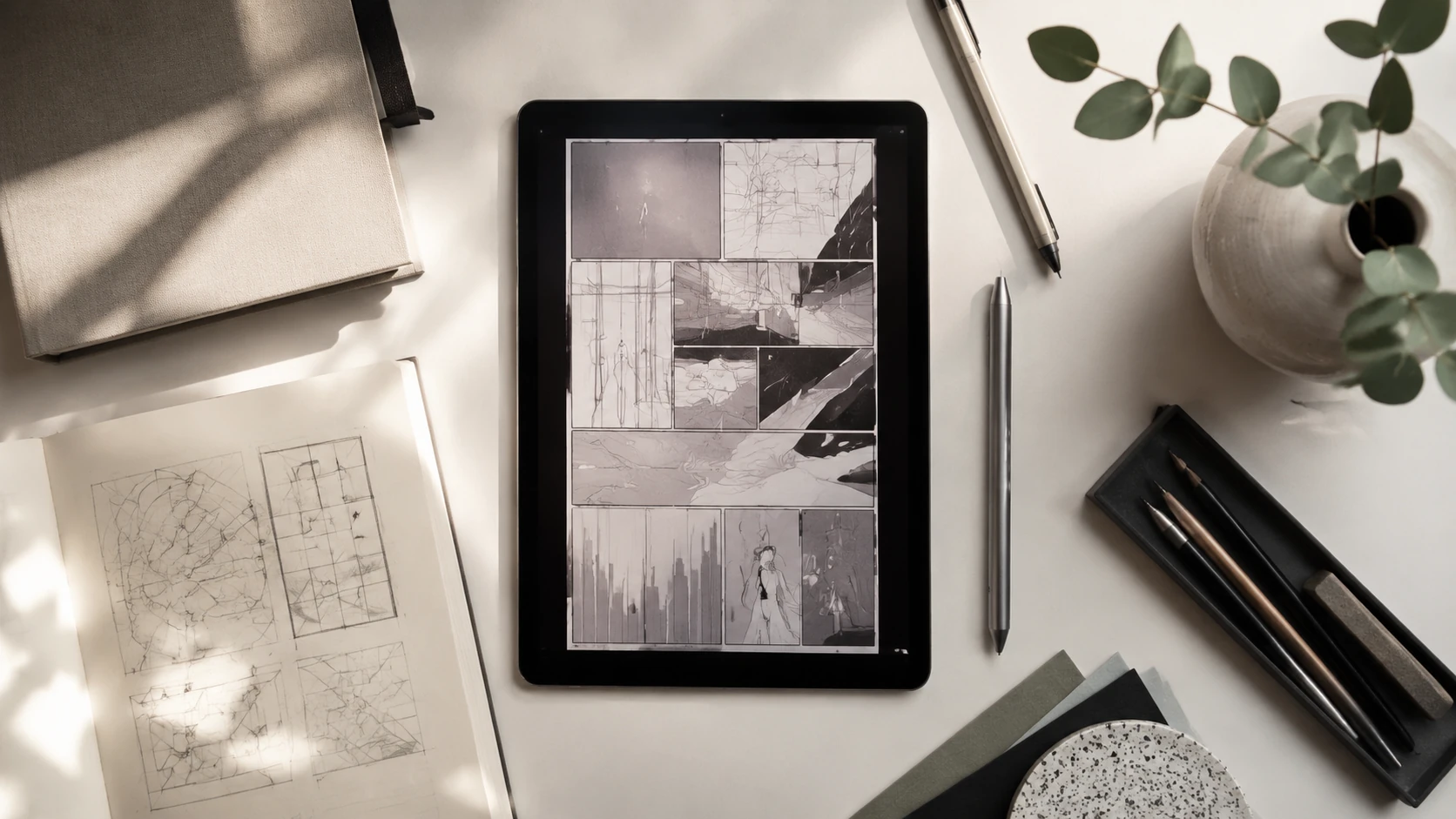
By 2026, the global shift toward vertical consumption has reached its logical conclusion: the 'Infinite Canvas' is no longer treated as a long strip of paper, but as a psychological navigation space. Traditional page-turning mechanics relied on the physical flip to reset the reader's attention; however, the vertical scroll operates on a continuous stream of consciousness. The Spatial Narrative Framework (SNF) has emerged as the definitive 2026 standard for creators to manage 'Chronos' (sequential time) and 'Kairos' (the opportune moment) through literal physical distance on the screen. As mobile devices evolve with higher haptic sensitivity and varied aspect ratios, understanding how to architect the void between panels has become as important as the art within the panels themselves.
The Anatomy of the Scroll: Understanding Gutters as Temporal Voids
In the 2026 narrative landscape, the 'gutter' is not just a white space—it is a clock. In traditional manga or Western comics, the eye moves across a fixed grid, often making assumptions about the time passed between panels based on visual cues. In the infinite canvas, the creator controls the literal speed at which the reader encounters information by manipulating the vertical pixels between assets. A short gutter of 100-200 pixels suggests immediate action or rapid-fire dialogue, whereas a long transition of 800-1200 pixels functions as a cinematic 'fade to black,' forcing the reader to scroll through emptiness and build anticipation or dread.
The Scroll Velocity Principle
The primary challenge for 2026 creators is 'Scroll Velocity'—the speed at which a user's thumb moves. High-retention webtoons now use 'Speed Anchors,' which are oversized or highly detailed panels that force the reader to slow down, effectively acting as a narrative speed bump. By alternating between high-density clusters and low-density transitions, you create a rhythmic experience that mirrors human breathing, preventing the 'skimming' behavior that plagues poorly structured digital content.
Chronos vs. Kairos: Managing Narrative Timing
Mastering the Spatial Narrative Framework requires a distinction between linear progression and emotional impact. Chronos is the logic of the plot—A leads to B. In vertical comics, Chronos is maintained through clear visual flow and consistent character placement. However, Kairos is the 'peak moment'—the punchline, the kiss, or the betrayal. To achieve Kairos in 2026, creators utilize the 'Full-Screen Reveal.' By ensuring the preceding 2,000 pixels contain only minimal atmospheric elements, the creator clears the reader's mental cache, making the eventual reveal hit with maximum emotional resonance.
- Temporal Compression: Using overlapping panels to show simultaneous actions in a single scroll-view.
- Atmospheric Dilation: Extending the background art vertically to simulate the feeling of falling or long-distance travel.
- Emotional Anchoring: Placing a close-up of a character's eyes at the top and bottom of a long sequence to maintain a sense of internal monologue.
The Psychological Descent: Verticality and Tension
Research into 2026 mobile reading habits shows that the act of scrolling down creates a subconscious feeling of 'descending' into a story. This verticality can be weaponized. For horror or thriller genres, placing the 'threat' at the bottom of a long, dark corridor of panels utilizes the reader's own physical movement to increase heart rate. Conversely, for slice-of-life or comedy, a 'flat' scroll with consistent panel heights creates a sense of stability and comfort. The SNF encourages creators to map their emotional beats to the physical exertion required to reach them.
Implementation: The 2026 Pre-Flight Check for Vertical Pacing
Before finalizing a chapter for the 2026 market, creators should perform a 'Thumb Stress Test.' This involves scrolling through the draft on a mobile device at three different speeds: a fast skim, a moderate read, and a slow analytical view. If the narrative beats fail to land in the 'fast skim' version, the visual hierarchy is likely too weak. If the 'slow analytical' view feels repetitive, the spatial gaps are likely too wide, leading to boredom. The goal of the Spatial Narrative Framework is to ensure that regardless of scroll speed, the core emotional arc remains intact through the strategic use of visual silence and focal points.
- Check for 'Panel Stacking': Avoid placing more than 4 dialogue bubbles in a single screen-height to prevent cognitive overload.
- Verify 'Color Bleeds': Use background gradients to transition between scenes, signaling a change in time or location without using text boxes.
- Sync Haptics: If your platform supports 2026 haptic standards, ensure 'impact panels' align with subtle vibration triggers for deep immersion.
FAQ
What is the ideal pixel gap between panels in 2026?
There is no single 'ideal' gap, but the 2026 standard for a standard transition is 300-500 pixels. For high-tension beats, gaps can extend to 1000+ pixels to create a 'pause' in the reader's mind.
How does spatial narrative improve SEO for webtoons?
By optimizing pacing, you increase 'Dwell Time' on the page. Search engines and platform algorithms in 2026 use dwell time as a key signal for 'Helpful Content,' boosting your visibility in discovery feeds.
Can I use the Spatial Narrative Framework for traditional print?
While the SNF is designed for the infinite canvas, its principles of emotional weight and focal points can be adapted for page layouts by treating the page turn as the 'long scroll' transition.