The Pre-Visualization Playbook: Using 'Ghost Storyboarding' to Validate Webtoon Hits in 20
In 2026, successful webtoon creators have moved beyond the 'draw and pray' model. Discover how ghost storyboarding and AI pre-visualization allow you to test narrative hooks and market viability before investing in high-fidelity art.
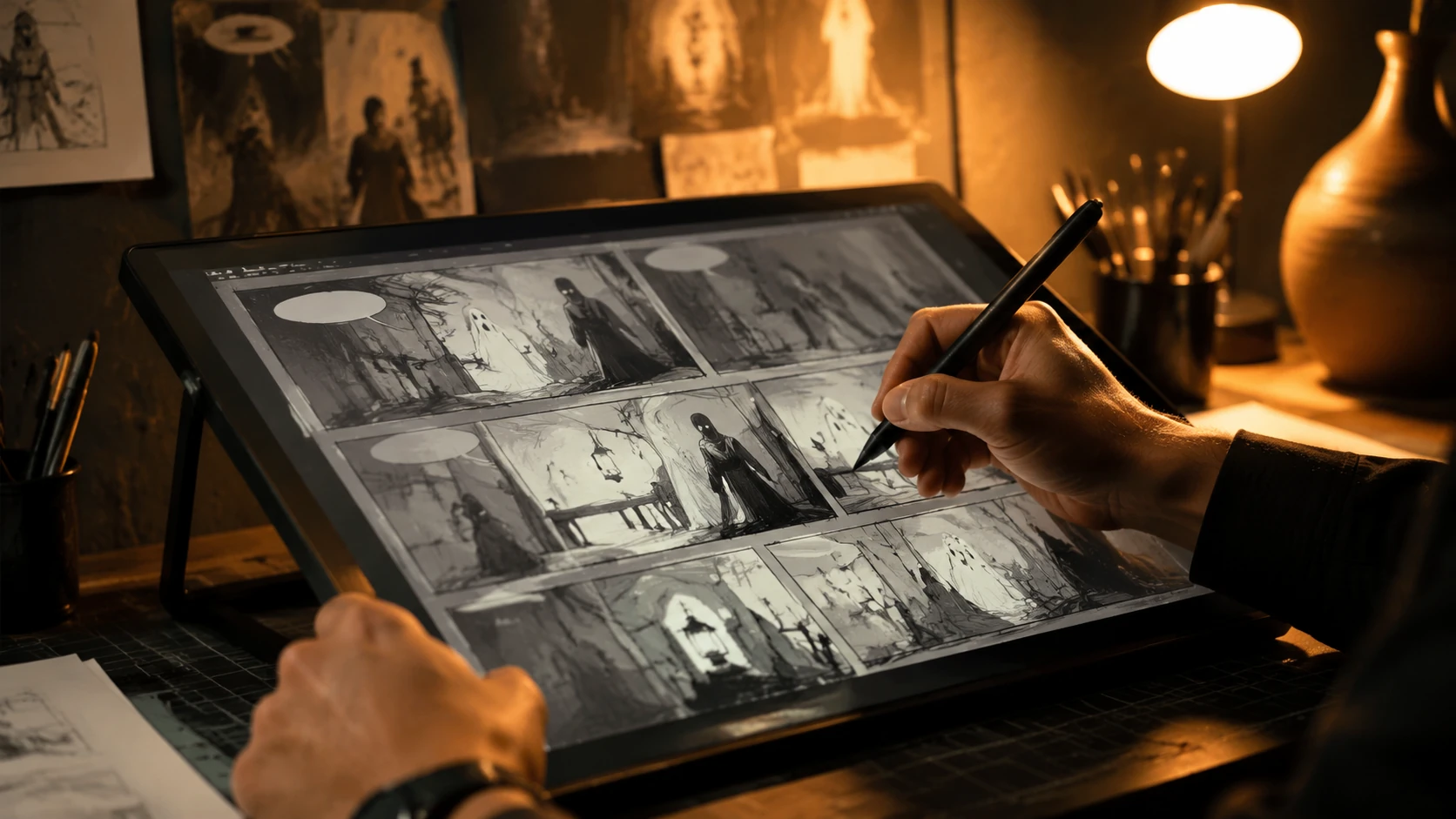
By 2026, the cost of high-fidelity webtoon production has reached a tipping point where 'drawing and praying' for a hit is no longer a viable business strategy. As the market becomes increasingly saturated with visually stunning but narratively hollow content, elite creators are shifting their focus to the pre-production phase. Enter 'Ghost Storyboarding'—a high-speed, low-fidelity workflow that utilizes AI pre-visualization to test narrative pacing, emotional beats, and reader retention before a single line of final art is rendered. This approach treats a webtoon like a tech product, allowing for rapid prototyping and market validation. In this guide, we explore how professional studios and sovereign creators use ghost storyboarding to de-risk their IPs and ensure that their stories resonate with 2026's hyper-critical audience before the heavy lifting of production begins.
What is Ghost Storyboarding in the 2026 Context?
Ghost storyboarding is the process of creating a full, readable version of a webtoon chapter using simplified, AI-generated or rough-sketched placeholders. Unlike traditional storyboards, which are internal guides for the artist, ghost storyboards are designed for 'semantic testing.' They focus on the flow of the scroll, the clarity of the visual shorthand, and the placement of 'cliffhanger triggers.' In 2026, these are often generated using prompt-to-layout tools that maintain character posture and camera angles without the need for polished linework. The goal is to produce a 60-panel chapter in hours rather than weeks, providing a 'ghost' of the final product that can be analyzed by focus groups or AI sentiment engines.
The Pre-Viz Workflow: From Concept to Validated Pilot
Adopting a pre-visualization workflow requires a mental shift from 'artist' to 'director.' Instead of focusing on the beauty of a single panel, the creator focuses on the architecture of the entire scroll. This modular approach allows for structural changes that would be impossible—or prohibitively expensive—to make once the final coloring and shading are complete.
Step 1: Semantic Scripting and Block-Out
Start by converting your script into a visual block-out. Use AI-assisted layout tools to define the 'eye-path.' In 2026, software can now predict where a reader’s eye will rest based on the weight of the speech bubbles and the negative space between panels. During this phase, you are looking for 'dead zones' where the reader might lose interest or scroll too quickly.
- Prioritize vertical pacing over individual panel detail.
- Use 'ghost characters' (basic 3D models or AI sketches) to check for consistent spatial logic.
- Identify the 'Scroll Heatmap'—the areas where narrative tension should peak.
Step 2: Rapid Sentiment Testing
Once the ghost storyboard is complete, it is shared with a controlled group of 'Alpha Readers' or run through a narrative analysis engine. These tools measure 'dwell time' on specific panels. If readers are skimming past your mid-chapter climax in the ghost version, they will certainly do so in the final version. This data-backed feedback loop allows you to rewrite or re-board scenes to maximize engagement.
Reducing Risk: The Business Case for Pre-Viz
The primary cause of series cancellation in 2026 is 'Mid-Season Churn,' where readers drop off after the initial hook fails to pay off. Ghost storyboarding mitigates this by allowing creators to map out the first 10 chapters in low-fidelity. By seeing the narrative arc in its entirety, you can spot plot holes and pacing issues that are often masked by beautiful art. For independent creators, this means spending your limited budget or energy only on stories that have already 'proven' their structural integrity in the ghost phase.
Avoiding the 'Uncanny Valley' in Pre-Production
A common mistake in 2026 is making ghost storyboards *too* detailed. If the pre-viz looks too much like the final art, the creator becomes emotionally attached to the panels and resists making necessary structural changes. The 'ghost' should be ephemeral. It should use just enough visual information to convey emotion and action, keeping the focus on the narrative mechanics rather than the aesthetic polish.
The Future of Professional Storyboarding
As we move further into 2026, the gap between 'hobbyist' and 'professional' is defined by the rigor of the pre-production process. Platforms are increasingly demanding 'Validated Storyboards' before signing licensing deals, as these provide a higher guarantee of ROI. By mastering the ghost storyboarding playbook, you position yourself as a creator who understands both the art and the science of the modern attention economy.
FAQ
What is the difference between a storyboard and a ghost storyboard?
A traditional storyboard is a production guide for the artist. A ghost storyboard is a low-fidelity, full-length prototype used to test reader engagement and narrative flow before final production.
Does AI replace the need for a storyboard artist in 2026?
No. AI acts as a 'visual accelerator' that handles the drafting of layouts and placeholders, but the creator's directorial eye is still required to manage pacing, emotional resonance, and narrative structure.
How long should a ghost storyboard phase take?
For a standard 60-panel webtoon chapter, the ghost storyboarding phase should take between 4 to 8 hours, including semantic block-out and initial pacing adjustments.