The Neuro-Cognitive Advantage: Why Visual Narratives Dominate the 2026 Attention Economy
In an era of chronic information overload, the neuro-cognitive efficiency of visual narratives provides a distinct competitive edge. Learn the science behind why comics outpace prose in retention and emotional resonance.
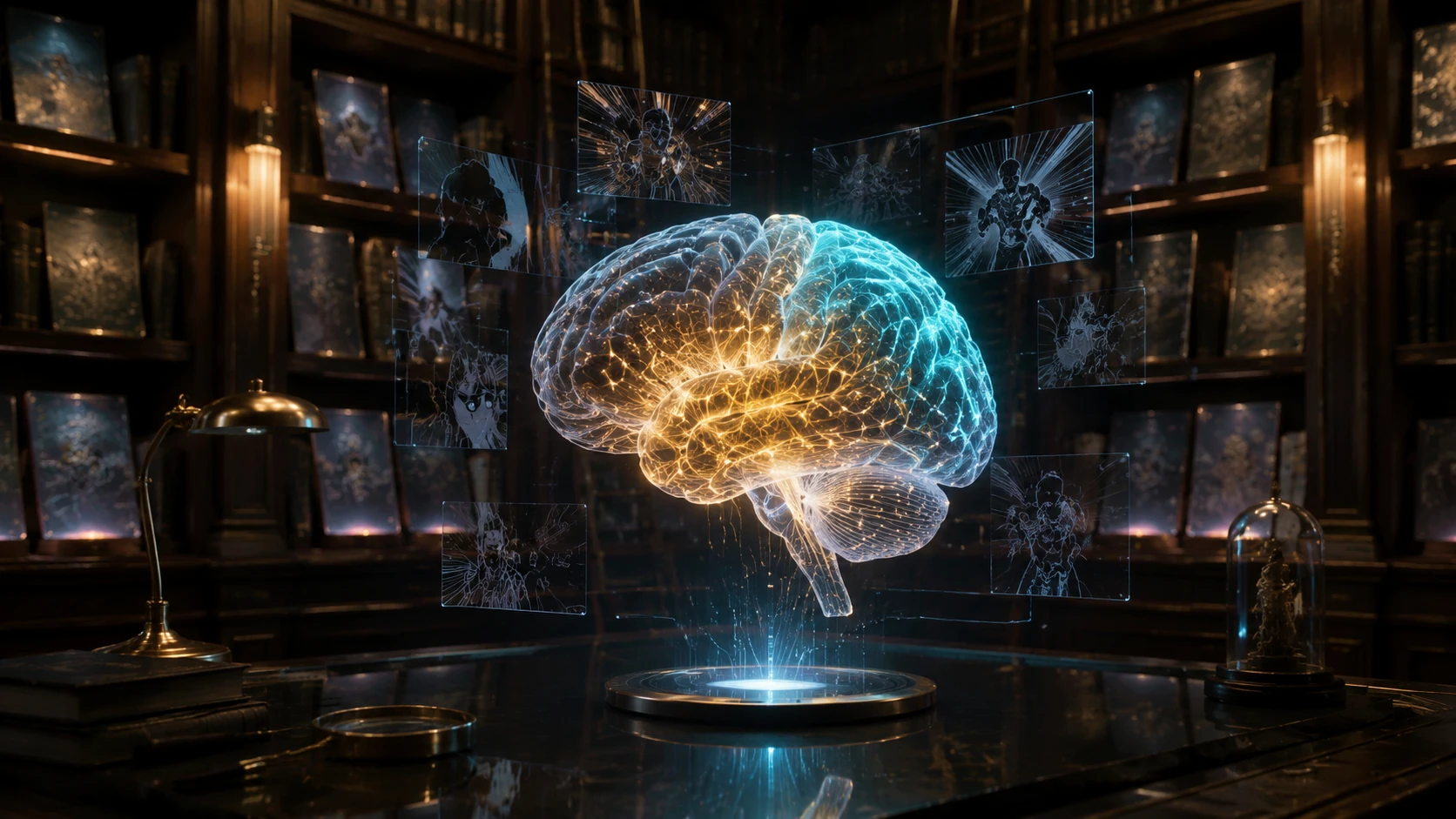
By 2026, the 'Attention Economy' has shifted from a battle for minutes to a battle for cognitive efficiency. As digital consumers are bombarded with more data than the human prefrontal cortex was ever evolved to handle, the traditional prose format is facing a structural decline in engagement. In its place, visual narratives—specifically comics, webtoons, and graphic novels—have emerged not just as entertainment, but as the most neuro-cognitively efficient method of information delivery. This dominance is not accidental; it is rooted in the fundamental architecture of the human brain. Understanding the science of how we process 'text-plus-image' reveals why visual storytelling is the superior vehicle for brand building, education, and IP retention in the modern era.
The Dual Coding Theory: Why 1+1 Equals 3
At the heart of visual narrative dominance is Allan Paivio’s Dual Coding Theory, which has seen a massive resurgence in 2026 educational and media research. The theory posits that the human mind processes verbal and non-verbal information through two distinct yet interconnected systems. When a reader consumes prose, the brain primarily activates the verbal system, requiring significant cognitive energy to translate abstract symbols (letters) into mental imagery. However, when reading a webtoon or comic, both the verbal and visual systems are activated simultaneously.
This simultaneous activation creates a 'referential connection' between the two systems. The brain doesn't just add the image to the text; it multiplies the processing power. This cross-referencing reduces the cognitive load required to build a mental world, allowing the brain to allocate more energy to emotional engagement and long-term memory encoding. In 2026, data suggests that readers of visual narratives retain plot details 40% longer than prose readers after a single exposure.
The Pictorial Superiority Effect in Digital Reading
The 'Pictorial Superiority Effect' is a well-documented phenomenon where pictures and images are more likely to be remembered than words. In the context of 2026's infinite scroll culture, this effect is amplified. Because the brain can identify an image in as little as 13 milliseconds, visual narratives provide 'instant context' that prose cannot match. This allows for a 'fast-path' to the amygdala, the brain's emotional center.
Emotional Anchoring and Mirror Neurons
Visual storytelling leverages 'mirror neurons' more effectively than text alone. When a reader sees a character’s micro-expression in a well-drawn panel, their brain mimics that emotional state almost instantly. Prose requires a descriptive bridge—'he looked sad' or 'tears welled in his eyes'—which the brain must first interpret before the mirror neurons fire. In a visual format, the emotional 'hit' is direct and visceral, leading to higher levels of empathy and character loyalty.
Cognitive Load and the Infinite Scroll
One of the most significant shifts in 2026 is the optimization of the 'Vertical Scroll' format for mobile reading. Cognitive science shows that the vertical scroll mimics the natural saccadic movement of the eyes more efficiently than the 'page-turn' mechanic. By controlling the 'gutter' (the space between panels), creators can manage the reader's cognitive load, essentially 'metering' the information flow to prevent burnout.
- **Pacing Control:** Strategic gutter length acts as a cognitive 'breather,' allowing the brain to process the previous panel before moving to the next.
- **Spatial Memory:** Readers use the vertical position of a panel to anchor events in time, creating a 'spatial timeline' that prose lacks.
- **Reduced Decoding Fatigue:** Because visual symbols are processed in parallel while text is processed linearly, the total energy expenditure of the brain is lower during a 10-minute webtoon session compared to a 10-minute prose session.
Practical Takeaways for 2026 Content Architects
For creators and publishers, the neuro-cognitive advantage means that the 'Visual-First' approach is no longer optional for mass-market success. To leverage these biological shortcuts, content must be designed with 'Narrative Economy'—the art of using the least amount of text possible to complement the visual data. The goal is to reach the 'Flow State' where the reader stops 'reading' and starts 'experiencing.'
The Risk of Over-Stimulation: The 'VFX' Trap
While visual narratives are efficient, they are not immune to failure. In 2026, we see a trend of 'Over-Visualized' content—comics that use too many effects, glow, and complex textures that actually increase cognitive load. When the brain cannot distinguish the 'signal' (the story) from the 'noise' (the rendering), the neuro-cognitive advantage is lost. The most successful 2026 IPs use 'Clean-Path' visual design, where every line and color choice serves a specific narrative function.
FAQ
Is visual reading considered 'lazy' compared to prose?
No. Cognitive science shows it is simply a more efficient use of the brain's parallel processing capabilities, allowing for deeper emotional engagement with lower decoding fatigue.
Why do I remember webtoon plots better than novels?
This is due to Dual Coding Theory. By using both visual and verbal pathways, your brain creates more 'neural hooks' for the information, making retrieval easier.
Can prose ever compete with visual narratives in 2026?
Prose excels in abstract concepts and internal monologues, but for world-building and emotional pacing, visual formats hold a biological advantage in high-speed environments.