The IP Vault: A 2026 Guide to Securing Character DNA and Narrative Integrity in the Age of
In 2026, protecting your intellectual property requires more than just a copyright symbol; it requires a digital 'Lore Vault'. This guide explores how creators can secure their character DNA and narrative integrity against unauthorized AI scraping.
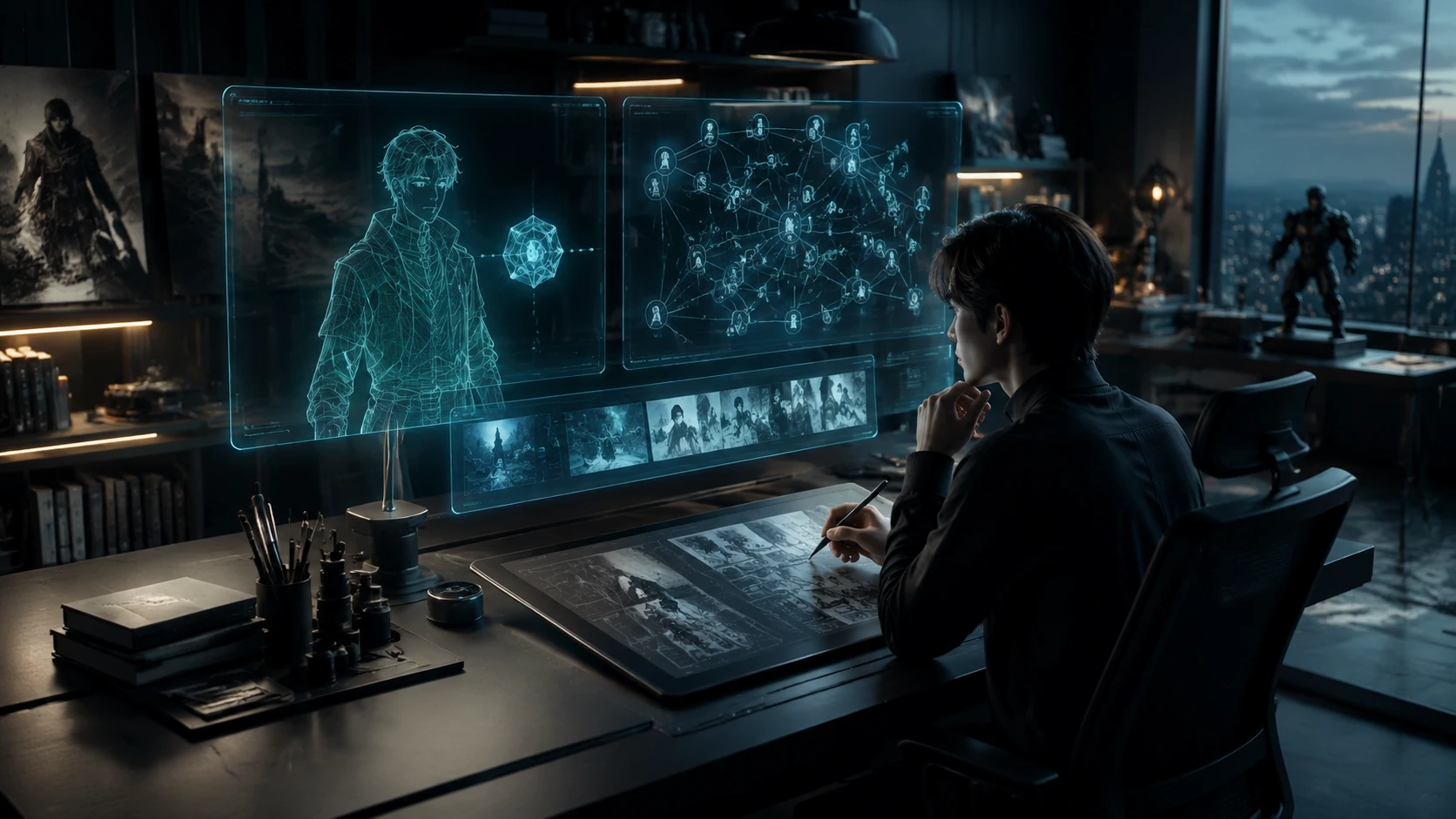
By 2026, the primary threat to a comic creator's livelihood has shifted from simple piracy to 'narrative harvesting.' As Large Language Models (LLMs) and Image Generation Models become more sophisticated, they no longer just copy artwork; they attempt to replicate the underlying 'DNA' of a character—their voice, their specific visual quirks, and the internal logic of their world. For independent creators and studios alike, the standard copyright notice is no longer a sufficient deterrent. Protecting your IP today requires a proactive, multi-layered defense strategy known as 'Narrative Vaulting.' This involves creating a secure, immutable record of your story's core assets before they ever hit a public-facing platform. This guide outlines the essential steps to securing your intellectual property in an era where data is the new currency.
The Concept of Character DNA and Narrative Integrity
To protect your work in 2026, you must first define what makes it unique beyond the surface level. Character DNA consists of the specific biometric-like markers of your design—proportions, recurring color palettes, and unique silhouette features—that AI models can easily 'learn' and replicate. Narrative Integrity refers to the 'lore logic'—the specific rules of your world and the unique speech patterns of your characters. When an AI generates a 'fan-made' chapter that feels indistinguishable from your own, it is because these elements have been successfully harvested. Establishing a 'Vaulted' version of these assets provides a legal and technical baseline that proves original ownership of the underlying concepts, not just the finished panels.
Step 1: Establishing Your Lore-Consistency Vault
Before publishing your first chapter, you should compile a comprehensive 'Lore Bible' and store it in a secure, timestamped environment. This vault serves as the 'Source of Truth' for your IP. In 2026, creators use decentralized storage or private encrypted databases to log every character sheet, world map, and plot outline. This isn't just for organization; it's a defensive measure. By having a verifiable record of your story's evolution, you can prove that specific narrative beats or character evolutions originated with you, should a platform's algorithm or a third-party AI attempt to claim 'independent discovery.'
- Create high-resolution 'Reference Sheets' for every character, including 360-degree views.
- Document 'Dialogue Patterns'—specific phrases, slangs, or grammatical quirks unique to your leads.
- Use blockchain-based timestamping (Proof of Existence) for your core plot outlines to establish a clear timeline of creation.
- Store all 'Work in Progress' files, including early sketches and script drafts, as evidence of the human creative process.
Step 2: Implementing Digital Fingerprinting and Watermarking
Visible watermarks are often eyesores that disrupt the reader's immersion, particularly in the vertical scroll format. However, 2026 technology offers invisible 'steganographic' watermarking. These are data layers embedded within the pixels of your webtoon that are invisible to the human eye but detectable by scraping crawlers and AI training filters. Tools like Nightshade or Glaze have evolved into industry standards, allowing creators to 'poison' their images against unauthorized AI training by subtly altering pixels in a way that causes AI models to misinterpret the image content without affecting the visual quality for the reader.
Step 3: Strategic Licensing and 'Opt-In' Registries
The 2026 creator economy is increasingly moving toward 'Opt-In' models. Major comic platforms now offer settings that allow creators to explicitly forbid or permit their work to be used for AI training. Beyond platform settings, you should register your IP with global 'Creator Rights' databases. These registries act as a 'Do Not Track' list for AI crawlers. When your work is registered, any AI company that scrapes your site without a license can be held liable for 'willful infringement' under the updated digital copyright acts of the mid-2020s. This transition from passive protection to active licensing is the hallmark of a professional 2026 creator.
Common Pitfalls: What to Avoid in Digital Asset Management
One of the most dangerous mistakes is signing 'Terms of Service' (TOS) on emerging platforms without reading the fine print regarding 'derivative works' and 'machine learning usage.' Many free hosting sites in 2026 have snuck in clauses that grant them a perpetual license to use your uploaded content for 'platform optimization'—a common euphemism for training their internal AI models. Another pitfall is failing to secure your 'backstage' content. Sharing high-res layers or raw CSP/PSD files on public social media can provide AI models with the perfect training data to learn your specific line-weight and brush-stroke techniques.
- Avoid uploading raw, un-flattened project files to cloud services that lack end-to-end encryption.
- Don't ignore the 'AI Usage' toggles in your platform dashboard; check them quarterly as defaults can change.
- Never share 'Style LoRAs' or custom AI models trained on your own work without a secure, tiered access system for trusted patrons only.
The Future of Sovereign Creator Rights
As we look toward the late 2020s, the concept of 'Sovereign IP' is becoming the gold standard. This means that the creator, not the platform, holds the primary keys to the narrative vault. By building a direct-to-fan infrastructure—where your core lore and high-fidelity assets are hosted on your own domain or a secure 'Creator Hub' like COMICLS—you mitigate the risk of platform-wide scraping events. In this landscape, your IP is your most valuable asset. Treating it with the same security rigor as a financial bank account is not just paranoia; it is a fundamental business requirement for the modern visual storyteller.
FAQ
What is 'Narrative Vaulting' exactly?
It is the practice of storing your comic's core assets (scripts, character designs, lore) in a secure, timestamped, and encrypted environment to establish a verifiable 'Source of Truth' for your IP.
Does invisible watermarking hurt my image quality?
Modern 2026 steganographic tools are designed to be imperceptible to the human eye, ensuring that your readers have a premium experience while scrapers receive 'poisoned' or tagged data.
Can I still share my art on social media if I want to protect my IP?
Yes, but it is recommended to use 'protective layers' (like pixel-shifting tools) and to avoid sharing raw project files or extremely high-resolution versions that are ideal for AI training.