The AI Storyboard Revolution: How 2026 Creators Are Slashing Pre-Production Time
The pre-production phase of comic creation is undergoing a radical shift as AI-assisted storyboarding becomes the industry standard for 2026. Learn how creators are using these tools to maintain narrative consistency and slash development time.
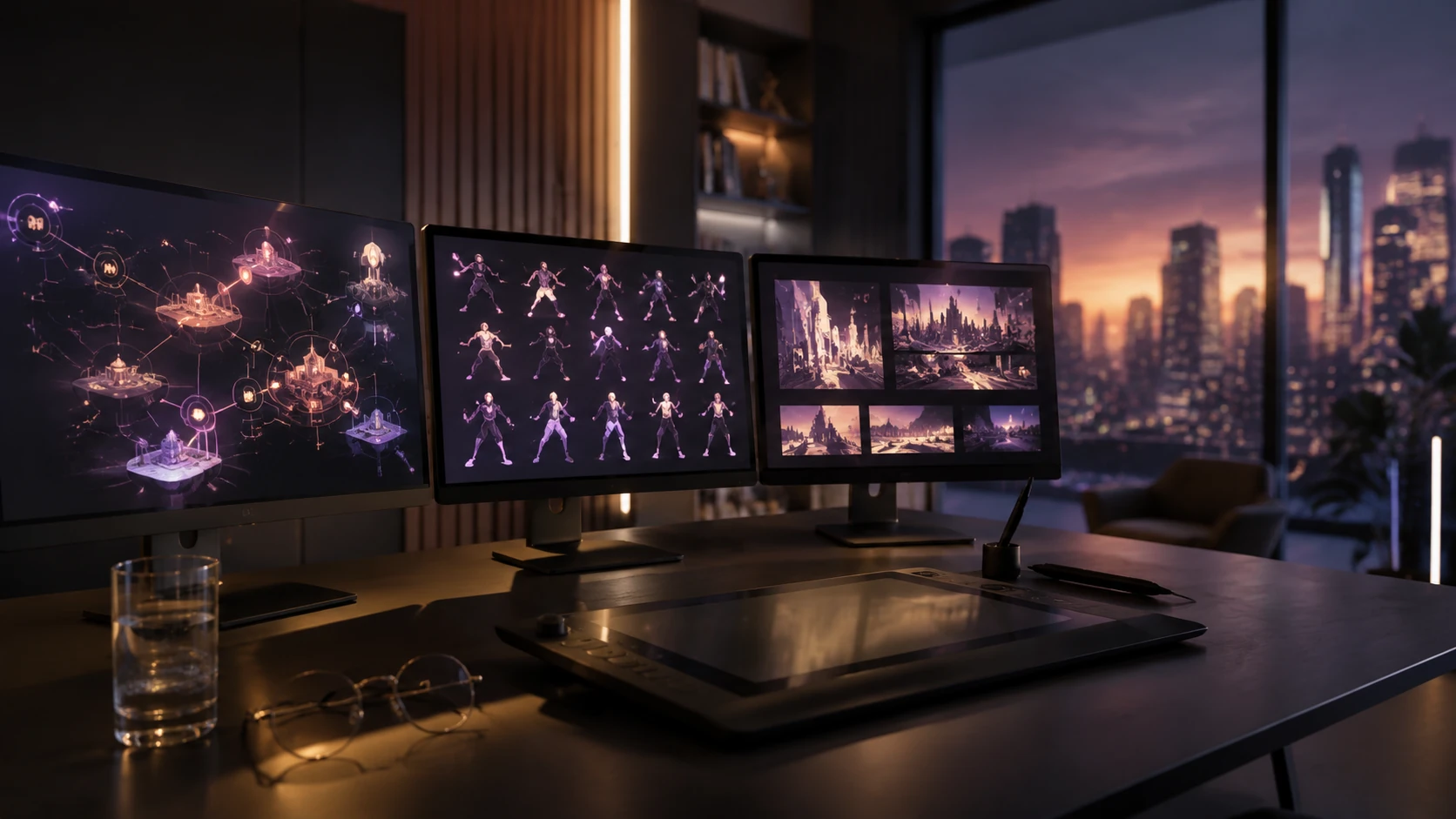
For decades, the 'blank page' has been the primary adversary of the comic creator. In 2026, that barrier is finally dissolving. The emergence of AI-assisted storyboarding isn't just about speed; it is about shifting the creator's role from a manual draftsman to a high-level narrative director. By automating the most tedious aspects of pre-production—perspective grid alignment, panel pacing, and consistent character positioning—independent creators are now producing content at a scale previously reserved for major studios.
The Shift from Manual Sketching to Logical Mapping
Traditional storyboarding required hours of rough sketching just to test if a sequence 'felt' right. Today’s AI-integrated workflows allow artists to input narrative beats and receive a variety of 'blocked' scenes in seconds. These aren't finished drawings, but rather structural blueprints that respect the laws of perspective and cinematic composition. This allows the artist to focus on the 'soul' of the panel—the acting, the lighting, and the emotional resonance—rather than the technical math of a three-point perspective background.
- Dynamic Layout Generation: AI suggestions for panel sizes that optimize mobile scrolling (vertical UX).
- Character Consistency Engines: Ensuring that a character's height and facial structure remain identical across 100+ panels.
- Automated Perspective Grids: Instantly snapping background elements to complex vanishing points.
- Lighting Pre-Viz: Testing different time-of-day scenarios before a single drop of digital ink is applied.
Maintaining Narrative Consistency in the Age of Automation
One of the greatest challenges in long-form webtoons and manga is 'drift'—the gradual change in a character's appearance or a setting's geography over hundreds of episodes. 2026 tools solve this through 'Entity-Based Generation.' By creating a digital 'DNA' for every character and location, the AI ensures that every generated storyboard frame adheres to the established world-building rules. This allows for a seamless transition from the script to the final line art without the usual continuity errors that plague solo creators.
The Impact on the Creator Economy
This technological leap is democratizing the industry. We are seeing a surge of 'micro-studios'—groups of two or three people—producing high-fidelity graphic novels that would have required a team of twenty in 2020. The reduction in pre-production time means that creators can spend more time on marketing, community engagement, and cross-platform adaptation. In 2026, the most successful creators are those who leverage AI to handle the technical heavy lifting while they focus on high-concept storytelling and brand building.
As COMICLS continues to monitor these trends, it is clear that the future of comics lies in this hybrid approach. The tools are no longer 'replacing' artists; they are augmenting them, allowing the human imagination to reach the finish line faster than ever before.
FAQ
Does using AI for storyboarding reduce the quality of the comic?
On the contrary, it often increases quality by allowing creators to experiment with more cinematic angles and complex perspectives that would be too time-consuming to draw manually.
Are AI-assisted storyboards copyrightable in 2026?
Current trends suggest that as long as the AI is used as a tool for 'blocking' and the final artistic output involves significant human creative input, the work remains the intellectual property of the creator.
What is the best way to start using AI in a comic workflow?
Start with world-building and perspective blocking. Use AI to generate architectural layouts for your settings, which you can then trace or paint over to maintain your personal style.