The 2026 ‘Vertical-to-Screen’ (V2S) Metadata Accord: Streamlining Webtoon-to-Anime Pipelin
The global comic industry enters a new era with the 2026 V2S Metadata Accord, a standardized framework designed to automate the transition from vertical-scroll comics to high-fidelity animation. This shift drastically reduces production costs and increases the market value of digital-first IP.
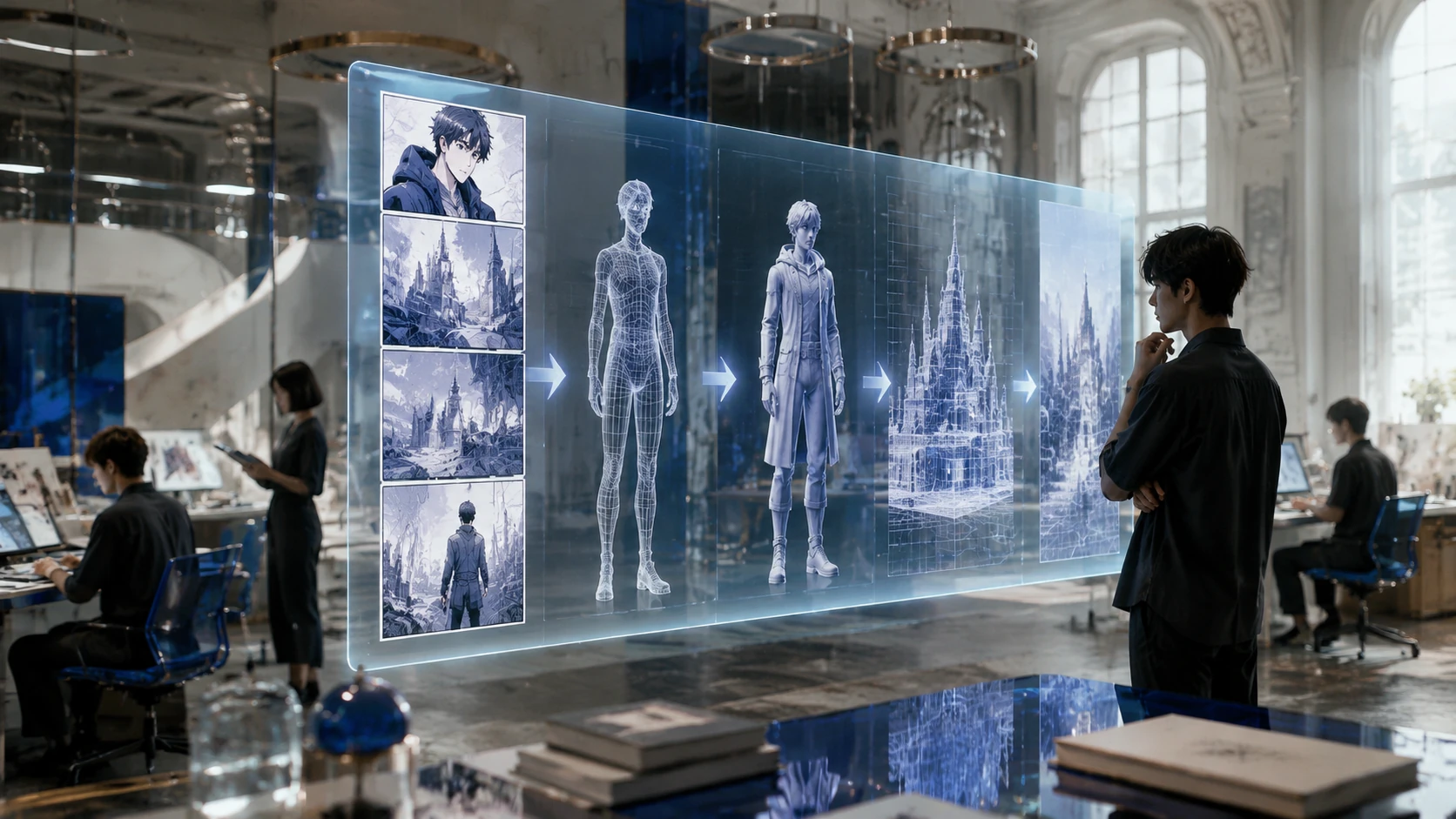
The global comic and animation industries have reached a pivotal milestone with the formal adoption of the 2026 ‘Vertical-to-Screen’ (V2S) Metadata Accord. This agreement, signed by major streaming platforms, leading webtoon publishers, and top-tier animation studios, establishes a unified technical framework for how digital comics are engineered for motion adaptation. For years, the transition from vertical scroll to screen was a manual, labor-intensive process of re-storyboarding and asset recreation. The V2S Accord changes the paradigm by introducing a standardized metadata layer that allows animation software to 'read' the narrative intent, spatial depth, and character consistency of a webtoon directly from the source file. This is not just a technical update; it is a fundamental shift in how comic IP is valued and scaled in a hyper-competitive streaming market.
The End of the ‘Adaptation Gap’: How V2S Works
The core of the V2S Accord lies in its 'Universal Asset Ingestion' protocol. Under this standard, creators and studios tag their webtoon files with semantic metadata that identifies character rigs, background layers, and lighting vectors. When an animation studio acquires a V2S-compliant IP, their production pipeline can automatically extract these elements into 3D environments or 2D animation engines. This eliminates the need for expensive 'pre-visualization' phases, as the webtoon itself serves as the high-fidelity blueprint. The accord also mandates the use of 'Consistency Anchors'—AI-readable tokens that ensure a character’s design remains identical across different art styles and frame rates. By bridging the gap between static art and fluid motion, the V2S standard reduces the time-to-market for a webtoon-to-anime adaptation by nearly 60%, allowing stories to capitalize on viral momentum while it is still peaking.
Key Components of the V2S Standard
- Layer-Semantic Tagging: Categorizing panels into foreground, midground, and background for instant parallax and depth mapping.
- Character Vector Bibles: Embedded data that defines skeletal proportions and range-of-motion constraints for 3D modeling.
- Emotional Keyframing: Metadata that maps character expressions in comic panels to corresponding facial animation shapes.
- Lighting & Palette Vectors: Standardized color profiles that can be instantly applied to lighting engines in animation software.
Impact on the Independent Creator Economy
For independent creators, the V2S Accord represents a massive leap in 'Adaptation Readiness.' In the 2026 market, IP is no longer judged solely on its readership numbers but on its technical liquidity—how easily it can be converted into other formats. A solo creator who follows V2S metadata standards during the production of their webtoon significantly increases the 'Adaptation Premium' of their work. Licensing deals are now being structured with 'Metadata Audits' as a prerequisite, where studios evaluate the cleanliness and completeness of the comic’s underlying data. This shift empowers creators to demand higher royalties, as they are providing studios with a ready-to-animate asset rather than a raw story that requires months of re-interpretation. The V2S Accord effectively democratizes the path to the screen, allowing high-quality independent stories to compete with massive studio productions on a technical level.
Streaming Giants and the Race for Global Content
Streaming giants like Netflix, Disney+, and Crunchyroll are the primary drivers behind the V2S Accord. Faced with the astronomical costs of traditional animation, these platforms are pivoting toward 'Agile Adaptation.' By standardizing the input format, they can greenlight more projects with lower risk. The 2026 data shows that V2S-compliant adaptations have a 40% higher chance of being produced in high-definition (8K) and spatial formats (VR/AR) because the source data is already resolution-independent. This has led to a 'Gold Rush' for high-quality manhwa and manga that have already been converted to the V2S standard. The accord also facilitates 'Simultaneous Global Releases,' as the metadata includes localization hooks that sync translated scripts with character mouth movements, further reducing the overhead of international distribution.
Challenges and the Future of Visual Consistency
Despite its benefits, the V2S Accord faces challenges regarding artistic 'Soul.' Critics argue that automated ingestion might lead to a homogenized animation style, where the unique quirks of a creator’s hand-drawn lines are smoothed over by AI interpolation. To combat this, the 2026 standard includes 'Artistic Variance Safeguards'—metadata fields that allow creators to lock certain visual characteristics that must not be altered during the animation process. Looking forward, the next evolution of V2S is expected to incorporate 'Dynamic Narrative Pathing,' allowing the metadata to support interactive and branching stories that can be played as games or watched as cinematic experiences interchangeably. The industry is moving toward a future where the line between a 'comic' and an 'anime' is merely a toggle on the reader’s device.
Strategic Action Plan for Studios
- Audit existing IP libraries for V2S compatibility to identify 'low-hanging fruit' for adaptation.
- Train in-house editorial teams on V2S metadata tagging during the pre-serialization phase.
- Negotiate licensing agreements with specific clauses regarding metadata ownership and update cycles.
- Implement AI-assisted 'Up-Res' workflows that utilize V2S vectors for 8K and spatial output.
FAQ
What is the V2S Metadata Accord?
The V2S (Vertical-to-Screen) Metadata Accord is a 2026 industry standard that defines how webtoon files are tagged with data to enable automated, high-speed animation production.
Does V2S replace traditional animators?
No, it streamlines the repetitive technical tasks of asset recreation and storyboarding, allowing animators to focus on high-level character acting and creative direction.
Can independent creators use V2S?
Yes, following V2S standards is highly recommended for independent creators to increase the licensing value and 'adaptation readiness' of their IP for streaming platforms.
Is V2S compatible with 2D and 3D animation?
Yes, the metadata is designed to be engine-agnostic, supporting 2D hand-drawn styles, 3D CGI, and hybrid AI-assisted animation workflows.