The 2026 Vertical Scripting Syntax: Optimizing Narrative Beats for Scroll-Native Compositi
Traditional comic scripts are evolving into the Vertical Scripting Syntax (VSS), a specialized format designed for the unique spatial logic of mobile reading. This framework prioritizes gap-logic and kinetic pacing to ensure narrative beats land with maximum impact on the infinite canvas.
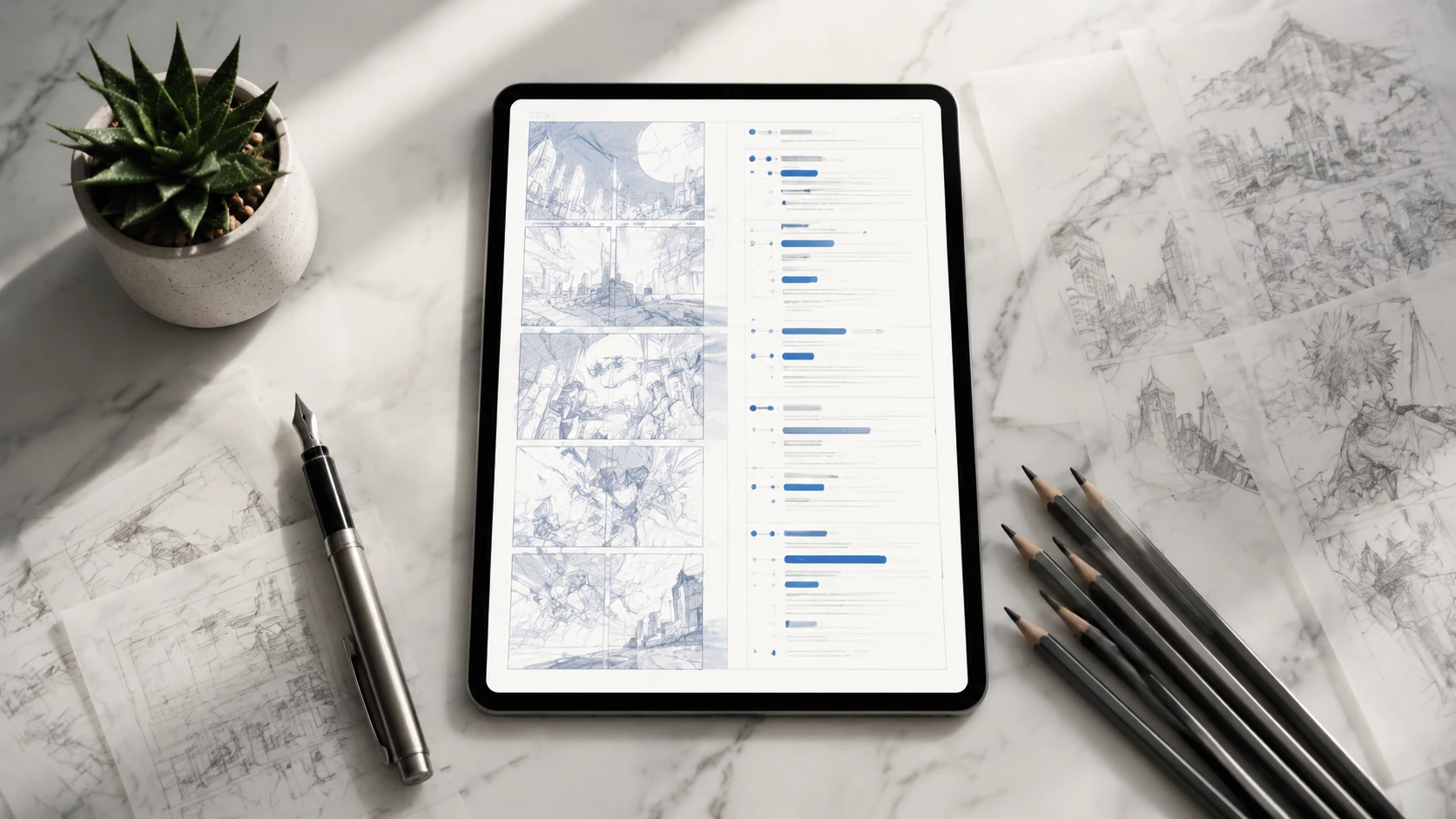
By 2026, the traditional comic script—rooted in the physical constraints of the printed page—has become a legacy format. As the global market shifts toward vertical scroll-first consumption, creators are adopting the Vertical Scripting Syntax (VSS). This technical framework is not merely about changing the page count; it is a fundamental reimagining of how narrative beats are communicated from writer to artist and, eventually, to the reader's screen. VSS treats the 'scroll' as a unit of time rather than a unit of space, allowing writers to engineer emotional resonance through precise gap-logic and kinetic pacing. In this guide, we explore the structural evolution of VSS and why it has become the mandatory standard for high-budget webtoon and manhwa productions seeking to capture the 2026 reader's fragmented attention.
The Core Philosophy of VSS: Gap-Logic vs. Page-Turns
Traditional scripting relies on the 'page-turn' to create suspense or reveal a major plot point. In the vertical scroll environment, the 'page-turn' is replaced by the 'scroll-gap.' VSS formalizes this by introducing spatial metadata into the script itself. Instead of simply describing a panel, a VSS script defines the 'Gutters'—the white space between panels—using standardized pixel-depth or scroll-duration markers. This allows the writer to control the reader's breathing room, ensuring that a tragic realization or a comedic punchline isn't rushed by the reader's thumb movement. By 2026, top-tier studios use VSS to synchronize narrative tension with the physiological speed of mobile reading, creating a seamless 'flow state' that drives binge-consumption.
The Three Pillars of Vertical Syntax
- Kinetic Transitions: Defining how one panel bleeds into the next through visual anchors or background gradients.
- Dialogue Economy: Standardizing text-to-visual ratios to prevent 'text-walling' on mobile displays.
- The Blind Reveal: A specialized tagging system for panels that must remain off-screen until a specific scroll depth is reached.
Writing for the 'Infinite Gutter'
One of the most significant shifts in VSS is the treatment of the gutter as an active narrative element. In the 2026 standard, the script defines the color, texture, and length of these gaps to simulate the passage of time or psychological shifts. A VSS script might designate a 'Negative Space Expansion' of 800 pixels to represent a character's isolation, or a 'Tight Sequence' with zero-pixel gaps to simulate a high-speed chase. This level of technical specificity ensures that the artist understands the intended pacing without needing a secondary 'director's cut' of the script. It bridges the gap between the literary and the cinematic, turning the script into a technical blueprint for the scroll.
VSS and the AI-Assisted Production Pipeline
The rise of VSS is also heavily influenced by the integration of AI in 2026 comic production. Modern VSS scripts use 'Semantic Anchors'—standardized tags that AI layout engines can interpret to generate rough storyboards. These anchors (such as [SHOT: LOW_ANGLE], [LIGHTING: NOIR], or [EMOTION: DREAD]) allow the writer to maintain creative sovereignty even when using automated tools for pre-visualization. By providing a structured syntax, VSS prevents the 'narrative drift' common in generic prompt-based generation, ensuring the final visual product adheres strictly to the writer's original vision. This interoperability makes VSS-trained writers the most sought-after architects in the modular studio era.
Common Pitfalls in Vertical Transitioning
- Vertical Monotony: Failing to vary panel heights, leading to reader fatigue.
- Text Overlap: Placing dialogue bubbles too close to the scroll-edge, where they may be obscured by platform UI.
- Visual Crowding: Ignoring the 'safe zone' of the mobile screen, resulting in panels that require excessive zooming.
The Future of VSS: Beyond 2D Layouts
As we move further into 2026, VSS is expanding to include haptic and audio metadata. The next iteration of the syntax allows writers to script vibration patterns (Haptic Beats) and localized soundscapes that trigger as the reader scrolls past specific panel coordinates. This 'Sensory Scripting' represents the ultimate evolution of the vertical format, transforming the comic from a static image series into an immersive, interactive narrative service. Creators who master the technical nuances of VSS today are positioning themselves at the forefront of this multi-sensory storytelling revolution.
FAQ
How does VSS differ from a standard movie script?
VSS focuses on spatial depth and vertical pacing rather than time-stamped scenes, using specific pixel-based markers for gutters and scroll-reveals.
Is VSS compatible with print-on-demand models?
While VSS is scroll-native, it includes 'Conversion Tags' that help artists rearrange panels into a modular grid for physical print without losing narrative flow.
Do I need special software to write in VSS?
Most 2026 writing suites support VSS plugins, but it can be implemented in any text editor using standardized brackets and tagging conventions.