The 2026 Vertical Lettering Masterclass: Engineering Typography for High-Speed Mobile Read
Lettering is no longer an afterthought; it is a navigation tool for the high-speed mobile reader. Learn the 2026 standards for vertical typography and bubble placement to boost reader retention.
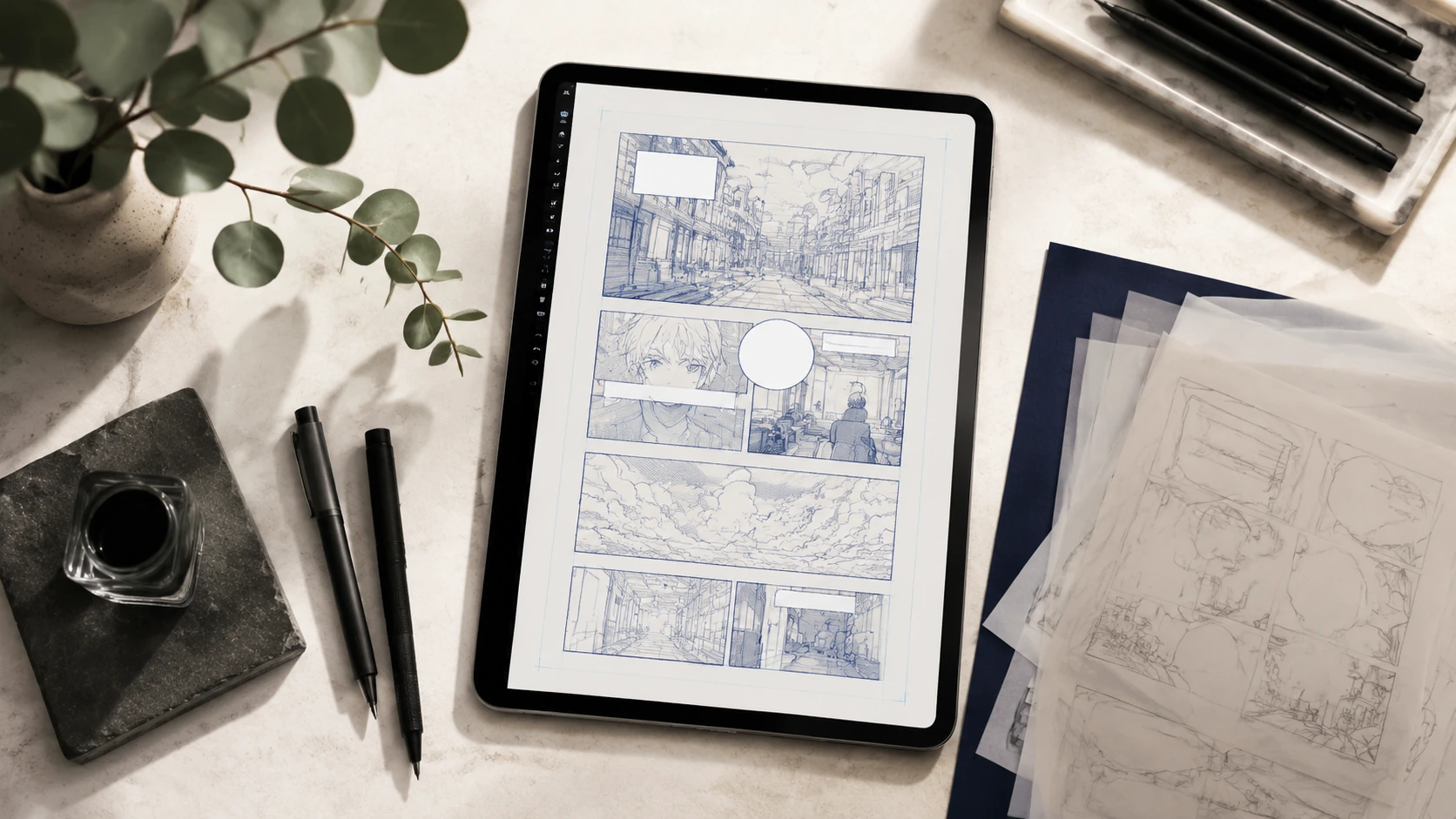
By 2026, the average webtoon reader consumes content at a scroll velocity 30% faster than they did five years ago. In this high-speed environment, lettering has evolved from a simple dialogue delivery mechanism into a critical navigation and retention tool. If your readers have to stop their scrolling thumb to decipher a font or re-read a poorly placed bubble, you have lost narrative momentum. Lettering today is about engineering the 'path of least resistance.' This masterclass provides a technical and aesthetic framework for optimizing vertical typography, ensuring your story remains immersive even at maximum scroll speeds.
The Physics of the Vertical Eye-Track
In traditional print comics, the eye follows a 'Z-pattern' across a page. However, the 2026 mobile reader utilizes a 'Vertical Anchor' pattern. Their eyes remain relatively fixed in the center-top third of the screen while their thumb moves the canvas upward. To accommodate this, your lettering must be placed to intersect this central focal point. Bubbles that are tucked too far into the corners of a 21:9 mobile screen require the eye to deviate from the central flow, causing cognitive load and physical eye fatigue over long chapters.
The Rule of the Central Column
- Keep 80% of critical dialogue within the center 60% of the horizontal canvas width.
- Use gutters and margins to breathe; bubbles should never touch the edge of the screen on modern high-refresh-rate displays.
- Align bubble tails to guide the eye directly to the next character or action beat, acting as a visual 'slide' for the reader's gaze.
Font Psychology and Legibility Standards
Legibility in 2026 is governed by pixel density and OLED contrast ratios. Traditional hand-drawn fonts often fail when scaled down on smaller, high-resolution mobile devices. The current industry standard leans toward 'Hybrid Sans-Serifs'—fonts that retain the charm of hand-lettering but possess the structural clarity of modern UI fonts. This ensures that even at 50% brightness or under sunlight, the text remains crisp. Furthermore, font weight is now used as a narrative pacing tool: lighter weights for internal monologue and heavier, bolder weights for outward dialogue to create a subconscious auditory hierarchy for the reader.
The 'Read-Skip' Prevention Framework
One of the most common issues in vertical storytelling is the 'Read-Skip' phenomenon, where a reader scrolls past a dialogue bubble because it wasn't visually distinct from the background or was placed in a predictable, repetitive pattern. To combat this, 2026 creators use 'Dynamic Bubble Anchoring.' This involves varying the vertical distance between bubbles to match the emotional tempo of the scene. Short, punchy dialogue should have tighter vertical spacing to encourage rapid reading, while heavy, emotional revelations require significant white space—acting as a 'scroll brake' that forces the reader to slow down and absorb the weight of the words.
Implementing Visual Hierarchy
- Primary Dialogue: Consistent 12-14pt equivalent on mobile devices.
- Secondary/Background Noise: 8-10pt with 60% opacity to denote distance.
- Sound Effects (SFX): Integrated into the art but using contrasting colors to avoid blending into the background palette.
Technical Workflow: Semantic Lettering and Automation
Efficiency is paramount in 2026. Professional studios have moved away from manual bubble drawing toward 'Semantic Lettering Pipelines.' This involves using vector-based tools that anchor bubbles to character metadata. If a character's position is adjusted during the 'Latent-Space' or '3D-Layout' phase, the lettering automatically adjusts its tail and position while maintaining the optimal eye-track distance. This ensures consistency across 60+ panels per chapter, a feat nearly impossible to maintain manually at high production volumes.
Common Lettering Mistakes to Avoid
The most frequent error in modern webtoon production is 'Bubble Overcrowding.' Creators often try to fit too much text into a single bubble, leading to small font sizes and cramped leading. In the vertical format, it is always better to split one large bubble into three smaller, staggered bubbles. This not only improves legibility but also creates a rhythmic 'beat' to the dialogue. Another common mistake is inconsistent kerning; on high-resolution screens, uneven spacing between letters becomes jarringly obvious, breaking the reader's immersion and making the work look amateurish.
FAQ
What is the best font size for webtoons in 2026?
While it depends on the device, the 2026 standard is roughly 12pt to 14pt for primary dialogue on a standard smartphone screen, ensuring legibility without overwhelming the artwork.
How do I handle sound effects (SFX) in vertical scroll?
SFX should be treated as part of the composition. Place them to bridge the gap between panels, helping to pull the reader's eye downward through the 'white space' gutters.
Should I use all-caps for webtoon lettering?
All-caps remains the standard for most action and comedy genres, but 2026 trends see an increase in mixed-case for 'Slice of Life' and 'Drama' to provide a more natural, conversational tone.