The 2026 ‘Vertical-Cinema’ Storyboarding Standard: Engineering High-Motion Layouts for Hyb
In 2026, the gap between webtoon and anime has vanished. Learn the storyboarding standards that make your IP instantly ready for global streaming production.
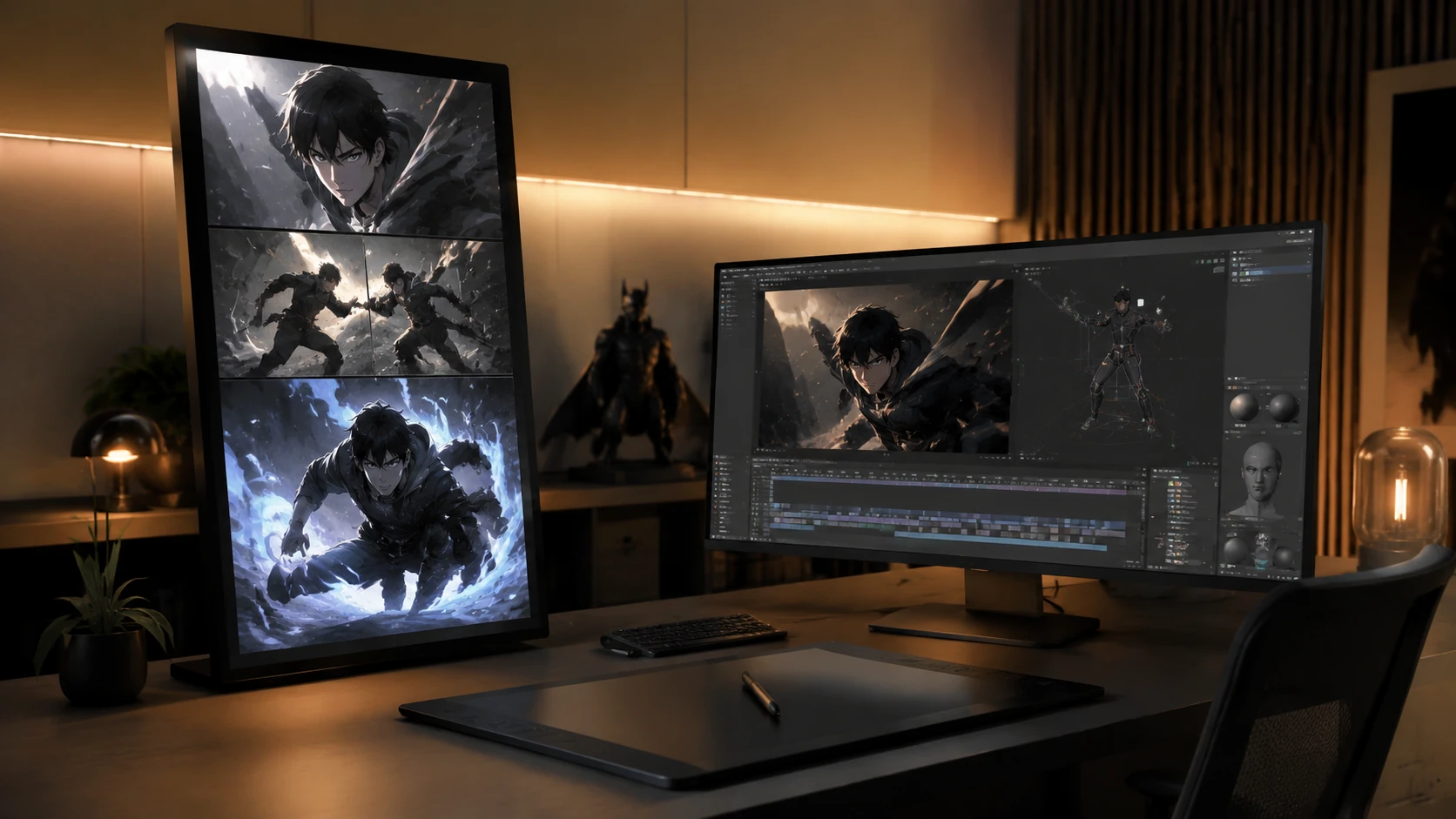
By 2026, the boundary between a digital comic and an animated series has become almost entirely semantic. As global streaming giants like Netflix, Disney+, and Crunchyroll shift toward 'Rapid-Acquisition' models, they no longer look for just a great story; they look for 'Production-Ready IP.' The 2026 Vertical-Cinema (VC) Storyboarding Standard has emerged as the definitive framework for creators who want to bridge the gap between the weekly scroll and the silver screen. This standard isn't just about drawing pretty panels—it is about engineering your visual assets from day one so that an animation studio can deconstruct, rig, and animate your work with 70% less manual labor. For the modern creator, mastering this workflow is the difference between a standard royalty check and a multi-million dollar media franchise deal.
What is Vertical-Cinema (VC) Storyboarding?
Vertical-Cinema storyboarding is a layout methodology that treats the vertical scroll of a webtoon not as a series of static images, but as a continuous camera movement. In 2026, readers expect more than just 'cut-ins'; they want a cinematic experience that feels like a long-take in a film. VC storyboarding requires creators to think in terms of 'Keyframe Panels' and 'Transition Zones.' A Keyframe Panel is designed with a specific aspect ratio—usually 16:9 or 21:9—embedded within the vertical flow, allowing an animation director to instantly see the cinematic framing. Transition Zones use negative space and environmental cues to act as the 'camera's' path. By aligning your comic pacing with cinematic timing, you create a blueprint that is linguistically and visually compatible with modern animation software like Unreal Engine 6 or Harmony 2026.
The 3-Layer Asset Architecture: Designing for Motion
The most significant technical shift in the 2026 VC standard is the move away from flattened, single-layer exports. To be considered 'Animation-Ready,' a webtoon must be built using a 3-layer asset architecture. This ensures that the IP is not just a static image, but a collection of reusable components for different media formats.
- Foreground/Environmental Layer: High-resolution backgrounds that extend beyond the panel borders to allow for camera panning and parallax effects.
- Character/Actor Layer: Characters must be drawn in 'Clean-Break' styles, where limbs and hair are distinct assets, making them ready for AI-assisted rigging or 2D skeletal animation.
- FX/Atmospheric Layer: Lighting, particle effects, and speed lines are kept on separate alpha channels, allowing editors to swap them for dynamic, animated versions in the digital edition or TV adaptation.
Engineering the 'Scroll-to-Screen' Pacing
In traditional webtoons, pacing is dictated by the reader's thumb. In Vertical-Cinema, pacing is engineered using 'Visual Anchors.' These are large, high-detail panels that serve as the emotional peaks of an episode. In 2026, the standard dictates that every 1000 pixels of scroll should contain at least one 'Cinematic Anchor' that matches a standard film frame. This consistency allows AI-driven conversion tools to automatically map a webtoon's reading time to a 22-minute episode structure. Creators who follow this rhythm find that their stories translate more naturally to television, avoiding the 'rushed' or 'dragged out' feel that often plagues webtoon-to-anime adaptations. It’s about creating a visual heartbeat that resonates both in the hand and on the wall.
Metadata and Script-to-Engine Synchronization
Beyond the visuals, the 2026 VC standard includes 'Semantic Metadata.' This is a hidden layer in the creator’s project file that tags panels with emotional intent, character names, and recommended soundscapes. When an animation studio acquires a VC-compliant webtoon, their software can instantly generate a rough animatic based on these tags. This reduces the pre-production phase from months to weeks. By including these digital 'breadcrumbs,' creators make their IP significantly more attractive to investors who want to minimize technical debt and speed up the time-to-market for a series launch.
Common Pitfalls: What to Avoid in VC Storyboarding
The biggest mistake creators make when attempting Vertical-Cinema is 'Over-Framing.' While it’s tempting to use complex, jagged panel shapes to show action, these are incredibly difficult to animate. The 2026 standard favors clean, rectangular 'Window Frames' that can be easily cropped or expanded for different screen sizes. Another pitfall is 'Flattened FX.' If you draw your glow effects directly onto your character’s skin, an animator has to manually redraw that character to change the lighting. By keeping FX on a separate layer, you preserve the integrity of the character design for future use in gaming, VR, or high-budget animation.
FAQ
Does Vertical-Cinema storyboarding take longer than traditional webtoon art?
Initially, the setup takes about 15% longer due to layer management and asset organization. However, it saves hundreds of hours during the adaptation phase and increases the IP's market value.
Can I use AI to help with the VC 3-Layer architecture?
Yes. By 2026, most professional tools like COMICLS offer AI-assisted layering that can automatically separate characters from backgrounds to help you meet VC standards.
Is this standard only for creators who want an anime adaptation?
No. Even for indie creators, VC standards make it easier to create promotional trailers, social media motion-comics, and high-quality merch, increasing overall engagement.