The 2026 ‘VerManga’ Standard: Engineering Traditional Manga Aesthetics for Vertical-Scroll
Discover how the VerManga framework allows creators to maintain traditional ink-and-tone textures while mastering the infinite scroll. Engineering the future of black-and-white mobile comics.
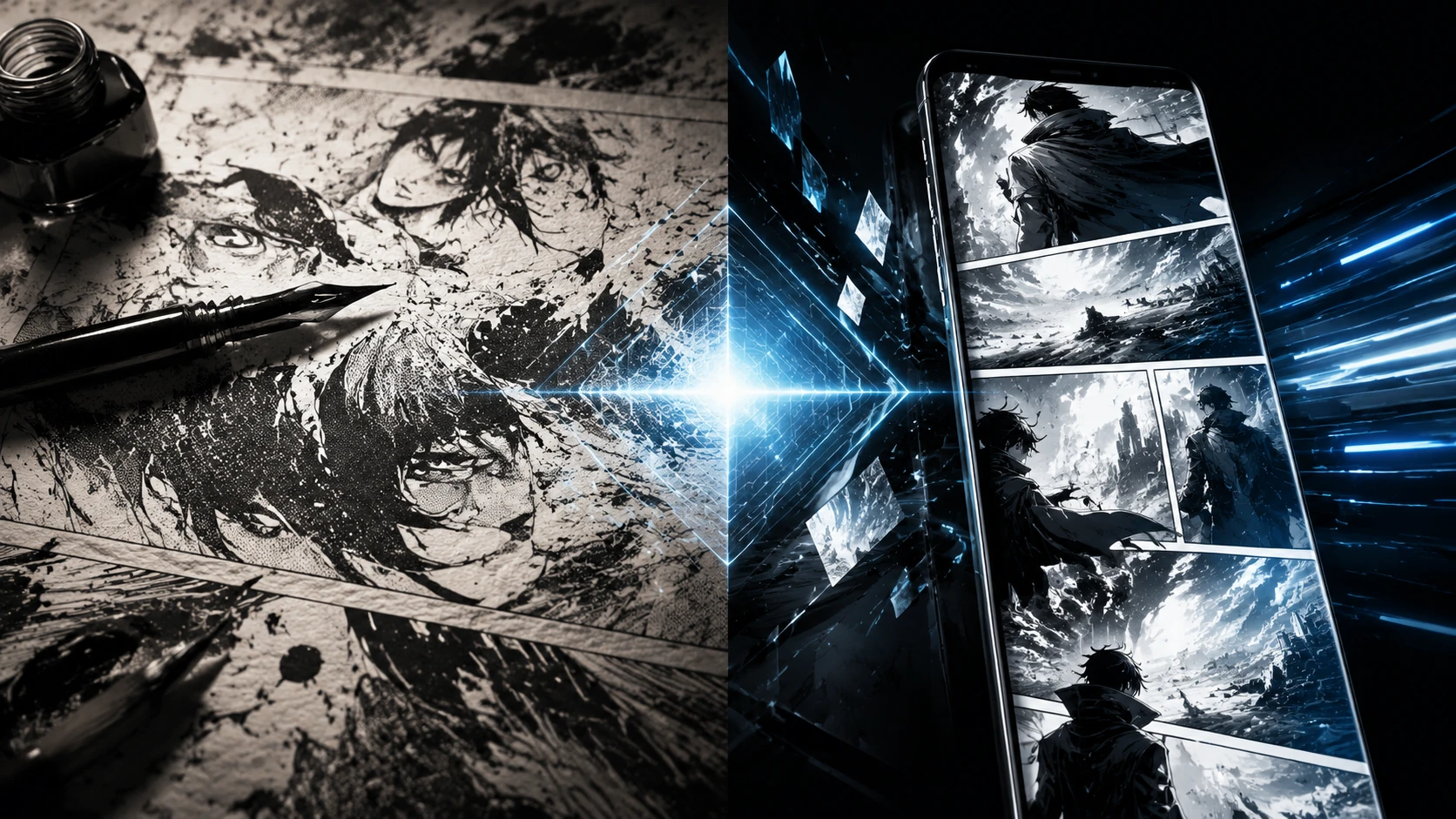
By 2026, the global comic market has reached a definitive tipping point: mobile-first consumption is no longer a secondary channel but the primary driver of IP valuation. While the 'Webtoon' format originally pioneered this shift with vibrant colors and cinematic spacing, traditional manga—characterized by its complex black-and-white linework, dense screentones, and rhythmic page layouts—faced a unique architectural challenge. The 2026 ‘VerManga’ Standard (Vertical-Manga) emerged as the industry-wide solution to this friction. It is not merely a re-cropping of old pages; it is a sophisticated engineering framework that preserves the 'soul' of traditional manga—its grit, its detail, and its specific pacing—while optimizing it for the physics of the infinite scroll. For creators and publishers, mastering this standard is essential for migrating legacy fanbases and capturing the attention of a generation that views the 'page turn' as an archaic interaction.
The Architectural Shift: From Page Pacing to Scroll Velocity
Traditional manga is built on the concept of the 'spread'—two facing pages designed to guide the eye in a Z-pattern, culminating in a 'page-turn' cliffhanger. In the 2026 VerManga framework, this eye-flow is re-engineered into 'Scroll Velocity.' Instead of horizontal surprises, creators now use 'Vertical Gravity' to pull the reader downward. This involves a shift from the dense, multi-panel grids of 20th-century manga to 'Dynamic Guttering.' By varying the distance between panels, a creator can simulate the passage of time or the intensity of an emotion. A narrow gutter accelerates the action, while a long, white space (the 'Visual Breath') slows the reader down, mimicking the dramatic weight of a traditional full-page spread.
The Moiré-Resistant Screentone Protocol
One of the greatest technical hurdles in the transition was the 'Moiré effect'—the visual interference patterns that occur when traditional dot-based screentones are resized on high-density mobile screens. The 2026 VerManga standard introduces 'Resolution-Independent Tonal Mapping.' Rather than using fixed dot patterns, modern manga assets are engineered using vector-based shading or high-frequency hatching that remains crisp across 4K and 8K mobile displays. This ensures that the gritty, textured look of a Seinen or Shonen masterpiece isn't lost to digital blur or pixelation during the scroll.
- Vector-Native Tones: Replacing rasterized dots with mathematical patterns to prevent display artifacts.
- Adaptive Line Weights: Automatically thickening key outlines to maintain character 'pop' on smaller smartphone screens.
- Contrast-Ratio Auditing: Ensuring black-and-white values are optimized for OLED displays to prevent 'smearing' during fast scrolling.
Engineering the 'VerManga' Panel Geometry
The VerManga standard dictates a move away from the 'fixed rectangle' toward 'Open-Border Composition.' In traditional tankobon, panels are contained within the margins of the paper. In the 2026 vertical model, character limbs, weapons, or emotional auras frequently 'break' the panel borders to bleed into the scroll. This creates a sense of three-dimensional depth that was previously impossible. Furthermore, the standard introduces the 'Anchor Panel'—a large, high-detail focal point that occupies at least 60% of the screen height, serving as the emotional centerpiece of a narrative beat. These anchors are the digital equivalent of the 'double-page spread,' designed to be screenshotted and shared on social lore-graphs.
The Economic Impact: Why the VerManga Shift is Mandatory
Publishers who have adopted the VerManga standard in 2026 report a 45% increase in reader retention compared to those using 'Classic Scan' formats. The reason is ergonomic: readers no longer have to pinch-and-zoom to read tiny dialogue bubbles or see fine cross-hatching. By engineering the text and art to be native to the 19.5:9 aspect ratio of modern phones, publishers are reducing 'Interaction Friction.' This transition has also opened up new monetization streams, such as 'Animated Tones'—where subtle, looping textures are applied to the traditional manga screentones to create a 'living' comic experience that still feels like paper-and-ink.
Global Compliance and Distribution
- Localized Eye-Flow: The VerManga engine can flip the scroll direction and text alignment based on regional reading habits (Right-to-Left vs. Left-to-Right) without breaking the visual composition.
- Smart-Lettering Integration: Text is kept on a separate metadata layer, allowing for instant translation while maintaining the hand-lettered aesthetic characteristic of high-end manga.
- Platform Interoperability: VerManga files are exported in a modular format that fits both webtoon apps and traditional digital bookstores.
FAQ
What is the difference between VerManga and a standard Webtoon?
VerManga focuses on preserving the traditional black-and-white, screentone-heavy aesthetic of Japanese manga while adopting the vertical scroll format, whereas Webtoons are typically full-color and use a more cinematic, less dense paneling style.
Does the VerManga standard work for color manga?
Yes, but it is specifically engineered to solve the technical challenges of black-and-white assets, such as moiré patterns and line-weight clarity on mobile screens.
Is VerManga compatible with print?
The VerManga standard uses a 'Modular Asset' approach, meaning panels are created in high-res vectors that can be re-composed into a traditional page layout for print if needed, though the vertical version is optimized for digital.