The 2026 ‘Trans-Media Narrative Sync’ (TMNS) Protocol: Engineering Real-Time Story Coherence Across Webtoons, Light Novels, and Audio-Dramas
Master the 2026 Trans-Media Narrative Sync (TMNS) protocol to maintain story consistency across simultaneous webtoon, novel, and audio releases. Explore the technical architecture of the 'Single Source of Truth' for modern IP studios.
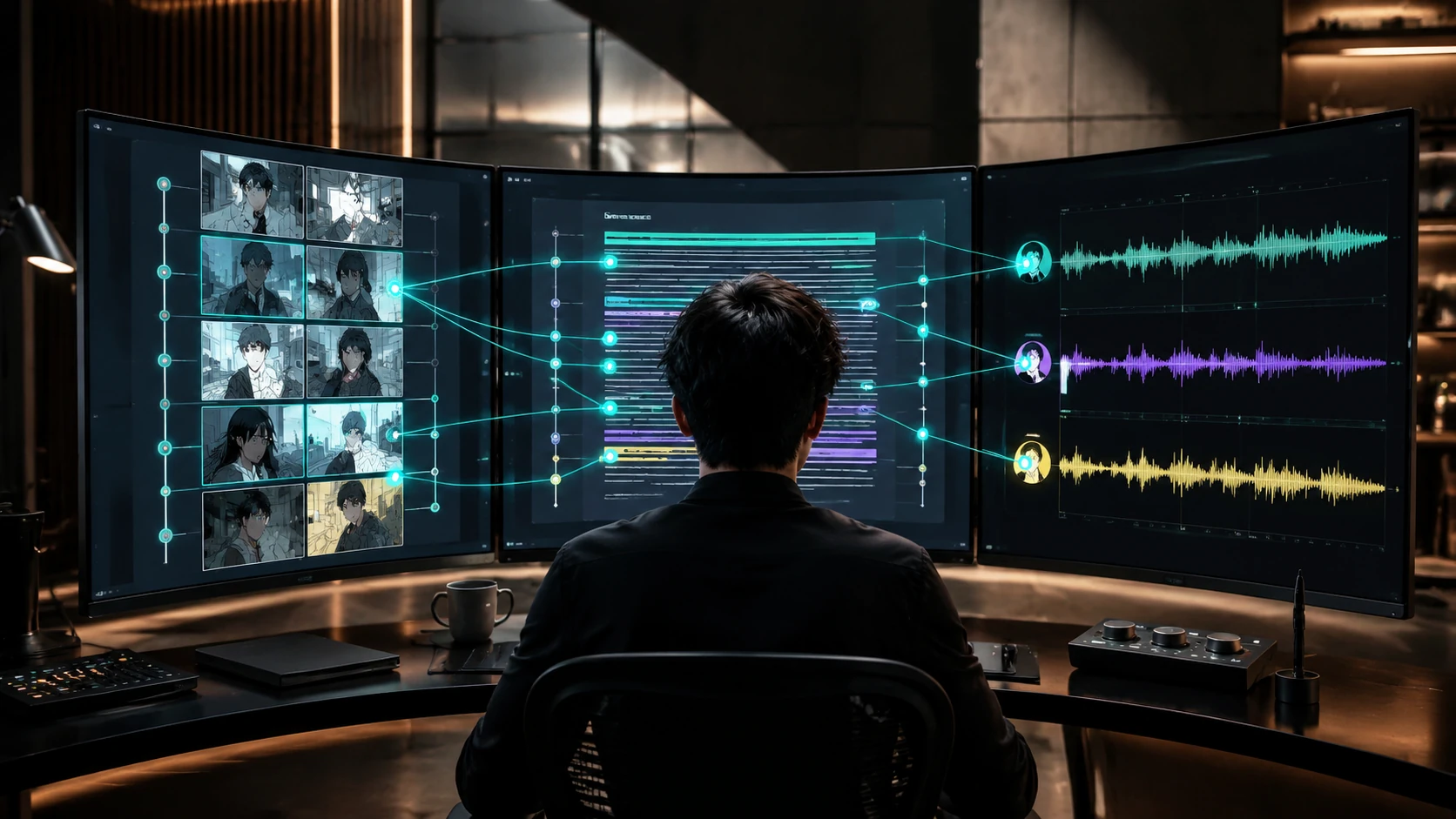
The 2026 digital comic landscape has moved beyond the simple adaptation of novels into webtoons. As reader attention spans fragment across multiple devices and sensory inputs, the industry has pivoted toward a 'Simultaneous Multi-Format' model. In this new reality, an IP is launched as a light novel, a vertical-scroll webtoon, and an immersive audio-drama all at once. This massive expansion creates a significant technical hurdle: Narrative Drift. When different creative teams work on different formats, small inconsistencies—a character's eye color, a forgotten plot point, or a slight change in tone—can accumulate, destroying the IP's canonical integrity and frustrating a fan base that expects a seamless experience across all platforms.
Understanding the TMNS Protocol Architecture
The Trans-Media Narrative Sync (TMNS) Protocol is the 2026 industry standard for solving the consistency problem. At its heart, TMNS replaces the traditional 'static script' with a 'Single Source of Truth' (SSoT) known as the Lore Core. The Lore Core is a semantic database that stores the DNA of the story—character traits, world-building rules, historical timelines, and plot beats—as data points rather than just text. This allows for a modular production environment where any change made in the 'master' database is immediately visible to the novel writers, comic artists, and audio engineers. This 'Data-First' approach ensures that the fundamental pillars of the story remain unshakable, regardless of the format through which the reader consumes it.
The Mechanics of Real-Time Reconciliation
Real-time reconciliation in TMNS works through a series of automated 'listeners' integrated into the studio's production software. For example, if a webtoon artist changes a character's outfit to better suit a visual composition, the TMNS listener flags this change. The protocol then cross-references the Light Novel's upcoming descriptions and the Audio-Drama's foley cues. If a discrepancy is found, an 'Editorial Alert' is generated, prompting a decision: should the novel be updated to match the visual, or should the visual be reverted? This prevents 'Consistency Debt,' a term used in 2026 to describe the cumulative cost of fixing lore errors late in a series' lifecycle.
- Entity Persistence: Characters and objects maintain a unique ID across all scripts and asset libraries.
- Semantic Tagging: Dialogue is tagged with emotional metadata to ensure AI voice-actors match the webtoon's visual expression.
- Conflict Detection: Automated algorithms scan for logic gaps between format-specific scripts.
- Branching Logic: Allows for 'Non-Canon' spin-offs to be managed within the same system without polluting the main timeline.
The Business Case: Why TMNS Drives IP Valuation
In 2026, the valuation of a webtoon IP is no longer based solely on its reader count, but on its 'Narrative Liquidity'—how easily it can be ported to other formats without friction. Studios using the TMNS Protocol see a dramatic increase in their acquisition value because their IP is 'Studio-Ready.' When a major streaming service or game developer looks to license a story, they prefer IPs with a pre-synced Lore Core, as it reduces their own development time by months. Furthermore, synchronized launches have shown to increase reader retention by 45%, as fans engage with the story through multiple touchpoints, reinforcing their emotional investment.
Common Pitfalls in Multi-Format Syncing
Despite its benefits, implementing TMNS is not without risks. The most common mistake is 'Over-Standardization.' Not every detail needs to be identical across formats; in fact, the strengths of each medium should be respected. A novel can afford more internal monologue than a webtoon, and an audio-drama can use soundscapes to convey atmosphere that a comic must draw. The goal of TMNS is not to make the formats identical, but to make them coherent. Another pitfall is 'Database Bloat,' where creators spend more time updating the Lore Core than actually writing. Successful 2026 studios solve this by appointing a 'Lore Architect' whose sole job is to manage the SSoT, allowing the creative teams to focus on storytelling.
Conclusion: The Future of Synchronized Storytelling
As we move toward the late 2020s, the line between a reader, a viewer, and a listener will continue to blur. The TMNS Protocol represents the first step toward a truly 'Omni-Format' narrative experience. By engineering story coherence at the data level, creators can build vast, interconnected universes that remain stable under the pressure of rapid expansion. For the modern webtoon studio, mastering TMNS is no longer optional—it is the baseline for professional production in a hyper-connected media ecosystem.
FAQ
What is the TMNS Protocol in webtoon production?
TMNS (Trans-Media Narrative Sync) is a technical framework used in 2026 to keep stories consistent across webtoons, novels, and audio-dramas by using a centralized 'Lore Core' database.
How does TMNS prevent narrative drift?
It uses unique IDs for characters and events, providing real-time alerts when a change in one format (like a novel) contradicts details in another (like a webtoon).
Can independent creators use TMNS?
Yes, by adopting 'Data-First' habits, such as using semantic world-building tools and keeping a single source of truth for lore before starting production.