The 2026 ‘Style-Variant’ Pipeline: A Technical Guide to Engineering Multi-Aesthetic Comic
Discover the 2026 production standard for creating 'Style-Variant' comics, allowing creators to release the same narrative in multiple aesthetic styles for different global markets.
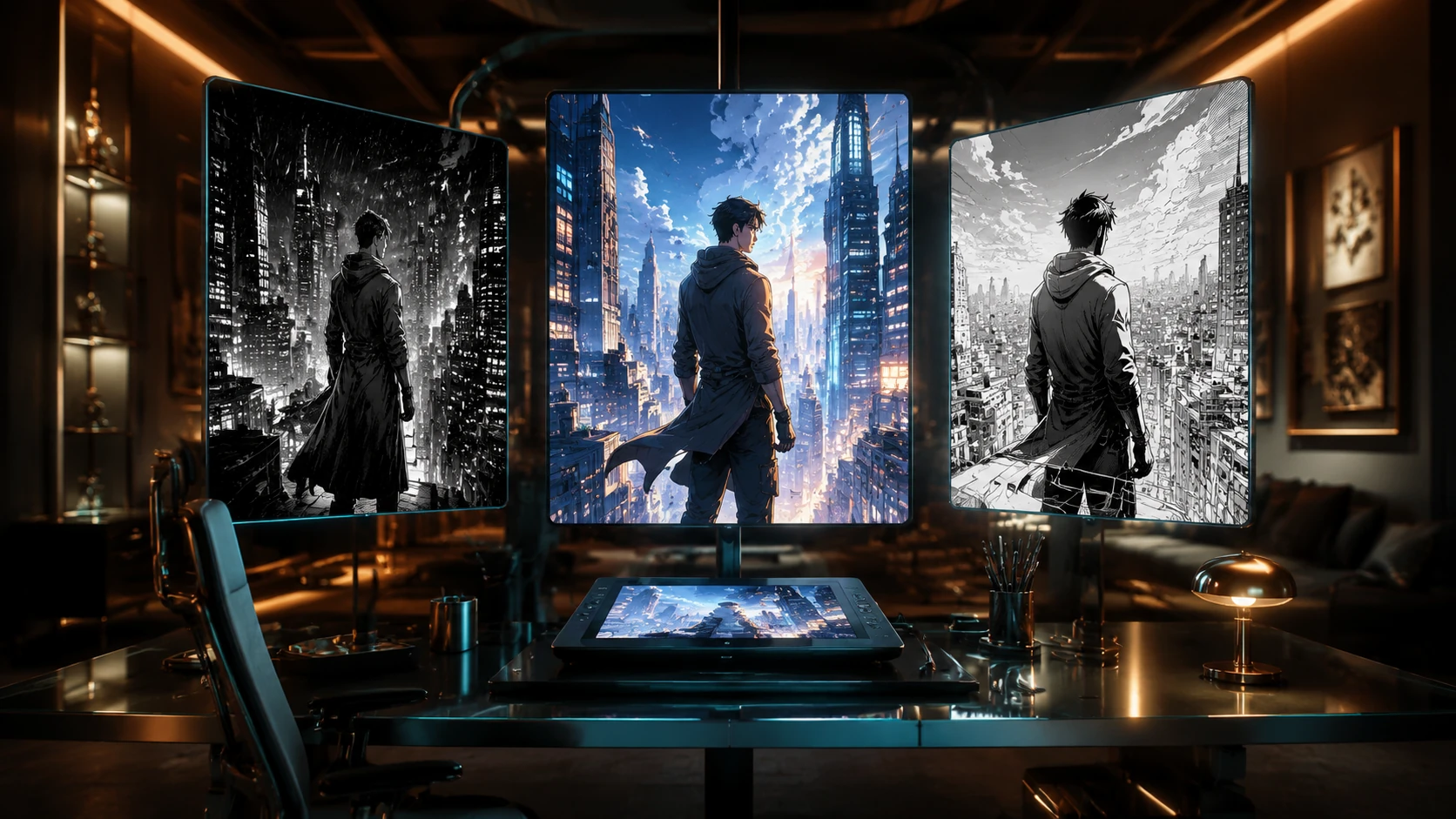
By 2026, the 'one-size-fits-all' approach to comic aesthetics has become a relic of the past. As global markets in Korea, Japan, France, and the US converge, creators are finding that a story’s success often hinges on its visual 'fit' within regional preferences. The ‘Style-Variant’ Pipeline (SVP) has emerged as the technical solution to this challenge, allowing studios and independent creators to engineer a single narrative core that can be rendered across multiple visual styles—from gritty American noir to high-detail Japanese Seinen—without redrawing every panel from scratch. This workflow utilizes semantic layering and Trained Aesthetic Models (TAMs) to ensure that the emotional weight and narrative intent remain constant, even as the line-art and color palettes shift to meet local audience expectations.
The Architecture of a Multi-Aesthetic Workflow
The 2026 Style-Variant Pipeline is built on the principle of 'Aesthetic Decoupling.' Traditionally, art and story were fused at the ink level. In the SVP, the production is broken down into three distinct layers: the Narrative Wireframe (pacing and dialogue), the Semantic Sketch (composition and character posing), and the Aesthetic Skin (the final visual style). By keeping the Semantic Sketch as a high-fidelity 3D or vector-based reference, creators can apply different Style-Transfer Engines to generate variants. This is not a simple filter; it is a generative process that understands the 'intent' of the brushstroke, ensuring that a character’s expression in a 'watercolor' variant carries the same emotional frequency as it does in a 'cell-shaded' variant.
Trained Aesthetic Models (TAMs)
At the heart of the pipeline are Trained Aesthetic Models. These are proprietary or open-source models trained specifically on a creator's unique style or a studio’s brand identity. Unlike generic AI, TAMs are fine-tuned on a limited, high-quality dataset of the creator’s own hand-drawn work. This ensures that the 'Manga' version of a comic still feels like it was drawn by the same artist who created the 'Western Graphic Novel' version. In 2026, these models are integrated directly into professional software, allowing for real-time style previewing during the sketching phase.
Step-by-Step: Implementing the Style-Variant Pipeline
Implementing the SVP requires a shift in how assets are managed from day one. It is no longer about finishing page one and moving to page two; it is about building a scalable visual library that can be re-skinned. This process ensures that the IP is not just a comic, but a 'Visual Asset Engine' capable of adapting to any platform or region.
- Semantic Storyboarding: Create digital storyboards using standardized 3D rigs or high-fidelity 'grey-box' sketches that define lighting, perspective, and volume.
- Character Logic Mapping: Define the 'visual DNA' of characters (e.g., specific hair silhouettes, eye shapes) that must remain consistent across all styles to ensure brand recognition.
- Variant Training: Select the target styles (e.g., 'Euro-Classic' for the French market, 'Vertical-Gloss' for Korea) and calibrate the TAMs to recognize your semantic sketches.
- Batch Rendering & Human-in-the-Loop Refinement: Use the pipeline to generate the base layers of the variants, then have lead artists perform a 'Value Pass' to ensure lighting and focal points are correct.
- Dynamic Lettering Integration: Match typography and SFX to the specific aesthetic variant, as 'Manga' sound effects function differently than 'Comics' onomatopoeia.
Maintaining Narrative Integrity Across Visual Shifts
A common mistake in early multi-aesthetic attempts was the 'Uncanny Valley of Style,' where the art looked correct but felt wrong for the story. In 2026, successful creators use 'Visual-Emotional Mapping.' For example, if a scene is meant to be claustrophobic, the TAM for the 'Noir' variant might increase contrast and shadow density, while the 'Watercolor' variant might use desaturated, bleeding edges to achieve the same psychological effect. The pipeline must be instructed not just on how to draw, but how to feel. This requires the technical team to work closely with the narrative leads to define 'Aesthetic Rulesets' for every major story arc.
The Market Impact: Why Multi-Aesthetic IP Wins
The business case for the Style-Variant Pipeline is undeniable. By releasing a 'Manga-Style' version in Japan and a 'Cinematic-Scroll' version in the US simultaneously, publishers are seeing 40% higher Day-1 retention rates. Readers no longer feel like they are consuming a 'foreign' product; they are consuming a story that feels natively designed for their visual culture. Furthermore, this technical infrastructure makes the jump to animation or gaming significantly faster, as the 'Semantic Wireframes' used for the comic variants serve as the perfect foundation for 3D modeling and cinematic pre-visualization.
FAQ
Does the Style-Variant Pipeline replace the need for artists?
No. It shifts the artist's role from manual labor to 'Creative Director' and 'Style Architect.' Artists are needed to create the base TAMs, refine the semantic sketches, and perform the final high-value polish that AI cannot replicate.
Can I use this pipeline for a solo indie webtoon?
Yes. While studios use high-end server-side TAMs, solo creators in 2026 use lightweight, local-run models and standard 3D posing tools to generate consistent style-variants for different platforms like Webtoon and Global Manga apps.
How do I ensure my characters look like the same person in different styles?
By using 'Character DNA' anchors—fixed geometric relationships between eyes, nose, and jawline—that the Style-Variant Pipeline is programmed to respect regardless of the aesthetic skin applied.