The 2026 ‘Spatial-Narrative’ Shift: Engineering Webtoons for the AR-Glasses Era
As AR glasses reach mass-market adoption in 2026, the webtoon industry is pivoting from flat vertical scrolls to spatial narratives. This shift redefines how readers interact with story panels in three-dimensional space.
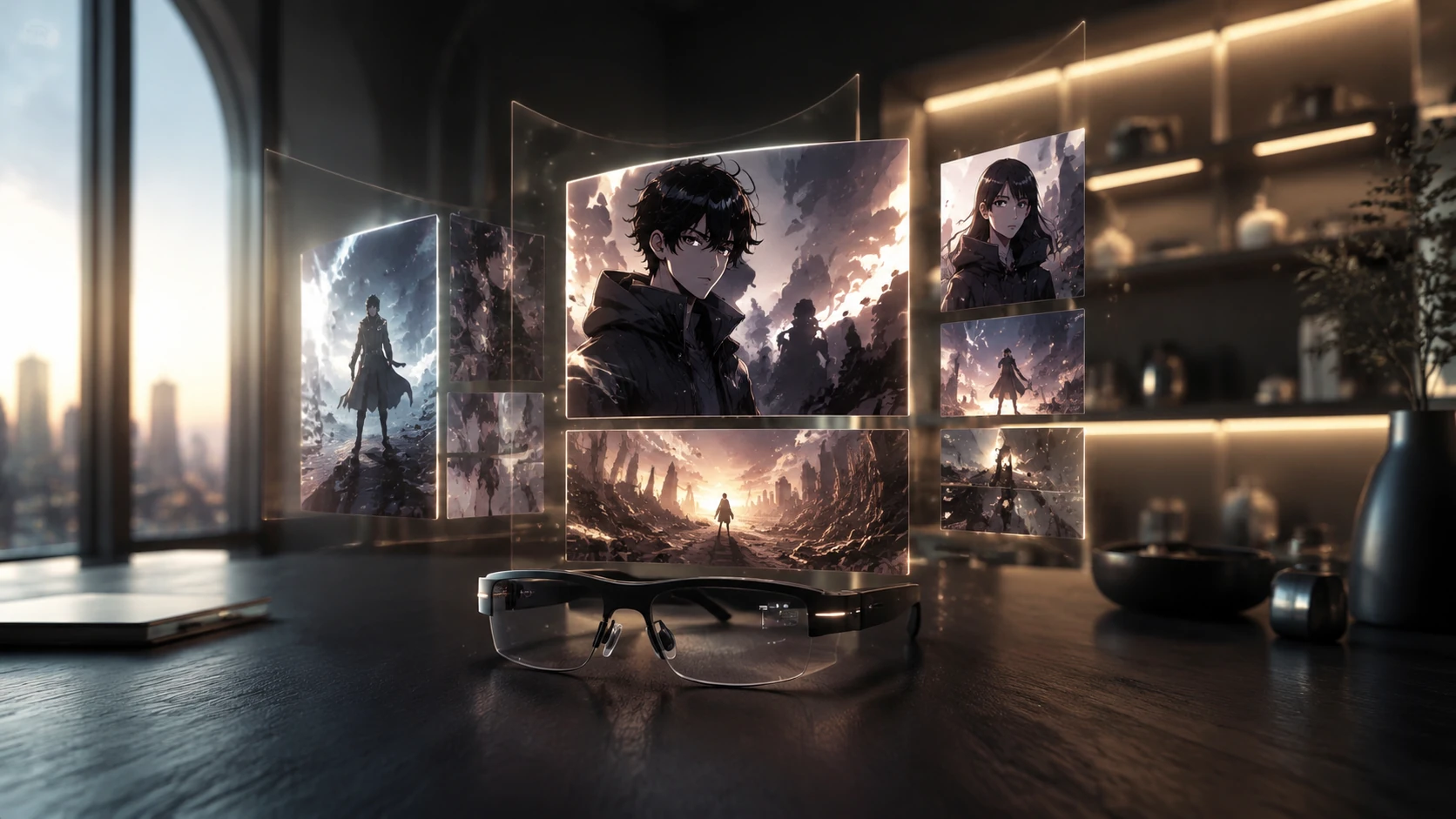
By mid-2026, the 'screen-fatigue' of the early 2020s has given way to the 'Spatial Era.' As lightweight Augmented Reality (AR) glasses become a standard accessory for mobile users, the traditional vertical scroll—once the pinnacle of webtoon innovation—is being challenged by Spatial-Narrative Architecture. This shift represents more than just a platform change; it is a fundamental transformation in how story sequences are engineered. Readers are no longer looking at a flat surface; they are stepping into a narrative volume where panels can exist at different depths, react to head movements, and occupy the physical environment of the reader.
The Z-Axis: Adding Depth to Narrative Pacing
In the traditional webtoon format, pacing was controlled exclusively by vertical speed. In the 2026 spatial model, creators are utilizing the Z-axis (depth) to signify narrative importance and emotional weight. Background elements in a panel might physically recede into the reader's room, while a 'jump scare' or a critical dialogue bubble can 'pop' forward, creating a biological focus response. This 'Depth-Based Pacing' allows for a multi-layered storytelling experience where the reader's eye doesn't just move down, but moves 'through' the story. Engineering these assets requires a move away from flat 2D exports toward layered, semantic files that AR engines can interpret as distinct spatial entities.
Gaze-Driven Interaction and Passive Immersion
One of the most significant technical trends in 2026 is the integration of eye-tracking or 'Gaze-Driven' narrative triggers. Unlike the tactile 'swipe' of a smartphone, AR-native webtoons can detect exactly which panel a reader is focusing on. This allows for 'Dynamic Reveal'—where secondary details or hidden 'easter eggs' in a panel only activate when the reader lingers on a specific area. This technology solves the 'spoiler-scroll' problem, where a reader accidentally sees the bottom of a page while reading the top. In a spatial environment, the next sequence of panels remains invisible or blurred until the reader’s gaze specifically moves to the transition point, ensuring the emotional impact of every beat is preserved.
Key Benefits of Gaze-Driven Pacing
- Elimination of accidental spoilers through peripheral vision.
- Reduction in 'scroll-fatigue' as the story flows based on natural eye movement.
- Higher retention rates due to the interactive, gamified nature of the reading experience.
- Precise analytics for creators to see exactly where readers lose interest or spend the most time.
The Engineering Challenge: From Pixels to Volumetric Assets
For studios, the shift to spatial narratives requires a complete overhaul of the production pipeline. The 2026 standard is moving toward 'Volumetric Layering.' Instead of a single flattened image, panels are delivered as a stack of transparent layers—foreground, character, midground, and background. This allows the AR hardware to apply parallax effects as the reader moves their head. Furthermore, the introduction of 'Spatial Audio' synced to specific panels creates a 360-degree soundscape that changes as the reader 'walks' through a digital chapter. Studios that continue to produce purely flat 2D content risk being categorized as 'Legacy Media' by AI-driven discovery algorithms that prioritize AR-compatible content for 2026 search queries.
Strategic Implications for IP Holders
As the market bifurcates into 'Mobile-Standard' and 'Spatial-Premium,' IP holders must decide where to allocate resources. Spatial narratives command a higher 'Value-per-Chapter' (VPC) because they offer an immersive experience that flat screens cannot replicate. We are seeing a trend where 'Flagship' series are launched with full AR support, while experimental or niche titles remain in the vertical-scroll format. This creates a new tier of 'Premium Reading' subscriptions where users pay for the hardware-optimized version of their favorite stories. Additionally, the ability to anchor a comic panel to a physical location—such as a specific wall in a reader’s home—creates a persistent 'Digital Gallery' effect that keeps the IP top-of-mind.
Action Checklist: Preparing for the Spatial Shift
- Audit existing IP for 'Depth Potential'—which stories would benefit from a 3D, layered presentation?
- Implement a 'Layered-First' workflow in your production pipeline to ensure future-proofing.
- Explore spatial metadata standards (like USDZ or glTF) for panel packaging.
- Monitor the adoption rates of mid-tier AR glasses to time your 'Spatial-Native' launch.
- Experiment with gaze-triggered soundscapes to increase reader immersion.
FAQ
Do I need 3D models to create spatial webtoons?
No. While 3D models help, 'Spatial-Narratives' in 2026 are primarily built using '2.5D' layering, where traditional 2D art is separated into multiple planes of depth to create a parallax effect.
Will vertical scroll webtoons become obsolete in 2026?
No, vertical scroll remains the high-efficiency standard for commuting and quick consumption. Spatial narratives are becoming the 'prestige' format for at-home, immersive reading.
How do AR glasses handle long-form reading without eye strain?
2026 AR hardware uses 'Variable Focal' technology and high-refresh rates specifically designed to mimic natural sight, significantly reducing the eye strain associated with early VR headsets.