The 2026 ‘Sound-Sync’ Production Guide: Engineering Webtoons for Immersive Audio-Narrative
Discover how to transform silent vertical scrolls into immersive sonic experiences. This guide covers the 2026 standards for scroll-triggered audio metadata and spatial narrative engineering.
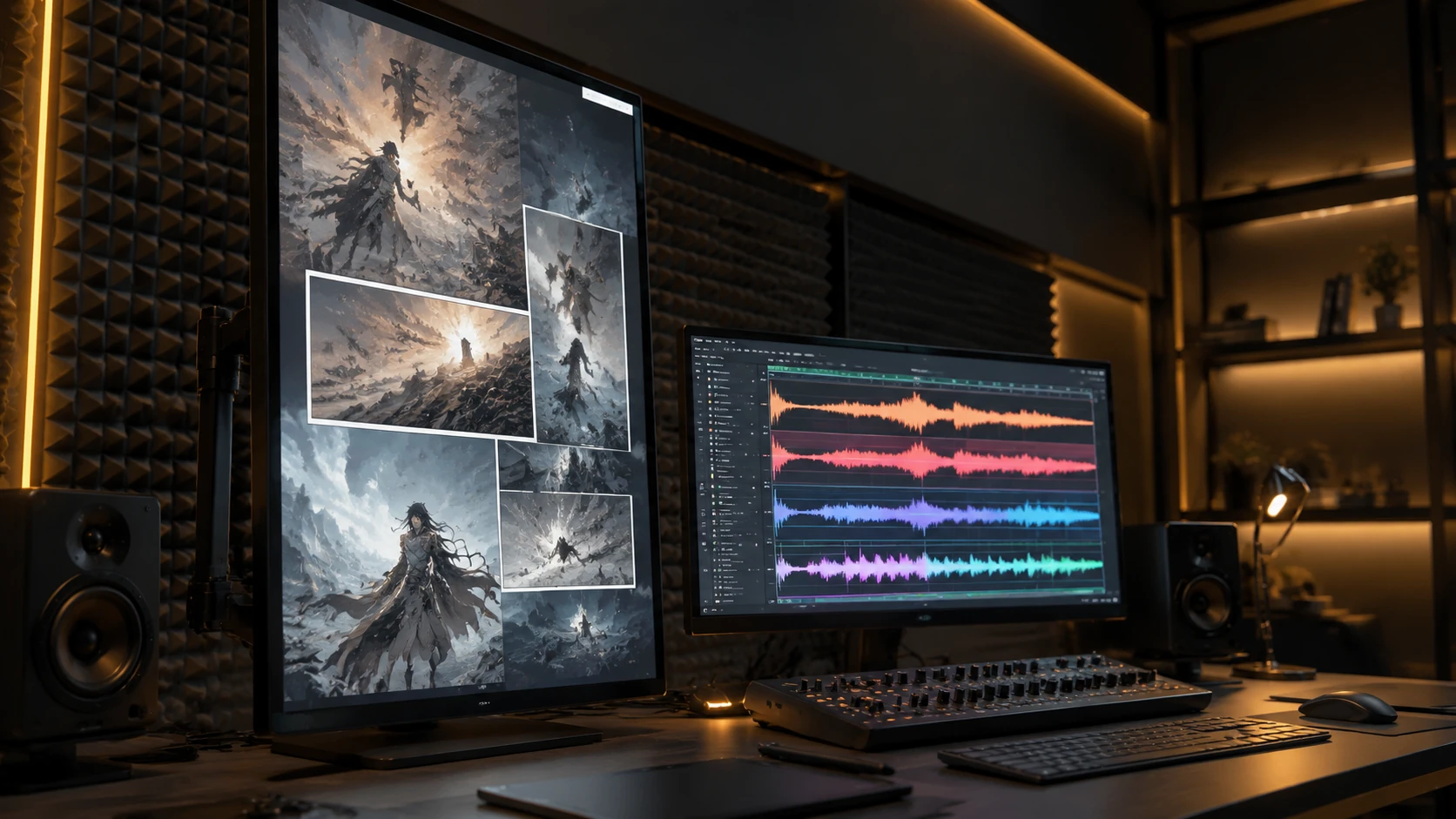
By 2026, the boundary between reading and listening has dissolved. As mobile hardware and 6G connectivity stabilize, readers no longer accept silent scrolls as the default. The 'Sound-Sync' (SS) standard has emerged as the definitive framework for creators to embed high-fidelity, scroll-triggered audio directly into the webtoon architecture. Unlike the clunky, auto-playing background music (BGM) of the past, modern audio integration is reactive, spatial, and semantic. It adapts to the reader’s scroll speed, triggering precise sound effects (SFX) and atmospheric shifts that align with the narrative beats. For creators and studios, mastering this production workflow is no longer optional; it is the key to increasing session duration by up to 40% and securing premium placement on global platforms like COMICLS and major webtoon hubs.
The 2026 Sound-Sync Standard (SSS): Core Principles
The Sound-Sync Standard (SSS) is built on the principle of 'Narrative-Sonic Cohesion.' It moves away from monolithic MP3 loops toward a modular asset architecture. In this system, a webtoon episode is not just a long image file; it is a container that includes a 'Sonic Metadata Layer.' This layer maps specific audio assets to pixel-depth coordinates. When a reader’s viewport reaches a specific Y-axis coordinate (e.g., 14,200px where a character draws a sword), the app triggers a specific 'Spatial SFX' file. This requires a shift in how creators think about their storyboards—treating the vertical canvas as a timeline where visual and auditory assets must be choreographed with millisecond precision.
Three Categories of Audio Assets
- **Ambient Environment Layers (AEL):** Constant, looping background textures (e.g., rain, distant city traffic) that provide the foundational 'vibe' of a scene.
- **Event-Triggered SFX:** Discrete sounds tied to specific panels or actions (e.g., a door slam, a heartbeat, or a magical explosion) that activate only when the panel is in focus.
- **Spatial Narrative Voice (SNV):** AI-assisted or recorded narration that tracks with the dialogue bubbles, providing accessibility and immersion for multi-tasking readers.
Step-by-Step Workflow for Audio-Integrated Webtoons
Implementing Sound-Sync requires a specialized pre-production phase. You cannot simply 'bolt on' sound at the end of the drawing process. The pacing of your vertical layout must account for the duration of the audio cues. If a character has a five-second dramatic monologue, you need enough 'negative space' or scrolling room to allow that audio to play before the next major sound event triggers. This is known as 'Buffer-Zone Engineering,' and it is the first step in a professional 2026 production pipeline.
1. The Sonic Storyboard
Begin by marking your storyboard with 'Audio Anchors.' These are symbols that denote where a sound should start, peak, and fade. During this phase, determine if the audio is a 'Hard Trigger' (must play at a specific point) or a 'Soft Loop' (fades in and out based on proximity). Using tools like the COMICLS Creator Suite, you can visualize these anchors alongside your sketches to ensure the visual and auditory pacing are in harmony.
2. Asset Optimization and Compression
Mobile performance is critical. In 2026, the industry standard for webtoon audio is the Opus codec at variable bitrates. This ensures high-fidelity sound while keeping file sizes small enough for instant streaming. Creators should export SFX as mono files to save space, using software-side panning to create 'Pseudo-Spatial' effects. Ambient loops should be seamless and typically no longer than 30 seconds to minimize memory overhead on the reader's device.
3. Metadata Mapping (The Scroll-Trigger)
The final technical step is generating the JSON manifest that links the image segments to the audio files. Each entry in the manifest should specify: the Audio Asset ID, the Start-Pixel Trigger, the Fade-In Duration (in milliseconds), and the Volume-Gain Level. This ensures that even if a reader scrolls quickly or slowly, the audio engine can interpolate the volume to match the visual focus.
Common Pitfalls: Avoiding 'Sonic Fatigue'
The most common mistake in early audio-comic attempts is over-saturation. If every panel has a unique sound effect, the reader becomes overstimulated, leading to 'Sonic Fatigue.' The audio should support the narrative, not compete with it. Use silence strategically—it is one of the most powerful tools in a sound designer's kit. Furthermore, ensure that your audio is 'Context-Aware.' If a reader is in a public place with their phone on silent, your app must automatically provide 'Haptic-Sync' (vibrations) or 'On-Screen Captions' to convey the missing auditory information.
The Silent-First Mandate
- **Default to Mute:** Always respect the device's hardware silent switch. Use a subtle on-screen 'Audio Available' icon.
- **Volume Normalization:** Ensure your peak levels don't exceed -6dB to avoid startling readers wearing earbuds.
- **Smooth Crossfades:** Never let an ambient loop cut off abruptly. Use a minimum 1.5-second crossfade between different scene atmospheres.
Future-Proofing Your IP: Accessibility and Licensing
As you build your audio-integrated webtoon, consider the long-term portability of your assets. By using the Sound-Sync standard, you are effectively creating a 'Script-to-Engine' (S2E) ready package. This makes it significantly easier to adapt your webtoon into an animated series or an interactive game later, as the sonic logic is already mapped to the narrative. Additionally, be cautious with licensing; ensure your BGM and SFX licenses cover 'Interactive Digital Distribution' and 'Global Streaming' to avoid legal friction as your IP scales across borders.
FAQ
Does adding audio significantly increase the loading time of a webtoon?
In 2026, using the Opus codec and modular streaming, audio adds only 5-10% to the total data payload. Assets are lazy-loaded as the reader scrolls, ensuring no impact on initial load times.
Can I use AI-generated music for my webtoon sound-sync?
Yes, but ensure you follow the 2026 Provenance-First Labeling Mandate. AI-generated audio must be tagged in the metadata to maintain transparency and comply with platform monetization rules.
What happens if a reader scrolls backward?
Professional Sound-Sync engines are bidirectional. The audio manifest includes 'Reverse-Trigger' logic that fades out or plays reversed soundscapes to maintain immersion even during non-linear reading.