The 2026 ‘Responsive Narrative Architecture’ (RNA) Standard: Engineering Webtoons for the
As device fragmentation peaks in 2026, the Responsive Narrative Architecture (RNA) standard moves beyond the static vertical scroll. Learn how to engineer adaptive layouts that preserve narrative flow across every screen size.
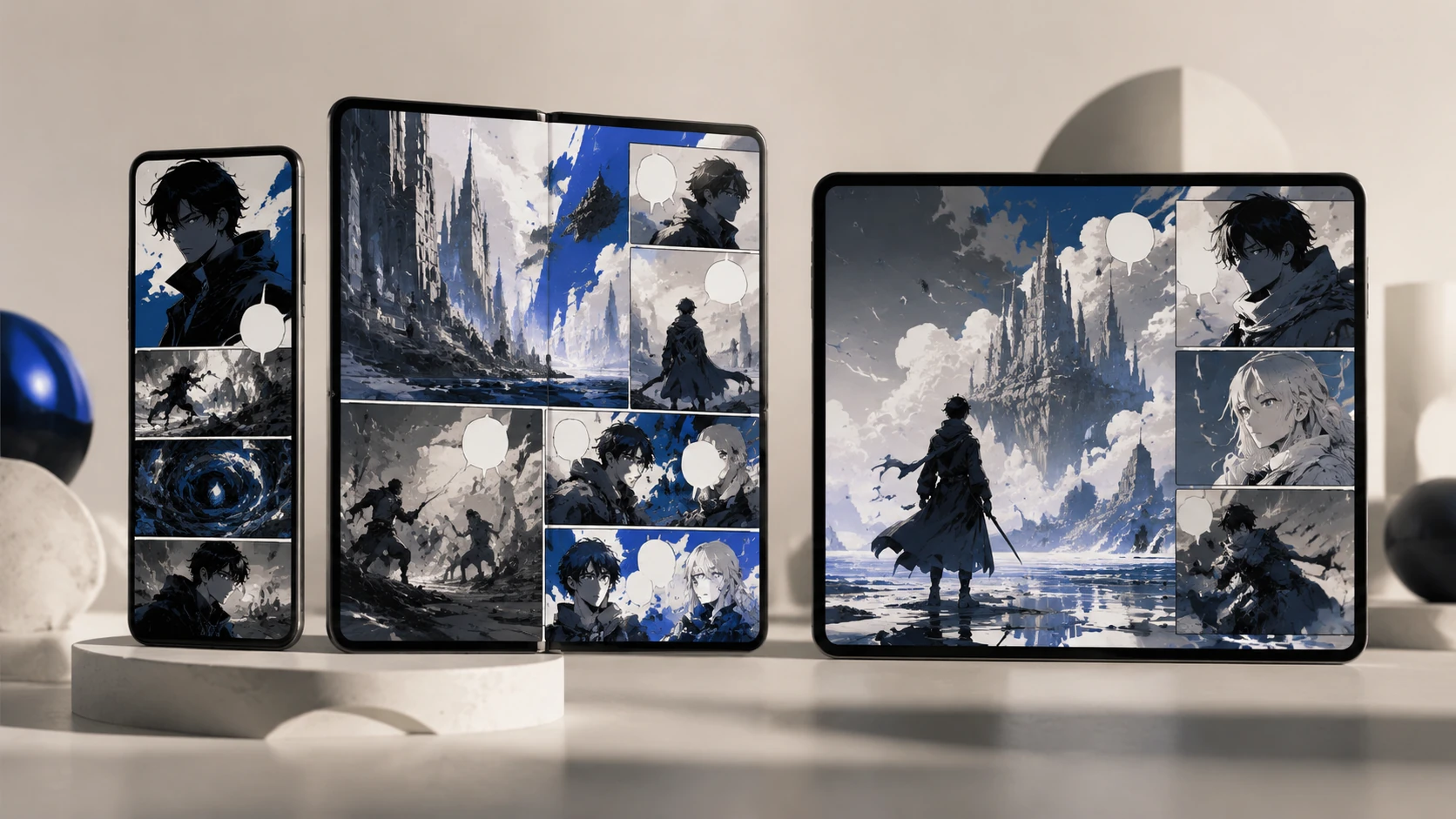
By 2026, the 'one-size-fits-all' vertical scroll is officially obsolete. With the global surge in foldable devices, dual-screen tablets, and high-performance XR-linked displays, comic readers no longer consume content on uniform screens. The Responsive Narrative Architecture (RNA) standard has emerged as the essential technical framework for creators and studios to ensure their IP remains legible, engaging, and immersive regardless of the hardware. RNA is not merely 'responsive design' borrowed from web development; it is a specialized storytelling logic that adjusts panel density, font size, and white-space pacing based on real-time hardware metadata. Engineering your webtoon with RNA ensures that a cinematic wide-angle shot feels as impactful on a 6-inch smartphone as it does on a 12-inch foldable, preventing the 'cramped' or 'stretched' visuals that lead to immediate reader bounce.
Understanding the Core Pillars of Responsive Narrative Architecture
The RNA standard is built on the principle of 'Narrative Reflow.' Unlike traditional PDFs or static images, an RNA-compliant comic file treats panels and dialogue as semi-independent entities tied to a master narrative timeline. When a reader switches from a portrait smartphone to a landscape tablet, the RNA engine recalculates the spatial relationships between assets. This prevents the 'letterboxing' effect and allows for a more natural eye-flow. Key components include 'Anchor Points' for character focus and 'Expansion Zones' where background art can extend to fill wider aspect ratios without cropping essential narrative information. This level of technical engineering preserves the creator's intent while maximizing the hardware's potential.
The Three Levels of RNA Implementation
- Level 1: Dynamic Font & Bubble Scaling – Automatically adjusting text size and dialogue bubble placement to maintain readability without obscuring character faces on smaller screens.
- Level 2: Adaptive Panel Clustering – Grouping related panels that can stack vertically on narrow screens but layout horizontally on wider displays to maintain the intended 'beat' of the scene.
- Level 3: Contextual Asset Swapping – Utilizing high-resolution 'expansion' assets that only load when the device detects a large-format display, ensuring performance optimization for mobile users.
The Technical Workflow: Engineering for Multi-Platform IP
Transitioning to an RNA workflow requires a shift in the pre-production phase. Creators must move away from flat 'long-strip' files and toward layered, metadata-rich projects. By utilizing the 2026 Layer-Semantic File Standard (LSFS), artists can tag specific layers as 'Critical' (action, characters, dialogue) or 'Ambient' (background extensions, lighting effects). This allows the publishing engine to make intelligent decisions about what to display. For instance, on a narrow screen, the engine might prioritize a tight crop of a character's expression, while on a foldable, it reveals the full environmental context. This modular approach not only improves the reading experience but also streamlines the adaptation of webtoons into other formats like animation or interactive media.
Why RNA is the New SEO Signal for Comic Platforms
In 2026, search engines and platform discovery algorithms have evolved to prioritize 'Reader Friction' as a ranking factor. Comics that force readers to pinch-and-zoom or those that display tiny, illegible text on standard mobile devices are penalized in search results. Implementing RNA acts as a strong signal of quality and technical authority. It directly impacts 'Time on Page' and 'Completion Rate'—two metrics that are now fundamental to the 2026 Helpful Content Update. By engineering for accessibility and responsiveness, you are not just pleasing the reader; you are optimizing your IP for the AI-driven discovery engines that now dominate the comic market.
Common Pitfalls in Adaptive Layouts
- Breaking the 'Gutter Logic': Allowing panels to reflow in a way that confuses the chronological reading order.
- Over-scaling Text: Making dialogue bubbles so large on tablets that they dominate the artwork and break the visual balance.
- Ignoring Aspect Ratio Transitions: Failing to test how a comic looks on 'squarer' foldable screens, leading to awkward whitespace gaps.
The Future: Spatial Reading and Beyond
As we look toward 2027, the RNA standard is already being adapted for 'Spatial Narrative' environments. This involves engineering panels that don't just sit on a flat screen but exist in a 3D depth-field within AR glasses. By mastering RNA today, creators are building a foundation of modular, semantic assets that will be compatible with the next generation of immersive storytelling. The shift from 'drawing a page' to 'engineering a narrative space' is the single most important transition for the modern comic professional. Those who adopt these technical standards early will secure their position at the forefront of the global digital comic economy.
FAQ
What is the difference between RNA and standard webtoon scrolling?
Standard scrolling is a fixed-width long strip. RNA (Responsive Narrative Architecture) is a technical framework that allows the layout, panel density, and text to adapt dynamically based on the device's aspect ratio and screen size.
Does RNA require me to redraw my comic for different devices?
No. RNA uses layered assets and metadata to 'reflow' the existing art. By creating slightly wider background layers and tagging 'Safe Zones,' the engine handles the adaptation automatically.
How does RNA improve my comic's SEO in 2026?
Search engines now measure 'Technical Reader Friction.' RNA reduces bounce rates by ensuring readability and visual impact on all devices, which signals high content quality to discovery algorithms.