The 2026 Responsive Canvas Standard: Why Modular Layouts are Replacing the Static Vertical
The era of fixed-width vertical scrolls is ending. Discover how the 2026 Responsive Canvas Standard (RCS) uses modular panel architecture to ensure webtoons look perfect on everything from smartwatches to foldable tablets.
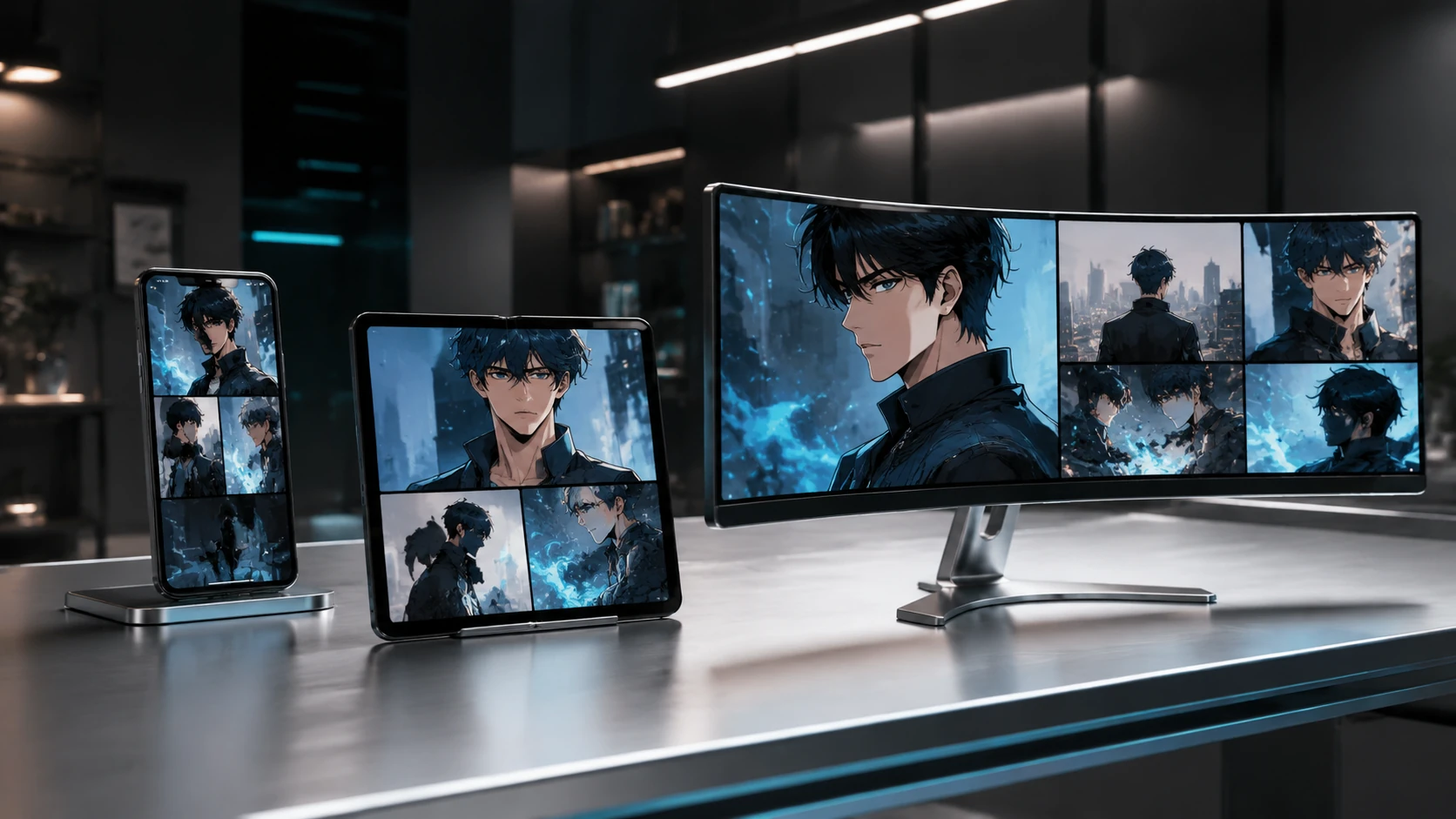
For over a decade, webtoons have been defined by a rigid 720-pixel width constraint. However, the 2026 market has rendered the 'fixed-width' scroll obsolete. With the mass adoption of foldable devices, ultra-wide desktop monitors, and the first generation of mainstream AR glasses, readers no longer consume content on a single, uniform screen. The 'Responsive Canvas Standard' (RCS) has emerged as the industry's answer, shifting the production workflow from static image exports to modular, metadata-driven layouts. This transition isn't just about aesthetics; it is a fundamental shift in how digital narratives are architected to ensure IP longevity across a fragmented hardware landscape. Studios that fail to adopt responsive frameworks are finding their legacy archives increasingly difficult to monetize on modern hardware, leading to a massive industry-wide push toward modular asset management.
What is the 2026 Responsive Canvas Standard (RCS)?
The Responsive Canvas Standard is a technical framework that treats a webtoon not as a long strip of flattened pixels, but as a collection of modular narrative components. Each panel, speech bubble, and sound effect is treated as an independent object with its own set of 'anchoring' rules. Similar to how modern websites use CSS to reflow content based on screen size, RCS-enabled webtoons use semantic metadata to determine how panels should stack, expand, or reposition when a reader switches from a narrow phone to a wide tablet. This prevents the 'letterboxing' effect that plagued older vertical scrolls and ensures that the artist’s intended emotional pacing remains intact regardless of the aspect ratio.
Key Components of Modular Architecture
- Fluid Panel Anchoring: Panels that expand to fill width without losing focal points.
- Semantic Text Layering: Speech bubbles that resize and reposition to maintain legibility on small screens while avoiding 'floating' in white space on large ones.
- Aspect-Ratio Triggers: Narrative 'breaks' that allow a vertical stack to transition into a side-by-side layout on wider displays.
- Lossless Vector Assets: The shift toward SVG-based line art and high-density textures to prevent pixelation during dynamic scaling.
The Hardware Catalyst: Beyond the Smartphone
The primary driver for RCS is the 2026 'Hardware Split.' While the smartphone remains the dominant reading device, foldable tablets now account for 35% of premium webtoon consumption. Furthermore, the rise of 'Ambient Reading' via AR glasses requires narratives that can float in space without a fixed border. Static 720px PNGs look blurry and amateurish on these high-fidelity displays. By adopting a responsive approach, creators can deliver 'Master-Quality' files that the platform’s engine downscales or reflows in real-time. This ensures the reader always receives the optimal version of the art, maximizing engagement and reducing the visual fatigue associated with zooming in and out of static images.
SEO and Discovery Benefits of Responsive Narratives
In 2026, search engines and platform algorithms prioritize 'Accessible UX.' A webtoon that is technically responsive is indexed more effectively because its text layers are machine-readable and its layout passes Core Web Vitals for mobile-first indexing. When a series is built on RCS, the dialogue isn't just pixels; it’s semantic data that AI-driven search engines can crawl. This significantly boosts discoverability for niche genres, as search intent can now be matched directly to the dialogue and panel descriptions embedded within the responsive file. Furthermore, the reduced file size of modular assets—compared to massive, flattened image strips—leads to faster load times, which is a critical ranking factor for 2026 discovery engines.
Common Implementation Mistakes
The most common mistake studios make when moving to a responsive workflow is 'over-automation.' Relying solely on AI to reflow panels often results in broken narrative pacing or awkward visual transitions. RCS requires a 'Human-in-the-Loop' approach where the artist or layout editor sets the 'breaking points' for the story. Another pitfall is ignoring the 'Safe Zone' for speech bubbles. On ultra-wide screens, bubbles can drift too far from their speakers if they aren't properly anchored to the character's coordinate data. Success in the RCS era requires a blend of traditional composition skills and basic understanding of digital asset architecture.
The Future: Context-Aware Storytelling
Looking toward 2027, the Responsive Canvas Standard is evolving into 'Context-Aware' storytelling. We are seeing the first experiments with layouts that change based on light sensors (switching to high-contrast 'Night Mode' art) or movement (haptic-triggered panel shifts). The webtoon is no longer a static document; it is an application. For the independent creator, this means the 'barrier to entry' is shifting from purely artistic skill to technical narrative design. Those who master the modular canvas will define the next decade of visual storytelling.
FAQ
Does RCS require me to redraw my comic for every device?
No. RCS is designed so you draw once at a high resolution with layered assets. The platform engine then uses your metadata to reflow the panels automatically.
Will responsive webtoons take longer to produce?
Initially, the setup takes longer, but it saves hundreds of hours in the long run by eliminating the need for manual reformatting for different platform requirements.
What software supports the Responsive Canvas Standard in 2026?
Most major professional tools, including Clip Studio Paint EX 2026 and specialized platform plugins like COMICLS Architect, now support RCS metadata exporting.