The 2026 ‘Pilot-to-Series’ (P2S) Case Study: Engineering Lean Production in High-Risk Webt
Learn how the 2026 P2S framework allows studios to validate narrative-market fit before committing to long-form serialization. A deep dive into Studio Nox's 60% waste reduction strategy.
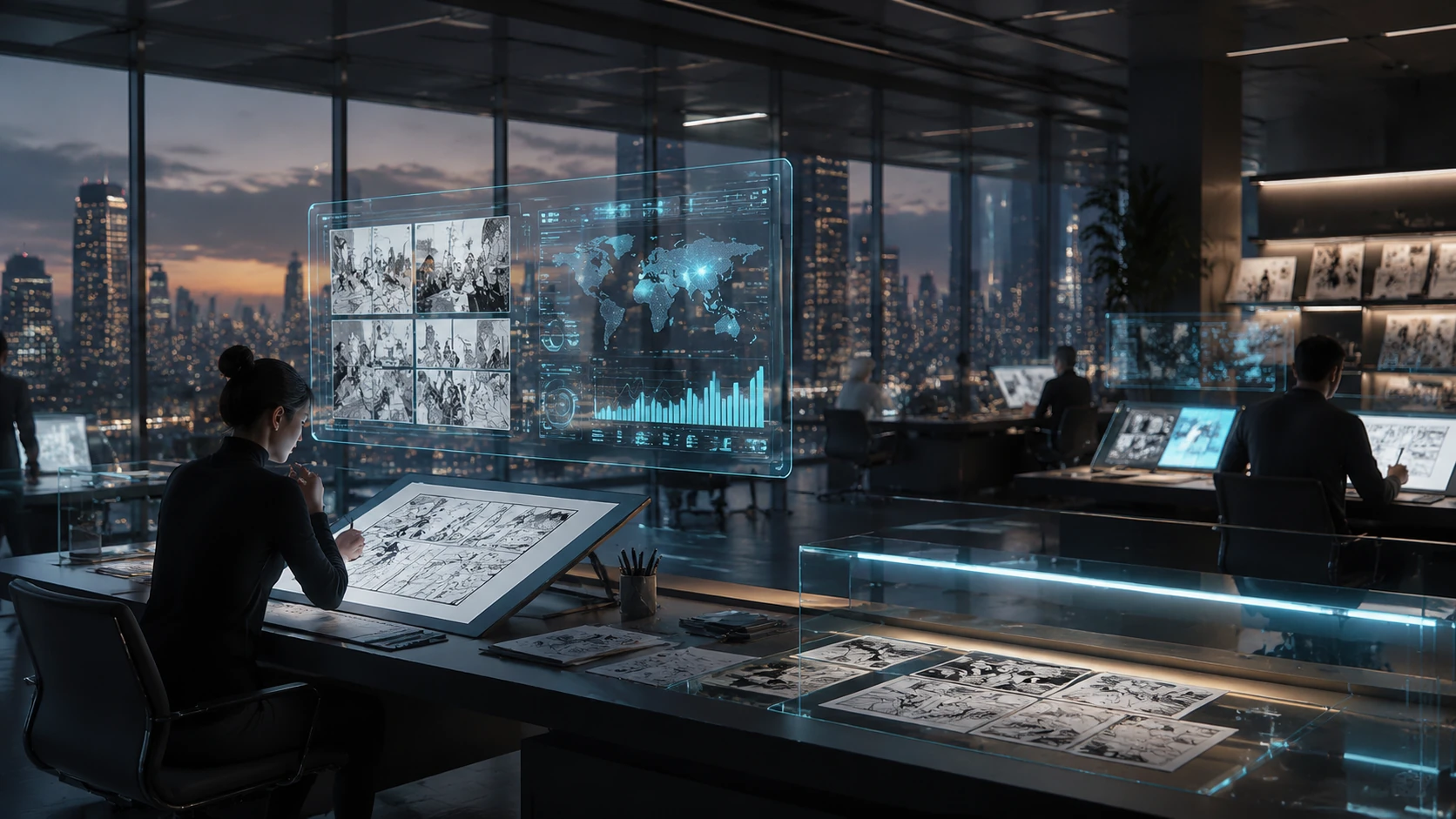
By mid-2026, the 'Infinite Serialization' model—once the gold standard for webtoon platforms—has encountered a terminal financial wall. High production costs combined with an increasingly fragmented reader attention span have made the traditional 50-chapter upfront commitment a high-risk gamble that many independent studios can no longer afford. The industry has shifted toward the 'Pilot-to-Series' (P2S) framework, a lean methodology designed to validate narrative-market fit (NMF) with minimal capital expenditure. This case study examines how Studio Nox, a boutique creative house, successfully implemented the P2S protocol to reduce production waste by 60% while simultaneously increasing their hit rate for long-form adaptations.
The Scenario: The Failure of the 'Spray and Pray' Strategy
Before adopting the P2S framework, Studio Nox followed the 2024-era industry norm: developing full bibles, 10-chapter buffers, and committing to a minimum 40-episode run regardless of early performance. In early 2025, three of their high-budget fantasy titles failed to gain traction past chapter 15, resulting in a combined loss of over $450,000 in sunk production costs. The 'Narrative Debt'—the cost of continuing a failing story to satisfy platform contracts—was threatening the studio's solvency. They needed a way to test the 'emotional resonance' of an IP before the heavy lifting of full-scale asset production began.
The P2S Execution: A Three-Phase Validation Loop
Studio Nox's pivot involved restructuring their entire production pipeline into three distinct validation gates. Instead of a linear path to serialization, every new IP had to survive a 'Narrative Stress Test' and a 'Market Pilot' before receiving green-light status for a full series. This modular approach allowed the studio to distribute their budget across more concepts while concentrating resources only on high-performing 'Alpha' narratives.
Phase 1: The Narrative Stress Test (NST)
Instead of full panels, the studio produced 'Narrative Slices'—a 10-panel vertical scroll consisting of key emotional beats and character introductions. These were tested against AI-assisted sentiment engines and small focus groups to measure 'hook velocity.' If a story's premise didn't trigger a 70% retention rate in the first 6 panels, the concept was returned to the script stage or scrapped entirely, saving thousands in art costs.
Phase 2: The 3-Chapter Pilot Launch
Concepts that passed the NST were advanced to a 3-chapter pilot phase. Unlike a standard launch, these chapters were produced using an 'Asset-Modular' workflow, focusing on high-impact character art while using simplified environments. These pilots were released on 'Sandbox' tiers of major platforms to gather real-world data on conversion rates, comment density, and the 'Cliffhanger-to-Fast-Pass' ratio.
The Result: 60% Waste Reduction and 3x Higher LTV
The results of the P2S implementation were transformative. Over a 12-month period, Studio Nox launched 12 pilots. Only 4 were green-lit for full series. While this 'kill rate' seemed high, the 4 selected titles outperformed the studio's previous portfolio by 300% in terms of Lifetime Value (LTV) and reader retention. By identifying 'dead-on-arrival' narratives in the pilot stage, the studio saved approximately $320,000 in art, lettering, and localization costs that would have otherwise been spent on failing series.
- Elimination of Sunk Cost Fallacy: The P2S framework provided a data-driven 'off-ramp' for underperforming IP.
- Increased Talent Density: Artists were moved from failing series to high-performing ones, preventing burnout and improving quality.
- Improved Investor Confidence: The studio's ability to demonstrate NMF data made their series more attractive for streaming and gaming adaptations.
- Scalable Asset Utilization: The modular assets created for pilots were reused in the full series, further reducing the 'Chapter 1-10' production cost.
The Reusable P2S Playbook for Independent Studios
For studios looking to replicate this success, the P2S playbook requires a cultural shift from 'Artist-First' to 'Audience-Validated' development. This does not mean sacrificing creative vision; rather, it means using data to find the most effective version of that vision. The playbook involves setting clear 'Kill/Keep' metrics before a single panel is drawn—specifically focusing on 'Scroll-Depth Consistency' and 'Lore Engagement' within the first 1,500 words of the narrative script.
As we move further into 2026, the P2S model is becoming the baseline for sustainable comic creation. Studios that continue to ignore the lean methodology risk being buried by the sheer volume of high-quality, validated content produced by more agile competitors. The era of the 'Infinite Series' isn't over, but the era of the 'Unvalidated Series' certainly is.
FAQ
What is the Pilot-to-Series (P2S) framework?
P2S is a lean production methodology where webtoon studios create 3-chapter pilots to validate reader interest and narrative-market fit before committing to long-form serialization.
How does P2S reduce production waste?
By identifying failing narratives early, studios avoid spending budget on art, localization, and marketing for series that lack long-term reader retention.
Does P2S limit creative freedom?
No. P2S provides a framework to test which creative ideas resonate best with audiences, allowing creators to refine their vision based on real-world feedback.