The 2026 ‘Novel-to-Webtoon’ Adaptation Framework: Engineering Narrative Density for High-V
Learn the professional 2026 framework for adapting prose novels into high-performance vertical webtoons. Master the art of narrative compression and visual-beat mapping to scale your IP efficiently.
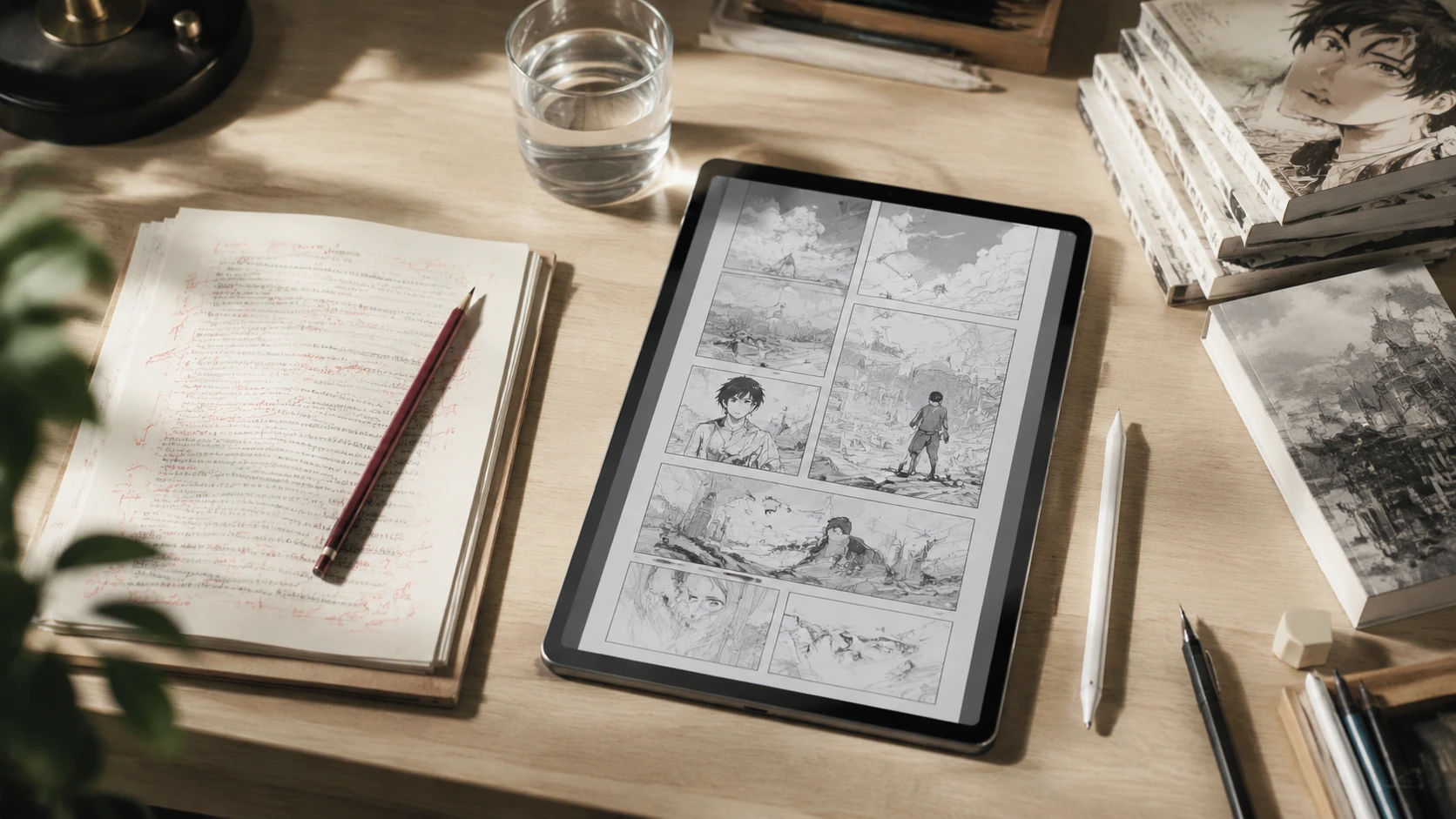
By 2026, the 'Novel-First' strategy has become the dominant engine for intellectual property in the global comic market. With serialized light novels and web novels providing a pre-validated audience, the challenge has shifted from finding original ideas to the technical engineering of 'Narrative Density.' Simply copying dialogue from a novel into a speech bubble is a recipe for high reader churn. Modern 2026 standards require a sophisticated 'trans-media reconstruction' that respects the pacing of mobile vertical scrolling while maintaining the emotional core of the source prose. This guide outlines the 2026 Adaptation Framework, a professional-grade methodology for studios and independent creators to convert text-heavy IP into high-velocity visual narratives that dominate platform algorithms.
The 'Narrative Compression' Engine: Converting Prose to Visual Flow
The fundamental hurdle in novel adaptation is the 'Internal Monologue Trap.' In prose, a character’s internal thoughts can span pages; in a webtoon, more than three consecutive thought bubbles often result in a 20% drop-off in reader engagement. The 2026 standard utilizes 'Visual Externalization,' where internal character growth is translated into environmental cues, micro-expressions, or symbolic imagery. This process requires a structural audit of the novel’s chapters to identify 'Anchor Moments'—the specific emotional or plot-driven beats that cannot be skipped. Everything else must be compressed into what we call 'Narrative Shorthand,' where background art and panel composition do the heavy lifting that descriptions used to perform.
The 3-to-1 Rule of Compression
- Consolidate three prose scenes into one visual sequence if they share the same emotional goal.
- Replace descriptive text (e.g., 'the castle was gloomy and cold') with atmospheric lighting and specific architectural assets.
- Limit dialogue to 15 words per panel to maintain the 60-second mobile reading rhythm.
Visual Beat Mapping: Engineering Pacing for Vertical Readers
In 2026, webtoon success is measured by 'Scroll Velocity.' Readers consume vertical content at a much higher speed than traditional manga or novels. To adapt a novel effectively, you must map the narrative beats to a 'Vertical Scroll Curve.' This involves placing 'Micro-Hooks' every 5-7 panels and a 'Macro-Hook' (a cliffhanger) at the end of every episode. Unlike novels, where chapters can end on a thematic resolution, 2026 webtoon episodes must end on an 'Incomplete Action' to drive the conversion to the next chapter. This requires the scriptwriter to occasionally re-order novel events—a process known as 'Temporal Shifting'—to ensure each weekly release ends with high retention signals.
The 2026 Technical Workflow: AI-Assisted Storyboarding
Efficiency is the backbone of the 2026 adaptation pipeline. Studios are now using 'Script-to-Layout' AI tools to generate initial panel compositions directly from prose text. This doesn't replace the artist but acts as a 'Spatial Blueprint.' The creator inputs the novel’s text, and the system suggests panel placements based on character proximity and dialogue weight. This 'Hybrid Workflow' allows creators to focus on the 'Emotional Finish'—the subtle artistic choices that give a series its soul—while the machine handles the repetitive task of layout proportions. This has reduced the time from 'Novel Bought' to 'Chapter One Launched' by approximately 45% compared to 2023 standards.
Common Pitfalls in Novel Adaptations
- Over-relying on 'Wall of Text' narration boxes that clutter the vertical flow.
- Failing to update character designs for visual distinctness (novels allow for similar-looking characters; webtoons do not).
- Ignoring 'White Space' as a pacing tool, leading to visual exhaustion.
Mastering the 'Transition Layer' in 2026
One of the most overlooked aspects of novel-to-webtoon conversion is the transition between scenes. In a novel, you might write 'The next day...' and start a new paragraph. In a 2026 webtoon, that transition must be visual and seamless. We use 'Gutter Transitions'—varying the length of the white space between panels—to denote the passage of time or a change in location. A long, empty gutter creates a feeling of silence or time passing, whereas tight panel spacing accelerates the action. Mastering this 'negative space' is what separates professional adaptations from amateur attempts. By engineering these transitions, you ensure that the reader never feels 'jarred' out of the story, maintaining the immersive loop necessary for high-value IP.
FAQ
How much of the original novel dialogue should I keep?
Generally, keep only 30-40% of the original dialogue. Visual storytelling should replace the remaining 60-70% to maintain vertical scroll speed.
What is the ideal episode length for a novel adaptation in 2026?
The 2026 standard is 60-80 panels per episode, covering roughly 1.5 to 2 chapters of a standard web novel.
Should I change the story order when adapting a novel?
Yes. 'Temporal Shifting' is often necessary to ensure every episode ends on a high-retention cliffhanger, even if it deviates slightly from the novel's linear path.