The 2026 ‘Multi-Agent Orchestration’ (MAO) Standard: Engineering High-Output Webtoon Studios with Autonomous AI Pipelines
Transition from manual AI prompting to autonomous Multi-Agent Orchestration (MAO). This 2026 framework defines how webtoon studios scale production by 400% through specialized agent hierarchies.
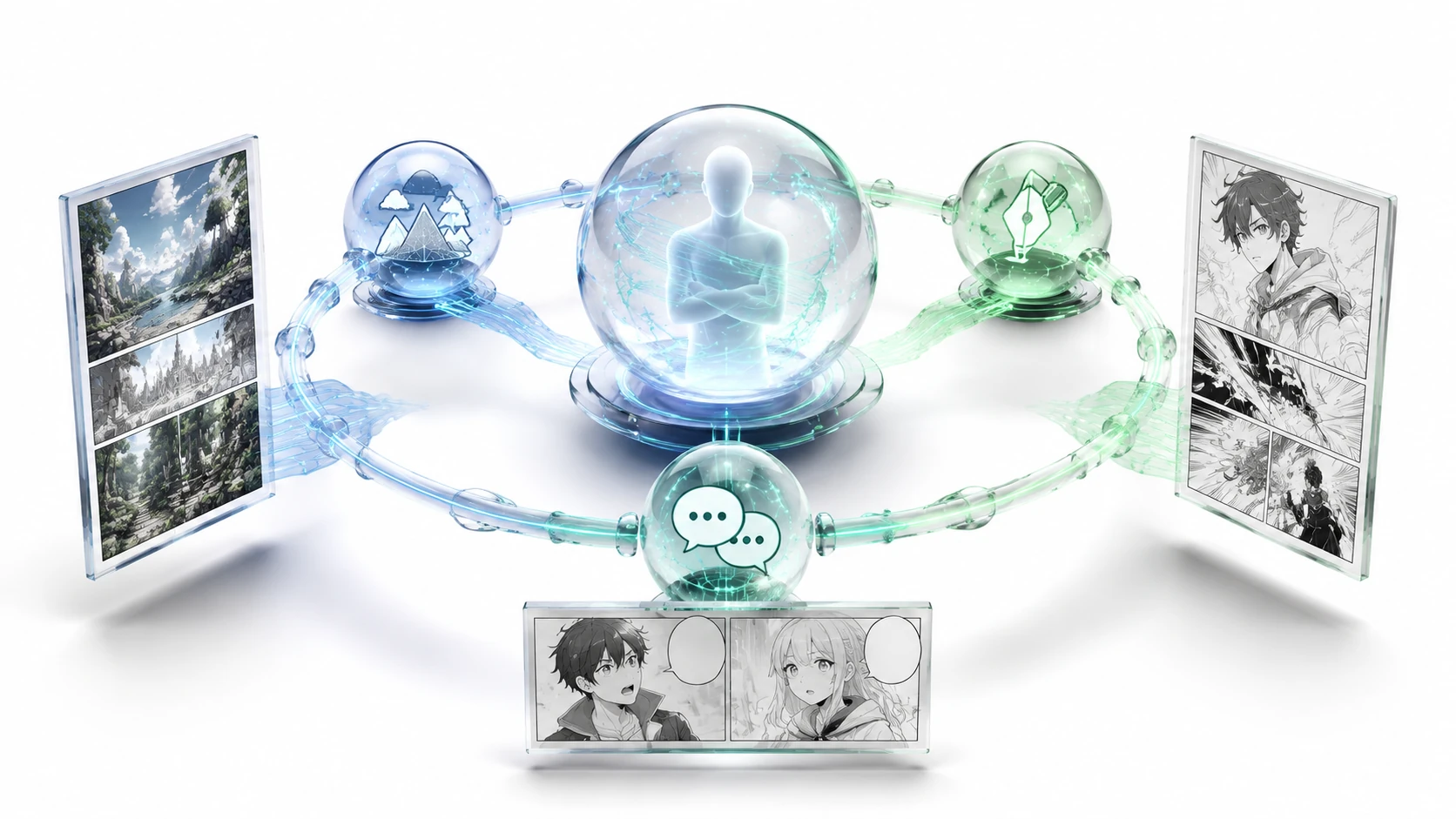
The year 2026 marks a fundamental shift in how digital comics are built. We have moved beyond the 'AI as a tool' phase into the 'AI as a workforce' era. For professional webtoon studios, the challenge is no longer about generating a single good image; it is about engineering a scalable, autonomous system capable of producing 60 to 100 panels of high-fidelity, stylistically consistent art every single week. This is where Multi-Agent Orchestration (MAO) becomes the industry standard. By breaking down the production pipeline into specialized, autonomous nodes—each dedicated to a specific task like line art, background synthesis, or narrative pacing—studios can achieve a level of output that was previously impossible without a massive human workforce.
The Architecture of a 2026 MAO Studio
At the heart of the MAO standard is the 'Manager-Worker' architecture. In this setup, a central 'Orchestrator' agent acts as the project manager. It takes the human-written script, parses it for visual cues, and delegates tasks to 'Worker Agents.' For instance, while the 'Character Consistency Agent' ensures the protagonist's facial features remain identical across 50 panels, the 'Environmental Synthesis Agent' builds the background based on the scene's location metadata. This modularity ensures that if a studio needs to change a character's outfit mid-production, they only need to update the instructions for one agent, rather than manually re-editing hundreds of files.
The Role of the Human-in-the-Loop (HITL)
In an MAO environment, the role of the creator shifts from 'illustrator' to 'Director.' The human artist remains the ultimate authority, setting the creative vision and approving the agents' work at critical checkpoints. This 'Human-in-the-Loop' (HITL) model is essential for maintaining the emotional soul of the story. While agents can handle the technical execution of light and shadow, only a human can decide if a character's expression truly captures the nuance of a heartbreak or a betrayal. The 2026 standard emphasizes that MAO is an augmentation of human creativity, not a replacement for it.
- Director: Sets the creative vision and emotional tone.
- Orchestrator: Manages task delegation and agent communication.
- Specialized Agents: Execute high-labor tasks like flatting, rendering, and background generation.
- Validation Gates: Human-led checkpoints to ensure narrative quality.
Engineering for State Persistence and Visual Lore
One of the primary technical hurdles in AI-assisted comic production has always been 'style drift'—the tendency for characters to look slightly different in every panel. The 2026 MAO framework solves this through 'State-Persistent Asset Mapping.' Every character, prop, and location is stored as a 'Lore Entity' in a central database. When the Character Agent generates a panel, it doesn't just create a new image; it 'retrieves' the mathematical map of that character and 'projects' it into the new scene. This ensures 100% visual fidelity across the entire series, a requirement for any studio looking to license their IP for anime or merchandise.
The Economic Impact: Scaling Without Burnout
The most immediate benefit of the MAO standard is the elimination of creator burnout. Historically, the webtoon industry has been plagued by grueling schedules that lead to physical and mental exhaustion. MAO takes the 'heavy lifting' off the human artist's plate. By automating the 80% of production that is repetitive—such as coloring backgrounds, cleaning line art, and formatting for different screen sizes—creators can maintain a healthy work-life balance while still meeting the high-frequency demands of modern readers. In 2026, the most successful studios are those that use technology to protect their human talent, not just to increase speed.
Future-Proofing: From MAO to Real-Time Generative Stories
Looking toward 2027, the MAO standard is evolving to support 'Responsive Narratives.' Because the production pipeline is modular and automated, studios are beginning to experiment with webtoons that change based on reader feedback in real-time. If a specific character becomes a fan favorite, the MAO system can automatically adjust the upcoming chapters to give that character more screen time, all while maintaining the core narrative integrity. This level of 'Narrative Liquidity' is only possible through the multi-agent infrastructure defined by the 2026 standard.
FAQ
What is Multi-Agent Orchestration in webtoons?
MAO is a production framework where multiple specialized AI agents (e.g., line art, color, layout) work together under human supervision to automate the creation of serialized comics.
Does MAO replace human artists?
No. MAO shifts the artist's role to 'Creative Director,' allowing them to focus on story, emotion, and art direction while agents handle repetitive rendering tasks.
How does MAO ensure character consistency?
It uses specialized 'Asset-Consistency Agents' that reference a central 'Lore Database' to ensure characters and environments look identical in every panel.
What are the technical requirements for an MAO pipeline?
A studio needs an API-first infrastructure, specialized fine-tuned models for different artistic tasks, and a central database for state-persistent asset management.