The 2026 Legacy-IP Restoration Model: Engineering Modern Growth from Classic Comic Archive
Discover how the 2026 Legacy-IP Restoration Model is allowing publishers to revitalize static archives for the mobile-first era. Learn the technical and narrative shifts required to turn classic catalogs into scalable, high-retention assets.
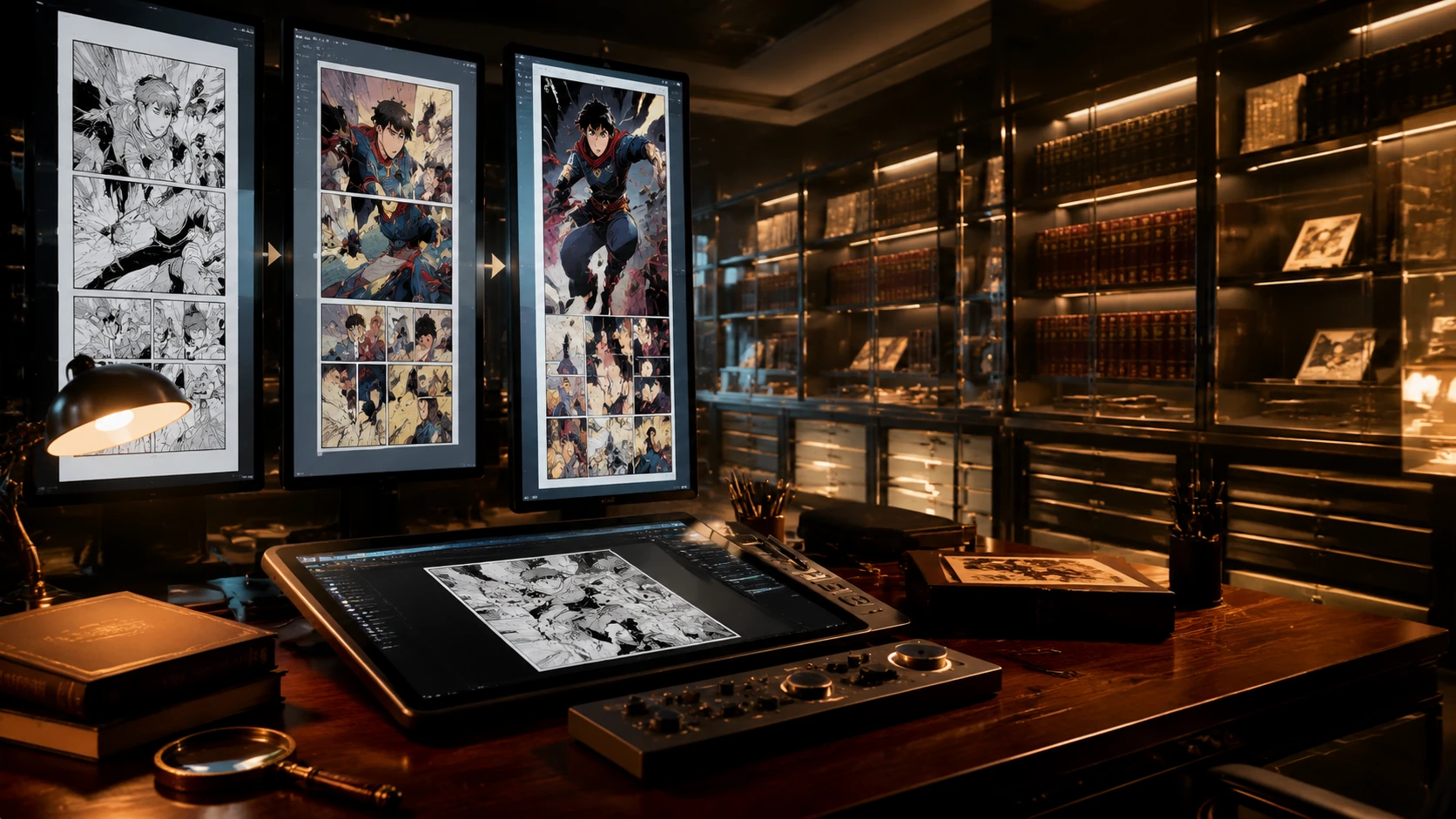
As we move through 2026, the global comic market has reached a critical saturation point with new content. In this hyper-competitive landscape, publishers and IP holders are discovering that their most valuable assets aren't necessarily new pilots, but their existing 'back-catalogs.' The 2026 Legacy-IP Restoration Model has emerged as the definitive framework for taking static, page-based archives—ranging from 20th-century manga to classic Western indies—and re-engineering them for the vertical-scroll, mobile-first generation. This isn't a simple 'slice-and-stack' operation; it is a sophisticated process of narrative and visual transcreation that respects the original intent while optimizing for 2026 reading behaviors.
The Economics of Restoration: Why Archives are Winning in 2026
The shift toward legacy restoration is driven by the 'Proven IP Premium.' In an era where algorithmic discovery is increasingly expensive, a title with existing brand recognition, a nostalgic fan base, and completed narrative arcs represents a significantly lower risk than a new serialization. By applying modern restoration standards, publishers can achieve up to 70% higher day-one retention compared to new IP launches. The model focuses on unlocking 'dormant equity'—turning assets that were previously yielding zero revenue into high-LTV digital subscriptions or premium 'Vault' collections.
Key Drivers of Archive Value
- Reduced Production Risk: The story, character designs, and world-building are already stress-tested and finalized.
- Built-in Marketing Hooks: Nostalgia acts as a powerful 'top-of-funnel' driver for both original readers and new audiences.
- Cross-Generational Appeal: High-quality restorations bridge the gap between older 'physical-first' readers and Gen Alpha mobile readers.
- Asset Liquidity: Restored vertical assets are 4x more likely to be optioned for streaming adaptations in the 2026 market.
The Restoration Framework: From Page to Scroll
Successful restoration requires a deep understanding of 'Vertical Choreography.' Traditional comic pages were designed for the Z-pattern eye movement. Vertical scrolls, however, rely on 'Temporal Gapping'—the space between panels that dictates the passage of time and emotional weight. The 2026 model breaks the restoration process into three distinct layers: Visual Deconstruction, Narrative Re-pacing, and Atmospheric Enhancement.
Layer 1: Visual Deconstruction & Re-composition
Restoration teams use AI-assisted segmentation to isolate characters, backgrounds, and SFX from original high-resolution scans. Once isolated, these elements are re-composed on an infinite canvas. This allows for 'cinematic parallax'—where a background can persist while the reader scrolls past multiple character panels, creating a sense of depth that was impossible in the original print format.
Layer 2: Narrative Re-pacing
Classic comics are often dialogue-dense, which can create 'cognitive friction' on mobile screens. The restoration model involves 'script-leaning'—judiciously editing or re-positioning word balloons to ensure the text doesn't obscure the art and fits the rapid-scroll rhythm. This often involves breaking a single dense page into 3 to 5 'scroll-beats' to maintain the 2026 dopamine-sequencing standard.
Modernizing the Aesthetic: Color and Sound
Many legacy IPs were produced with limited color palettes or in black and white. While some 'purist' editions are maintained, the most successful 2026 restorations utilize 'Adaptive Colorization.' This involves applying modern lighting scripts and gradients to classic line art, making it feel contemporary without losing the original artist's 'hand.' Furthermore, adding 'Atmospheric Layers'—subtle haptic feedback and ambient soundscapes—can turn a 30-year-old comic into an immersive 2026 experience.
Monetization Strategies for Restored IP
In 2026, the 'All-You-Can-Eat' subscription model is giving way to 'Curated Ownership' and 'Vault Access.' Publishers are using the following tiers to monetize restored archives:
- The Serialization Model: Re-releasing the restored version on a weekly 'Daily Drop' schedule to build new community habits.
- The Premium Vault: One-time purchase access to the entire restored series with high-fidelity 8K assets and behind-the-scenes 'making-of' layers.
- Phygital Bundles: Linking the digital restoration to limited-edition physical 'Legacy Prints' for high-LTV collectors.
- Lore-Gating: Using restored assets to fuel private community hubs where fans can discuss the history and future of the IP.
The 2026 Restoration Checklist for Publishers
Before initiating a restoration project, publishers must conduct a 'Technical and Legal Audit' to ensure the IP is ready for the 2026 ecosystem. This includes verifying digital rights for vertical distribution and ensuring the original source files (or physical masters) are of sufficient quality for AI-enhanced upscaling.
- Rights Clearance: Ensure 'derivative digital works' and 'vertical formatting' are covered in original creator contracts.
- Source Integrity: Audit the DPI and color depth of existing archives; identify panels that require heavy manual redrawing.
- Market Fit: Analyze current 'Emotional Resonance' trends to see if the legacy theme aligns with 2026 reader intent.
- Platform Compatibility: Ensure the restored files meet the 2026 Responsive Canvas Standard (RCS) for multi-device delivery.
By following the 2026 Legacy-IP Restoration Model, publishers can move beyond the 'new release' treadmill and build a sustainable, high-margin business on the foundations of comic history. The goal is to treat these archives not as static relics, but as living narratives capable of dominating the modern digital stage.
FAQ
Does vertical restoration hurt the artistic integrity of the original comic?
When done correctly using the 2026 model, restoration enhances integrity by using technology to fulfill the artist's original narrative pacing, which was often limited by physical page counts and printing costs.
How long does a typical restoration take?
With 2026 AI-assisted segmentation and re-choreography tools, a standard 20-page classic comic can be fully restored for vertical scroll in approximately 3-5 days by a specialized boutique team.
Can black and white manga be restored to color?
Yes, 'Adaptive Colorization' is a major trend in 2026, though many publishers offer a 'Classic B&W' toggle to satisfy different reader preferences while using modern lighting effects.