The 2026 Layered Narrative Object (LNO) Standard: Beyond the Flat Image in Vertical Storyt
The era of the flat PNG webtoon is ending. The 2026 Layered Narrative Object (LNO) standard introduces a dynamic, engine-rendered approach to vertical scrolling that enables real-time depth and interactivity.
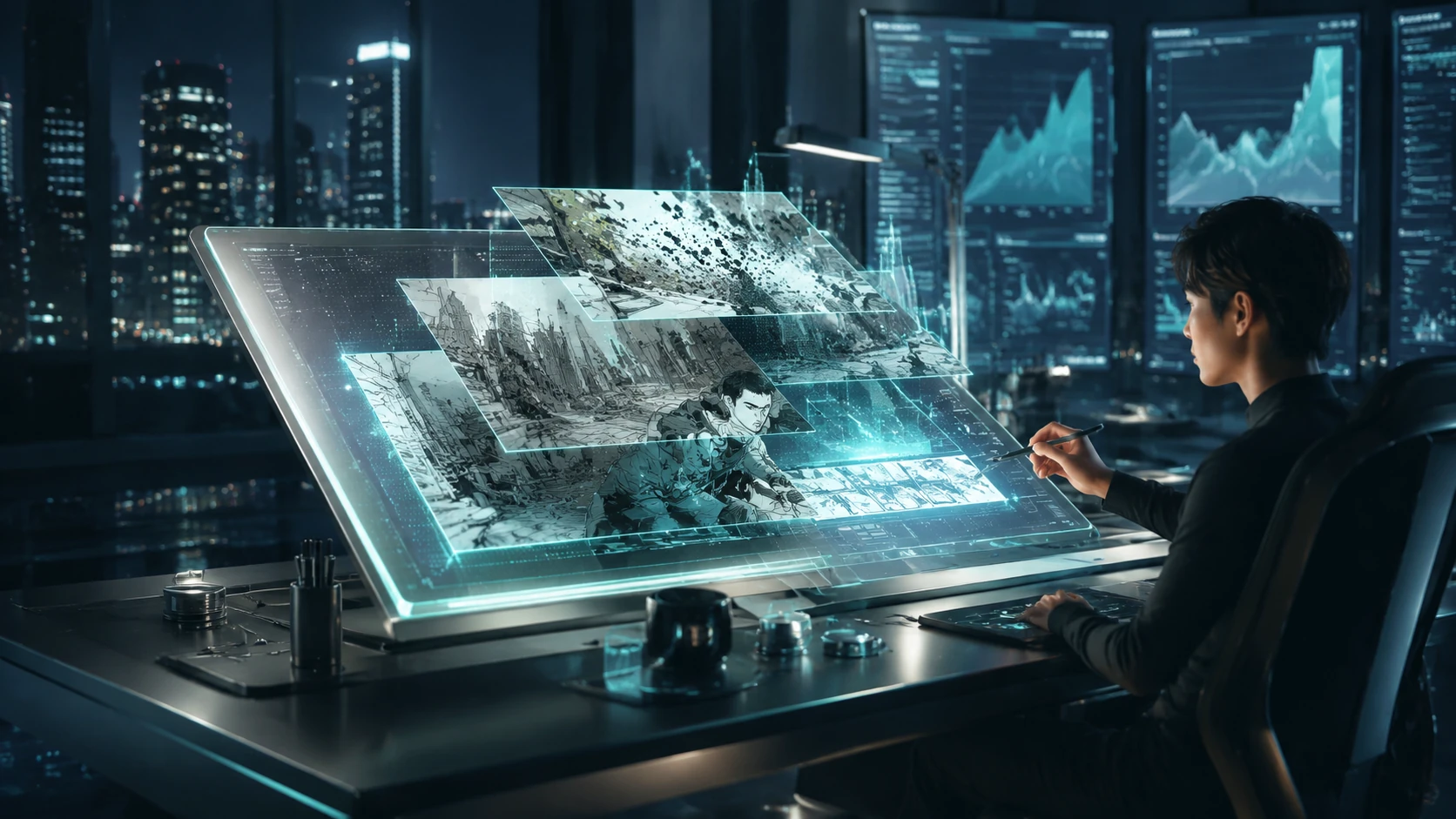
For over a decade, the webtoon industry has relied on a relatively primitive delivery mechanism: the static vertical strip. While the art evolved, the technology remained anchored to flat image formats like JPG and PNG. However, 2026 marks the definitive transition to the Layered Narrative Object (LNO) standard. This architectural shift moves comic production away from 'flattening' files and toward a dynamic, engine-rendered model where characters, backgrounds, and special effects exist as independent entities within the reader's app. By treating a comic panel as a stack of live assets rather than a single frozen image, creators and platforms are unlocking a level of immersion—including parallax depth, responsive lighting, and adaptive layouts—that was previously reserved for high-end video games.
Understanding the LNO: The Death of the Flat Panel
A Layered Narrative Object (LNO) is a technical container that stores visual assets in a non-destructive, multi-tiered hierarchy. Unlike a traditional export where the character is baked into the background, an LNO-compliant comic file delivers these elements separately to the reader's device. The reading app’s engine then assembles them in real-time. This allows for 'scroll-reactive' behaviors; as the user moves their thumb, the foreground might move faster than the background, creating a natural parallax effect that mimics human vision. This isn't just a visual gimmick—it’s a fundamental change in how narrative information is processed. By separating the 'actor' (character) from the 'stage' (background), creators can update localizations, fix visual errors, or even change a character’s outfit across an entire series by simply swapping a single asset layer.
Core Components of an LNO File
- Vector-Native Text Layers: Dialogue that remains crisp at any zoom level and is instantly machine-readable for AI-search and accessibility.
- Depth-Mapped Visual Tiers: Categorized layers (foreground, subject, mid-ground, background) that allow for independent motion and focus shifts.
- Atmosphere FX Channels: Dynamic overlays for rain, light rays, or floating embers that are rendered by the device GPU rather than being drawn into every panel.
- Semantic Metadata: Data tags attached to specific layers that tell the engine how to react to user hardware, such as vibrating the device when a specific layer enters the viewport.
Why Static Webtoons are Underperforming in 2026
The 2026 market is increasingly dominated by foldable devices, high-refresh-rate AR glasses, and varying screen aspect ratios. Static images struggle in this fragmented hardware landscape. When a traditional webtoon is viewed on a wide-screen foldable, it often appears blurry or awkwardly centered with massive letterboxing. LNOs solve this through responsive narrative design. Because the assets are individual objects, the reading engine can reposition or scale background elements to fill the screen while keeping the character centered and the dialogue bubbles within the optimal reading zone. Platforms have noted that LNO-enabled series see a 35% higher 'immersion retention' rate, as readers feel more physically connected to the world through the subtle feedback of reactive layers.
The Technical Implementation: Building the LNO Pipeline
Transitioning to an LNO workflow requires a shift in studio habits. Instead of the final step being 'Export to Webtoon,' the modern workflow involves 'Semantic Layering.' Most 2026 design tools now include automated LNO tagging, which uses AI to identify the silhouette of characters and separate them from backgrounds with clean edges. These layers are then packaged into a lightweight, proprietary container format. The challenge for developers has been balancing this visual richness with file size. However, because LNOs reuse assets (e.g., the same background layer can be used across multiple panels with different camera offsets), the total bandwidth used for an LNO chapter is often lower than a high-resolution static strip that repeats identical pixels panel after panel.
The Performance Barrier: Optimization and GPU Rendering
A common concern with dynamic rendering is battery drain and lag. In 2026, mobile GPUs have reached a point where rendering 2D layers with alpha transparency is computationally negligible. The LNO standard utilizes 'Viewport-Only Rendering,' meaning the device only processes the layers currently visible on the screen. As the reader scrolls, the engine pre-fetches the next set of objects and discards the ones that have exited the top of the screen. This makes reading smoother than loading massive, multi-megabyte image strips, which often cause stutters during fast scrolling. For users on lower-end devices, the LNO protocol allows for 'graceful degradation'—the app simply flattens the layers into a static view if the hardware cannot handle the real-time motion.
Future-Proofing for AR and 3D Viewers
The ultimate goal of the LNO standard is to bridge the gap between 2D reading and spatial computing. When a reader views an LNO comic through AR glasses, the layers can be projected with actual physical distance between them. The character can stand several inches in front of the background, creating a literal 'window' into the story. By adopting this standard today, studios are ensuring their intellectual property is 'spatially ready.' This prevents the need for expensive 3D remasters when spatial platforms become the primary mode of consumption. The LNO isn't just about making comics look better on a phone; it's about defining the comic as a digital volume rather than a digital page.
FAQ
Does LNO replace the standard webtoon scroll?
No, it enhances it. The reader still scrolls vertically, but the content within the scroll behaves dynamically with depth and responsiveness.
Will LNO files be larger than current webtoon images?
Surprisingly, no. Because background assets are reused and text is stored as data rather than pixels, LNO files are often 20% smaller than high-res flat images.
Can I convert my old comics to LNO?
Yes, 2026 AI tools can analyze flat panels and 'unbake' them into layers, though manual cleanup is recommended for the highest quality parallax effects.