The 2026 Latent-Space Sculpting Workflow: Moving Beyond Prompts for Professional Comic Con
In 2026, the era of 'prompt engineering' is fading, replaced by direct latent-space sculpting. This technical shift allows professional comic creators to maintain absolute character and background consistency across hundreds of panels with surgical precision.
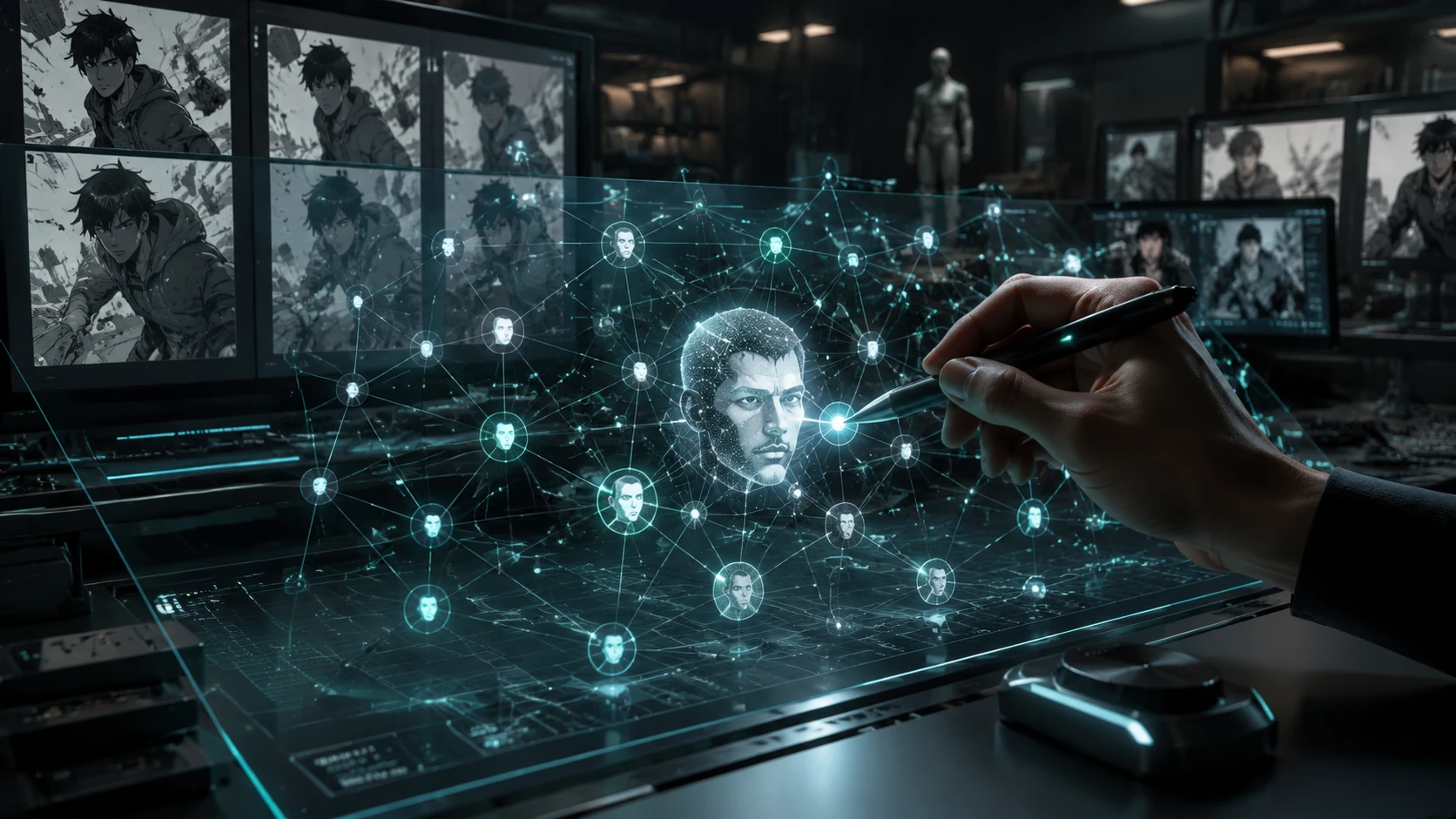
By early 2026, the comic industry has largely moved past the 'prompt-and-pray' era of generative AI. While natural language prompts were a revolutionary entry point, they proved insufficient for the rigorous demands of professional serialization, where a character must remain visually identical across 80+ chapters and thousands of distinct camera angles. The solution that has emerged as the industry standard is Latent-Space Sculpting (LSS). This workflow bypasses the unpredictability of text-to-image models, instead allowing creators to interact directly with the mathematical coordinates of a model's latent space to 'lock' character identities and environmental assets with surgical precision. For studios, this shift represents the transition from AI as a toy to AI as a high-fidelity production instrument.
What is Latent-Space Sculpting?
Latent-Space Sculpting is a technical workflow that utilizes spatial and mathematical anchors rather than linguistic descriptions. In traditional generative AI, a creator might type 'protagonist with blue hair and a scar.' In 2026, a professional artist uses a 'Latent Anchor'—a specific, saved coordinate within the AI's multidimensional map. By 'sculpting' around this anchor, the creator can manipulate lighting, pose, and expression without ever risking a change to the fundamental geometry of the character’s face or the specific texture of their clothing. This provides a level of control equivalent to traditional 3D modeling but with the speed and stylistic richness of high-end 2D painting.
The Shift from Words to Coordinates
The fundamental flaw of text prompts is 'semantic drift.' A word like 'angry' can be interpreted in a million ways by a model depending on the surrounding tokens. LSS replaces these tokens with 'Vector-Driven Positional Encoding.' This means the AI isn't guessing what you want; it is following a precise map of visual weights that the studio has pre-validated. This allows for 'Reference-Free' generation, where the model no longer needs a heavy library of training images for every new pose, as it already understands the character's 'Identity Node' within the latent space.
Solving the Character Drift Problem in Serialization
The greatest challenge in the webtoon and manga markets has always been the '100-Chapter Test.' Maintaining the exact slope of a jawline or the specific pattern of an iris over years of production is grueling for human artists and nearly impossible for standard AI. LSS solves this through 'Identity Anchoring.' By isolating the specific dimensions in the latent space that govern a character's unique features, studios can 'freeze' those dimensions while leaving others—like limbs, lighting, and background—entirely fluid and generative.
- Identity Locking: Freezing the Z-axis coordinates of facial geometry.
- Weight Painting: Manually increasing the 'influence' of specific character traits over the background.
- Latent Interpolation: Smoothly transitioning between two known 'Identity Nodes' to create perfect movement and emotion without distortion.
- Asset Decoupling: Separating the character's latent data from the environment data to allow for 360-degree background rotation.
The 2026 Technical Stack: Tools of the Trade
Modern studios are moving away from browser-based AI interfaces toward 'Direct-Link' plugins integrated into professional software like Clip Studio Paint and Photoshop 2026. These tools feature 'Latent Sliders' and 'Spatial Brushes.' Instead of typing, an artist might use a brush to 'paint' a specific character identity into a rough storyboard sketch. The AI then fills in the details, respecting the latent anchors assigned to that specific brush. This 'Human-in-the-Loop' approach ensures that the artistic soul and direction remain with the human creator, while the AI handles the heavy lifting of rendering and consistency.
Implementation: Transitioning Your Studio to LSS
Transitioning to a latent-space sculpting workflow requires a shift in how assets are managed. Rather than a folder of PNG character sheets, a 2026 studio manages a 'Latent Library.' Each character is a small metadata file containing their specific coordinates and weight biases. When starting a new chapter, the lead artist loads these 'Identity Anchors' into the production environment, ensuring that every assistant and AI-assisted station is pulling from the exact same visual DNA. This reduces the time spent on 'Model Checking'—the process of correcting character off-models—by nearly 90%.
Common Pitfalls to Avoid
The most common mistake is 'Over-Weighting.' If an Identity Anchor is pushed too hard, the character becomes stiff and unable to show a full range of emotion. The key to successful LSS is 'Elasticity'—knowing which latent dimensions must remain locked and which must remain flexible to allow for the 'squash and stretch' necessary for dynamic visual storytelling. Another pitfall is 'Latent Pollution,' where data from the environment begins to bleed into the character's identity coordinates, often solved by using multi-layer latent masking.
FAQ
Is latent-space sculpting harder than prompting?
It requires more technical knowledge of how AI models work, but it is significantly more reliable. It replaces the 'luck' of prompting with the 'precision' of digital sculpting.
Do I need a special GPU for LSS?
By 2026, most LSS workflows are optimized for local high-end consumer GPUs or dedicated cloud-rendering pipelines that integrate directly with drawing software.
Can LSS be used for different art styles?
Yes. LSS is style-agnostic. It works by anchoring the geometry and features, whether the final render is a flat-color webtoon, a detailed manga, or a cinematic painted style.