The 2026 IP Packaging Masterclass: A Case Study in the ‘Lore-First’ Series Acquisition
Discover the blueprint for high-value comic acquisitions in 2026. This case study breaks down how to package lore-dense IP for streaming and gaming conglomerates.
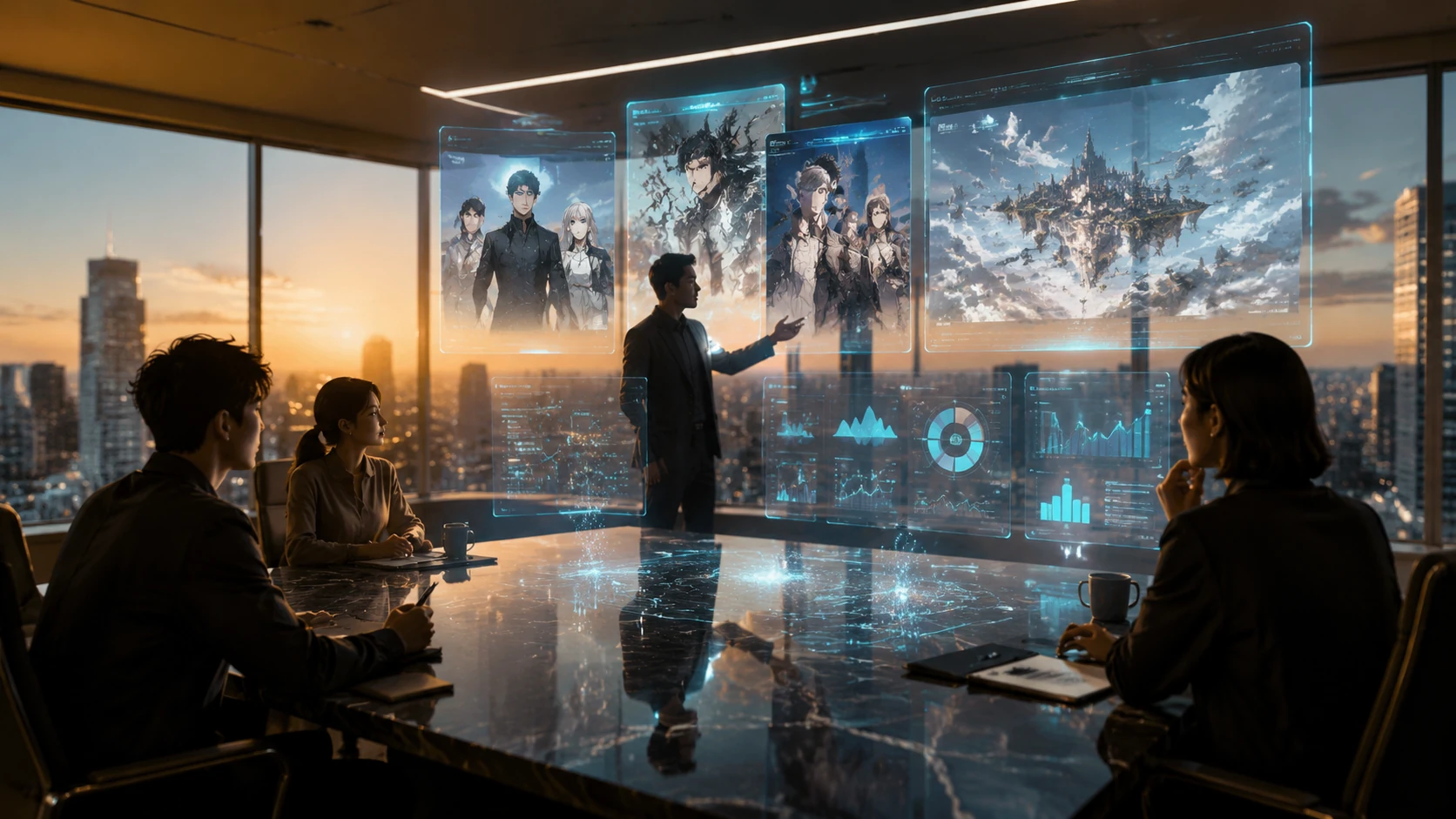
By 2026, the landscape for comic and webtoon acquisitions has shifted from a search for 'the next hit visual' to a rigorous hunt for 'the next sustainable narrative ecosystem.' Media conglomerates and venture-backed studios are no longer satisfied with high follower counts alone; they require IP that is 'packaged' for cross-media elasticity. This case study examines the success of Studio Nebula, a boutique independent studio that secured a $12M multi-platform acquisition for their series 'The Aether-Bound' by utilizing a Lore-First strategy. This approach moved away from traditional pitch decks and toward a Narrative Proof-of-Concept (NPoC) that treated the story as a modular data asset rather than a static comic book. For creators and studios looking to exit or scale in the 2026 market, understanding this shift in packaging is the difference between a standard royalty deal and a high-multiple IP acquisition.
The Challenge: Breaking Through the 'Saturation Ceiling'
In early 2025, Studio Nebula faced a common problem: their flagship series had strong engagement but was competing against thousands of AI-assisted releases on major platforms. Traditional publishers were offering standard serialization contracts, but the studio sought a Tier-1 acquisition that included gaming and animation rights. The 'Saturation Ceiling' of 2026 means that visual quality is now a baseline, not a differentiator. To break through, Nebula had to prove that 'The Aether-Bound' was more than just a successful scroll; it was a lore-governed universe with 'narrative gravity'—the ability to pull readers into secondary and tertiary spending tiers.
The Pivot to Narrative Proof-of-Concept (NPoC)
Instead of pitching with a 10-page script and a character sheet, Nebula spent six months building a Semantic Lore Graph. This digital framework mapped every character relationship, magical law, and historical event within the story world. By presenting the IP as a structured database, they demonstrated to potential buyers that the world was already 'pre-engineered' for adaptation into an RPG or a streaming series without the need for expensive lore-reconstruction by third-party writers.
The Lore-First Packaging Strategy
Nebula’s strategy was built on three distinct pillars that have since become the 2026 standard for IP packaging. These pillars ensure that the IP is 'de-risked' for investors who are wary of the high churn rates associated with traditional webtoon serialization. By focusing on the structural integrity of the narrative, Nebula was able to justify a valuation 3x higher than the industry average for their genre.
- **Modular World-Building:** Every asset was designed to be platform-agnostic. Backgrounds were rendered in 8K vector formats, and character 'logic' was documented in a way that game designers could immediately translate into NPC behavior.
- **Sentiment-Validated Arcs:** Using 2026 AI-driven sentiment analysis, Nebula provided data showing exactly which plot points triggered the highest 'emotional resonance' (ERI) in their readers. This proved the story's market fit before a single frame of animation was drawn.
- **Trans-Media Hook Points:** The comic included 'lore-gated' clues that pointed to a potential AR experience, showing investors a clear roadmap for secondary revenue streams.
The Role of Narrative Integrity
A critical component of the deal was the Narrative Integrity Audit. Studio Nebula hired a third-party 'Lore Architect' to stress-test their world-building for plot holes and logical inconsistencies. For the acquiring party—a global streaming giant—this audit was the final 'green light.' It signaled that the IP was mature, stable, and ready for a $50M production budget without the risk of narrative collapse mid-season.
The Playbook: How to Package Your IP for 2026 Acquisition
If you are an independent creator or a small studio aiming for a major media deal, the 'Project Chronos' playbook provides a clear set of steps to elevate your IP from a simple comic to a high-value narrative asset. The focus must be on 'Asset Liquidity'—how easily your story can move between formats.
The successful acquisition of Studio Nebula’s IP was not an accident of 'going viral.' It was the result of meticulous packaging that aligned with the 2026 industry demand for de-risked, data-backed storytelling. By treating their webtoon as the 'marketing funnel' for a larger narrative ecosystem, they transformed their creative work into a high-yield financial asset.
FAQ
What is a Lore-First pitch deck?
A Lore-First pitch deck focuses on the structural rules, systems, and data-backed engagement of a story world rather than just plot summaries, making it easier for investors to see adaptation potential.
How do I prove my comic has 'narrative resonance'?
In 2026, creators use Narrative Resonance Index (NRI) tools to track reader sentiment, scroll-depth, and re-read rates on specific emotional beats to provide quantitative proof of story impact.
Why are studios moving away from 'art-first' packaging?
With high-quality visuals becoming more accessible through AI, the true value of IP has shifted to the uniqueness and structural integrity of the lore, which cannot be easily replicated.