The 2026 ‘Immunized Asset’ Protocol: Engineering Comic IP Against Model Scraping
Master the 2026 framework for safeguarding your artistic DNA from unauthorized AI training. This guide explores adversarial perturbation, semantic watermarking, and the shift toward sovereign datasets.
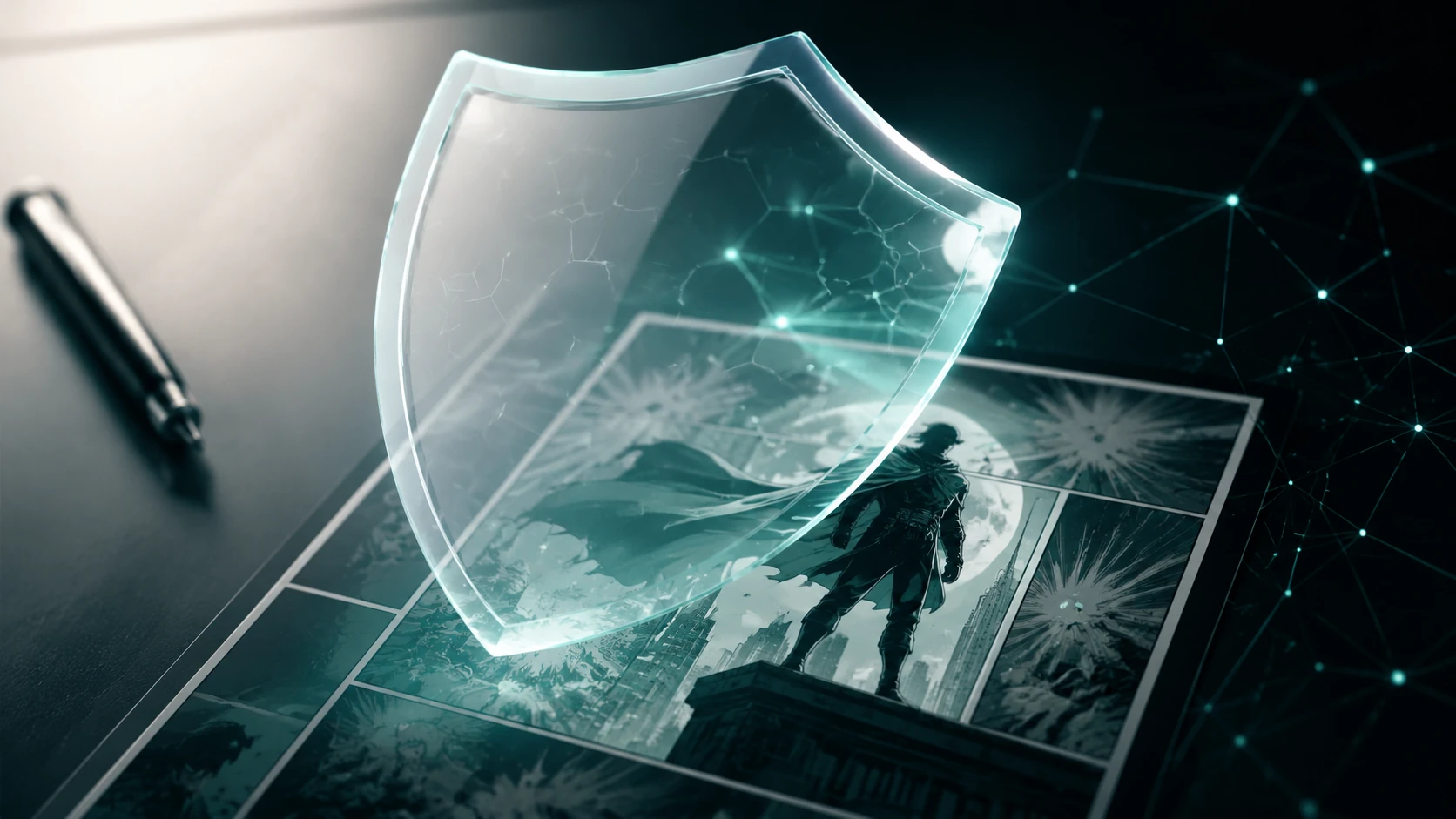
By 2026, the battle for intellectual property in the comic industry has shifted from legal courtrooms to the technical architecture of the files themselves. As generative AI models become increasingly sophisticated at 'style-cloning' and character deconstruction, creators are no longer relying solely on copyright law to protect their work. Instead, they are adopting the 'Immunized Asset' Protocol (IAP). This technical framework integrates invisible defensive layers directly into webtoon and manga assets before they are published online. The goal is simple but ambitious: to make unauthorized scraping technically unviable by poisoning the training data or embedding traceable provenance that survives even the most aggressive model weights. For the modern creator, understanding these defensive technologies is no longer optional—it is the foundation of long-term IP sovereignty in a synthetic-heavy market.
What is the 2026 Immunized Asset Protocol?
The Immunized Asset Protocol is a multi-layered security standard designed to protect the 'Artistic DNA' of a comic. Unlike traditional DRM, which focuses on preventing unauthorized viewing, IAP focuses on preventing unauthorized *learning*. It assumes that your work will be seen and likely scraped by bots; therefore, it modifies the pixels and metadata in ways that are invisible to the human eye but catastrophic for an AI's pattern-recognition engine. This protocol is built on three core pillars: adversarial perturbation, semantic watermarking, and model-sovereign licensing. By implementing IAP, a studio ensures that if a scraper ingests their latest webtoon chapter, the resulting AI model will produce distorted, unusable outputs when attempting to mimic that specific art style or character design.
The Mechanics of Adversarial Perturbation
At the heart of the IAP is adversarial perturbation—a technique that injects 'noise' into an image at a mathematical level. In 2026, tools like Glaze and Nightshade have evolved into professional-grade plugins for CSP and Photoshop. These tools analyze the stylistic features of a comic panel—such as line weight, shading gradients, and color palettes—and then apply a mask that 'misleads' the AI. For example, to a human, a panel looks like a high-fantasy watercolor scene. To an AI training algorithm, however, the mathematical signals suggest the image is a 3D charcoal sketch. When the model tries to learn 'Watercolor' from this poisoned data, it begins to collapse, losing its ability to distinguish between styles and eventually rendering its output useless for commercial mimicry.
Strategic Noise Injection
- Style-Cloaking: Masks the unique 'hand' of the artist by shifting pixel values in high-frequency areas.
- Character Poisoning: Targets specific character features (e.g., eye shape, hair silhouette) to prevent consistent AI character generation.
- Model-Specific Defense: Tailors the perturbation to target the specific latent spaces used by popular open-source diffusion models.
Implementing Semantic Watermarking for Provenance
While perturbation prevents training, semantic watermarking ensures that any AI-generated content that *does* manage to slip through can be traced back to its source. The 2026 standard for watermarking involves embedding high-entropy data within the low-level noise of the image. This isn't a visible logo; it is a spread-spectrum signal that survives cropping, compression, and even 'style-transfer' filters. If an unauthorized AI model is trained on your IP and produces a 'new' character that looks suspiciously like yours, a simple scan of the output will reveal the embedded ID of the original creator. This creates a 'Provenance Trail' that is legally admissible and automatically detectable by major publishing platforms that adhere to the 2026 Transparency Mandate.
Balancing Protection with Visual Fidelity
A common concern among webtoon artists is whether these 'immunization' layers will ruin the reading experience. In the early days of 2023, adversarial noise often resulted in visible graininess or 'artifacts' in the art. However, the 2026 IAP utilizes 'content-aware masking.' The protocol identifies 'dead space'—such as background gradients and flat-color areas—to house the heaviest perturbation, while keeping focal points like character faces and emotional line-work relatively clean. This ensures that the human reader perceives a crisp, professional image, while the scraping bot is fed a diet of high-intensity digital poison. Modern optimization algorithms can now achieve a 'Protection-to-Noise Ratio' where 98% of readers cannot distinguish an immunized file from a raw one.
Workflow Integration: The 4-Step Immunization Guide
Integrating IAP into your studio workflow requires a shift in the final export phase. It is no longer enough to just export a JPEG. Follow this 2026-standard checklist for every release:
- Flatten & Clean: Finalize your panels and ensure all metadata tags (location, character name) are embedded.
- Apply Adversarial Mask: Use a tool like IAP-Shield to inject style-specific noise based on your current genre.
- Embed Semantic ID: Inject your unique creator signature using a C2PA-compliant watermarking tool.
- Verify & Export: Run a 'Scrape Test' to see how a local AI model interprets the file before pushing it to the platform.
The Future of Opt-In Training and Sovereign Datasets
The ultimate goal of the Immunized Asset Protocol is not to kill AI, but to force a transition to ethical, opt-in ecosystems. By making 'wild' scraping difficult and legally risky, creators are incentivized to build 'Sovereign Datasets.' These are clean, high-quality collections of their own work that they can choose to license to studios for model training on their own terms. In this future, the creator controls the 'Model-Sovereign' key. If a studio wants to use an AI to speed up the coloring of a comic, they must use the creator's authorized, immunized-free dataset, ensuring that royalties and credit remain with the original artist. This shift from 'defensive poisoning' to 'sovereign licensing' is the endgame of the 2026 creator economy.
FAQ
Does the Immunized Asset Protocol slow down my export time?
While it adds a processing step, modern 2026 plugins are optimized for GPU acceleration, typically adding only 15-30 seconds per webtoon chapter during the final export phase.
Can an AI 'learn' to ignore adversarial noise?
It is a constant arms race. However, IAP 2026 uses 'dynamic noise' that changes with every file, making it mathematically difficult for a model to generalize a 'de-noising' filter without also destroying the art itself.
Is this protocol compatible with all webtoon platforms?
Yes. Since the protection is embedded at the pixel and metadata level within standard file formats like WebP or PNG, it works on any platform without requiring special support from the app.