The 2026 ‘Hyper-Serial’ (HS) Production Framework: Engineering Daily-Release Webtoons for the High-Frequency Attention Economy
Transition from weekly to daily serialization with the 2026 Hyper-Serial (HS) framework. Learn to engineer high-frequency webtoon releases that capture the modern attention economy without creator burnout.
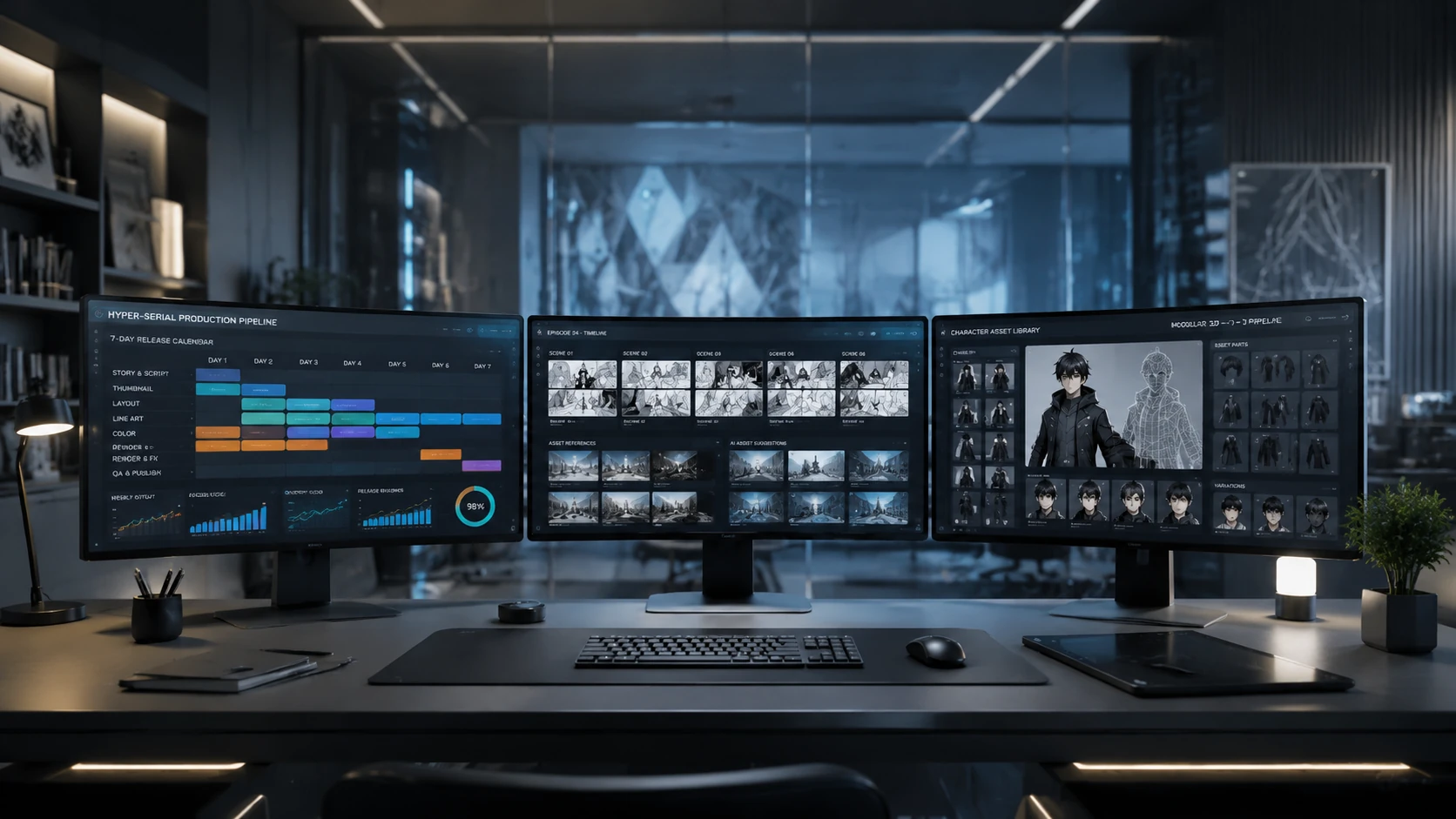
The digital comic landscape of 2026 has undergone a fundamental shift in how readers consume content. The 'weekly appointment' model, which dominated the early 2020s, is being rapidly replaced by high-frequency, daily-release habits driven by the short-form attention economy. For creators and studios, this means that the speed of discovery is now directly tied to the frequency of publication. AI-driven recommendation engines across platforms like COMICLS and major social aggregators now prioritize 'active signals'—fresh content that appears in a user’s feed every 24 hours. To survive and thrive in this environment, creators must adopt the Hyper-Serial (HS) Production Framework, a methodology designed to engineer webtoons for daily release without compromising visual quality or creator well-being.
The Mechanics of Daily Frequency
The HS framework is built on the principle of 'Narrative Chunking.' Instead of producing a single 60-panel chapter once a week, the content is broken down into six daily 'beats' of 10-12 panels each, with the seventh day reserved for a weekly recap or community engagement. This approach serves two purposes: it keeps the IP perpetually at the top of the 'New' and 'Updated' lists, and it integrates the story into the reader's daily digital ritual. In 2026, the most successful webtoons are those that become a morning coffee or commute habit. This level of intimacy is only achievable through daily touchpoints.
Modular Asset Engineering
The only way to sustain a daily release is to move away from bespoke, from-scratch drawing for every panel. The HS framework utilizes 'Modular Asset Engineering,' where characters, environments, and even complex emotional expressions are treated as reusable, high-fidelity components. By using 3D-to-2D workflows and Layer-Semantic File Standards (LSFS), a creator can assemble a panel’s core composition in minutes. This allows the human artist to focus on the 'acting'—the specific nuances of facial expression and lighting that drive emotional resonance—while the repetitive elements are handled by the asset library.
AI-Hybrid Workflow Integration
In 2026, AI is no longer a replacement for the artist but a critical member of the production pipeline. The HS framework integrates AI at the 'Inking' and 'Flatting' stages. Using models trained specifically on the creator’s own verified art style (the Narrative-Chain Provenance Standard), the AI can take a rough layout sketch and generate clean, inked lines that match the series' aesthetic perfectly. This automation reduces the 'grunt work' of production by over 50%, enabling a small team to produce high-quality daily beats that would have previously required a massive studio staff.
- Use private AI models trained on your own IP to ensure visual consistency.
- Automate environmental lighting using contextual metadata tags.
- Reserve human effort for 'Hero Panels' that define the chapter's emotional peak.
- Implement automated quality-control checks for character height and color consistency.
Sustainability and Burnout Prevention
The biggest risk of the Hyper-Serial model is creator burnout. The HS framework solves this through the 'Content Reservoir' strategy. Before launching a daily series, a creator must have a 30-day buffer of completed beats. The production schedule is then set to a '12-for-10' pace—producing 12 days of content every 10 days. This slowly grows the buffer, providing the creator with 'Rest Windows' where they can step away from the project for weeks at a time without the daily release schedule being interrupted. In 2026, consistency is the ultimate search signal; a break in the daily chain can lead to a 40% drop in algorithmic visibility.
The Economic Advantage of High Frequency
Financially, the HS model outperforms the weekly model by increasing the number of 'conversion events.' Each daily drop is an opportunity for a 'Fast-Pass' purchase or a micro-transaction. Readers in 2026 are more willing to pay a few cents daily than to commit to a large monthly subscription for a single series. This micro-transactional volume, combined with the higher retention rates of daily habits, results in a significantly higher Average Revenue Per User (ARPU). Furthermore, the constant presence of the IP makes it a more attractive target for 'Phygital' merchandising and cross-media licensing, as the audience is perpetually engaged and active.
FAQ
How many panels are required for a daily webtoon in 2026?
The HS standard recommends 8 to 15 panels per daily beat. This provides enough narrative movement to satisfy the reader while remaining manageable for a 24-hour production cycle.
Does daily serialization hurt the quality of the art?
Not if the Modular Asset Engineering (MAE) framework is used. MAE ensures that high-fidelity assets are reused, allowing the creator to maintain 'Hero Panel' quality across the entire series.
What is the best way to prevent burnout in a daily schedule?
Build a 30-day 'Content Reservoir' before launching and follow the 12-4-2 production cycle to ensure you are always producing more than you release.