The 2026 Hybrid-Format Architecture: Engineering IP for Simultaneous Scroll and Print Succ
In 2026, the divide between vertical webtoons and traditional manga pages has collapsed. Master the hybrid-format architecture to ensure your IP scales across every medium without costly redesigns.
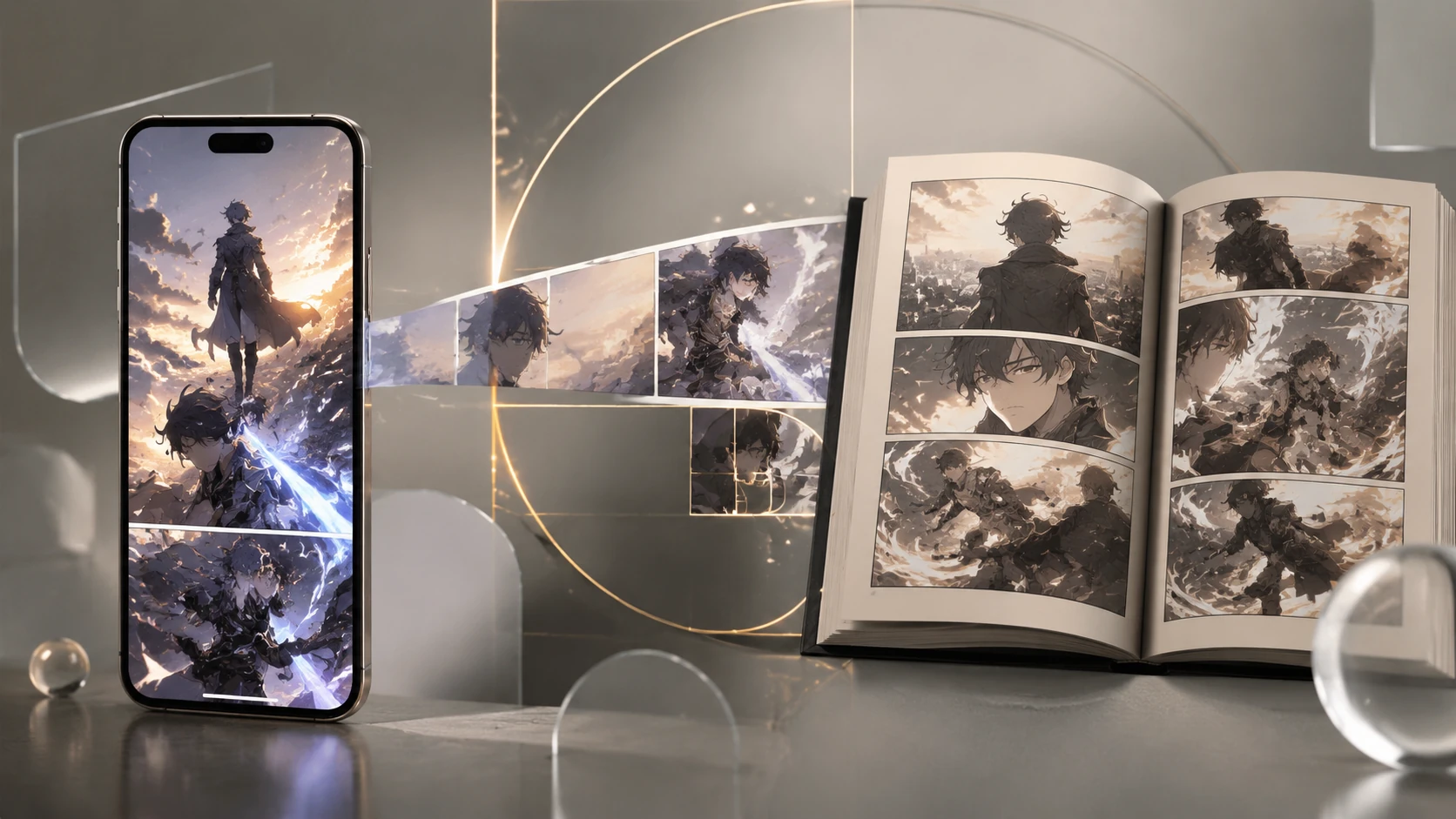
By 2026, the 'format war' between vertical-scroll webtoons and traditional paginated manga has officially ended. Intellectual Property (IP) is no longer platform-dependent; it is format-fluid. Leading studios and independent creators have moved away from the 'adaptation' model—where a webtoon is clumsily chopped up for print years later—and toward a 'Hybrid-Format Architecture.' This approach involves engineering the visual narrative from day one to exist simultaneously in both the infinite scroll and the physical book. This shift is driven by the 2026 market reality: readers demand premium physical editions of their favorite digital series, and platforms now prioritize 'Print-Ready' digital assets to maximize secondary licensing revenue. Understanding the technical foundations of this hybrid workflow is no longer optional for creators looking to scale.
The Master-Canvas Strategy: Designing for Universal Ratios
The core of Hybrid-Format Architecture is the 'Master-Canvas'—a production environment that uses a modular grid system capable of satisfying both the 800px-1200px width of mobile devices and the standard B4 or A5 dimensions of print. Instead of drawing in a single long strip, creators are now utilizing 'Narrative Blocks.' These blocks are self-contained visual units that maintain their internal composition regardless of the surrounding white space. In 2026, software tools have automated the 'stitching' process, but the human architect must still define the 'Safe Zone' where critical action and dialogue reside.
- Dynamic Gutter Management: Using variable-width gutters that can expand for vertical pacing or contract for dense page layouts.
- The 1.6:1 Anchor: Designing key panels with a 1.6:1 aspect ratio, which fits comfortably within a phone's viewport and a standard manga tier.
- Asset-Decoupling: Keeping characters, speech bubbles, and backgrounds on separate, high-resolution layers to allow for non-destructive reconfiguration.
Solving the 'Pacing Paradox' Between Scroll and Turn
The greatest challenge in hybrid engineering is not the resolution, but the psychology of the reader. Vertical scrolling relies on 'temporal delay'—the time it takes to move the thumb—while print relies on 'spatial discovery'—how the eye scans a static page. The 2026 Hybrid Standard solves this through 'Secondary Compositional Anchors.' These are visual elements (like a character's cape or a beam of light) that serve as vertical connectors in a webtoon but act as frame-breaking 'power panels' in a book spread.
The Transition Point Audit
Successful hybrid creators conduct a 'Transition Audit' every 10 panels. They ask: if this sequence is placed on a right-hand page, does the cliffhanger land before the turn? In 2026, AI-assisted layout engines can simulate this, but the creator must ensure that 'Scroll Fatigue' and 'Page Clutter' are avoided by maintaining a consistent information density (NID) across both formats.
Semantic Lettering and Resolution-Independent Typography
In the hybrid era, lettering is no longer 'burned' into the art. 2026 standards require semantic lettering layers that use vector-based typography. This allows for 'Responsive Text': speech bubbles that automatically resize based on the container (phone screen vs. print page). This technology prevents the 'tiny text' syndrome often seen in poorly converted webtoons. By using a centralized Lore-Graph and XML-based dialogue tags, creators can update a single script file and have it reflect across both the digital scroll and the print-ready PDF instantly.
Common Pitfalls in Hybrid Engineering
The most frequent mistake in 2026 is 'Over-Verticalization.' This happens when a creator uses too many 'transition panels'—empty space or repetitive background assets intended to build tension in a scroll. When these are compressed for print, they become wasted page real estate, driving up printing costs without adding narrative value. Conversely, 'Over-Clustering'—cramming too much detail into a single block—makes the webtoon version feel claustrophobic on small mobile screens. The goal is 'Narrative Elasticity,' where the story can breathe in a scroll and impact in a spread.
FAQ
Does hybrid-format architecture take twice as long to draw?
No. By using a modular grid and decoupled assets from the start, you reduce the 'conversion' time from weeks of manual work to a few hours of layout adjustment.
What is the best software for hybrid comic production in 2026?
Tools that support vector-native lettering and modular canvas systems, such as updated versions of Clip Studio Paint, specialized IP engines like COMICLS, and automated layout plugins for Adobe InDesign.
Will this help with licensing my webtoon to publishers?
Absolutely. Publishers in 2026 actively seek 'Print-Ready' IP because it significantly lowers their production overhead and time-to-market.