The 2026 Global Webtoon Production Census: How ‘Narrative-Orchestration’ (NO) is Decoupling Scale from Creative Burnout
The 2026 Global Webtoon Production Census reveals a massive industry shift toward Narrative-Orchestration (NO), a framework that allows studios to triple output without increasing creator burnout.
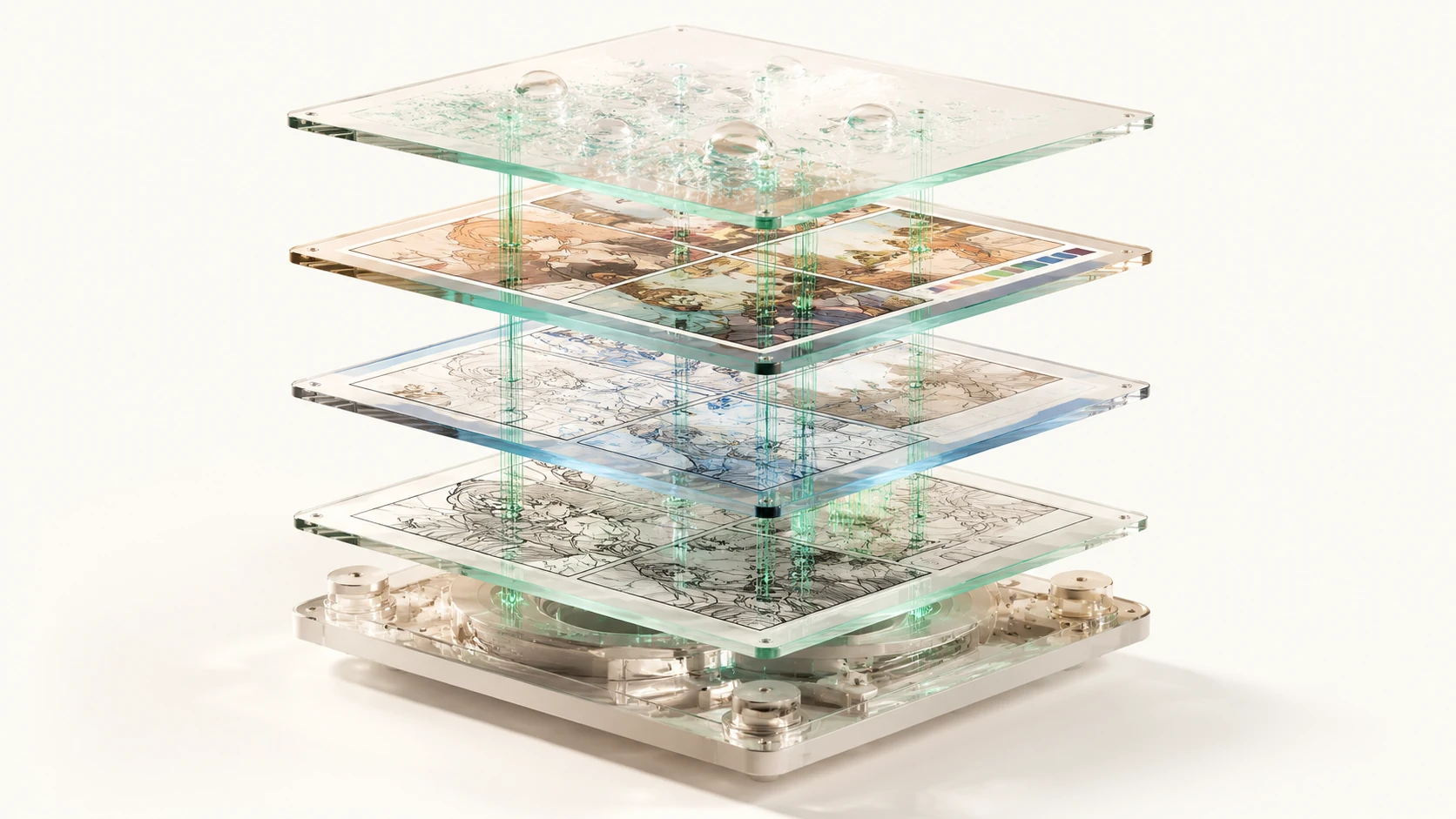
The 2026 Global Webtoon Production Census has arrived, and it paints a picture of an industry in the midst of its most significant transformation since the invention of the vertical scroll. The data reveals that the era of the 'lone creator' struggling through 80-hour workweeks to meet weekly deadlines is rapidly coming to an end. In its place, a new standard has emerged: Narrative-Orchestration (NO). This framework is not merely about using AI or better software; it is a complete reimagining of the comic production pipeline that prioritizes creator longevity and IP scalability above manual output. By decoupling the creative vision from the repetitive mechanical tasks of rendering and formatting, studios are finally finding a sustainable way to meet the insatiable global demand for content.
The Collapse of the Artisanal-Crunch Model
According to the 2026 Census, which surveyed over 1,500 studios and 10,000 independent creators globally, the 'artisanal-crunch' model—where a lead artist is responsible for every brushstroke—is no longer economically viable. The cost of human labor combined with the high frequency of platform algorithms has created a 'burnout ceiling.' Studios that attempted to scale using 2023-era methods saw a 45% increase in talent turnover and a significant dip in narrative quality. The 2026 shift toward NO is a survival mechanism. By modularizing the creative process, lead creators have transitioned into 'Narrative Architects' or 'Orchestrators,' focusing on character arcs, emotional beats, and world-building, while specialized hybrid systems handle the grunt work of perspective, lighting, and line-cleaning.
The Mechanics of Narrative-Orchestration (NO)
At its core, Narrative-Orchestration relies on the separation of 'Intent' and 'Execution.' The 2026 NO Standard utilizes a three-layer architecture. First is the Semantic Layer, where the story's 'DNA'—its lore, character psychology, and plot logic—is stored in a machine-readable format. Second is the Asset Layer, where characters, backgrounds, and props are maintained as high-fidelity, interoperable assets (often using the 2026 LSFS standard). Third is the Orchestration Layer, which coordinates human talent and AI agents to assemble these pieces into a final product. This modularity means that if a series needs to pivot from a webtoon to an anime or a game, the 'Orchestrator' doesn't need to start from scratch; the narrative intent and visual assets are already synchronized.
The Efficiency Dividend
The financial implications of this shift are staggering. Studios that have fully implemented the NO framework report a 240% increase in chapter output per year without increasing their headcount. More importantly, the 'mental load' on lead creators has dropped significantly. The census shows that creators in NO-compliant studios spend 70% of their time on story and composition, compared to just 15% in traditional studios. This 'Efficiency Dividend' is being reinvested into higher-quality writing, which the 2026 data correlates directly with higher reader LTV (Lifetime Value) and retention rates. For the first time in the history of webtoons, quantity is no longer the enemy of quality.
Maintaining the 'Narrative Soul' in a Hybrid Era
A major concern during the early adoption of NO was the potential loss of a creator's 'unique touch.' However, the 2026 Census indicates the opposite. By automating the 'invisible' tasks—such as coloring consistent backgrounds or rendering crowd scenes—creators have more time to focus on 'Signature Panels.' These are the high-impact, emotionally resonant moments that define a series' identity. The NO Standard encourages 'Human-in-the-Loop' (HITL) checkpoints where the lead creator manually refines key expressions and pivotal action sequences. This ensures that the 'Narrative Soul' remains intact, while the surrounding production volume is handled by the orchestration engine. The market has responded positively: 92% of the top-grossing webtoons in 2026 use some form of the NO framework.
The Future: Toward 2027 and Beyond
As we look toward 2027, the Narrative-Orchestration standard is expected to evolve further with the integration of real-time reader feedback loops. The 2026 Census suggests that 'Responsive Orchestration'—where a story's pacing or visual tone can be adjusted based on live sentiment data—is the next frontier. While this raises new ethical questions regarding creative autonomy, the primary goal remains the same: sustainable creation. The decoupling of scale from burnout is not just a win for studio profits; it is a win for the health and longevity of the global creator community. The 2026 Global Webtoon Production Census proves that when technology is used to empower the human spirit rather than replace it, the entire industry thrives.
FAQ
What is the Narrative-Orchestration (NO) Standard?
NO is a 2026 production framework that separates creative story intent from mechanical execution, allowing studios to scale production through modular assets and hybrid automation without increasing creator burnout.
Does Narrative-Orchestration replace human artists?
No. It repositions human artists as 'Orchestrators' or 'Architects' who focus on high-level creativity and quality control, while automated systems handle repetitive rendering and formatting tasks.
How much does it cost to implement NO in a small studio?
Initial costs involve setting up semantic lore bibles and modular asset libraries, but the 2026 Census shows these costs are typically recouped within 4-6 months through increased output and reduced talent turnover.
Why is the 2026 Census significant for independent creators?
It provides a blueprint for how independent creators can compete with major studios by adopting modular workflows that maximize their creative output without leading to physical or mental exhaustion.