The 2026 Character-Consistency Protocol (CCP): Engineering Visual Stability in Hybrid AI-H
Learn how the 2026 Character-Consistency Protocol (CCP) eliminates character drift in distributed studios. Master the technical workflow for visual stability in hybrid AI-human pipelines.
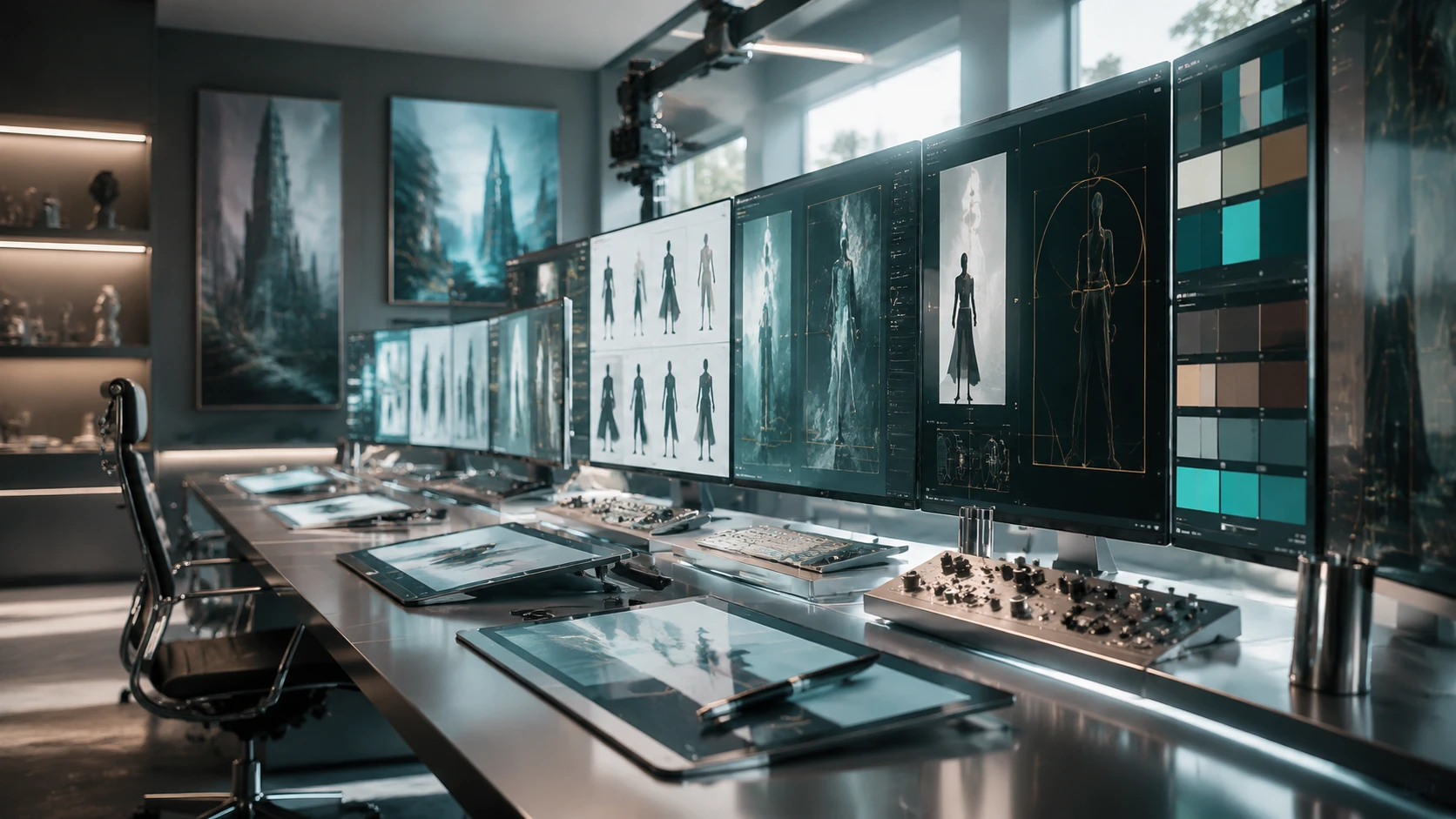
By 2026, the primary bottleneck in scaling global webtoon production is no longer speed, but 'character drift.' As studios increasingly move toward hybrid pipelines—combining human lead artists with AI-driven asset generation and distributed colorist teams—maintaining the visual soul of a character across 100+ chapters has become a technical discipline in its own right. The 2026 Character-Consistency Protocol (CCP) was developed to solve this specific friction point, moving away from subjective 'eye-balling' and toward a standardized, data-driven framework for visual integrity. This guide explores the CCP architecture and how independent creators and studios can implement it to ensure their protagonists remain recognizable and brand-stable regardless of the production speed.
What is the 2026 Character-Consistency Protocol (CCP)?
The CCP is a set of technical standards and workflows designed to lock character geometry, color profiles, and expressive range within a machine-readable format. Unlike traditional model sheets, which are static images meant for human reference, CCP-compliant assets are 'multi-modal anchors.' They include 3D topology data, latent space seeds for generative tools, and semantic descriptions of idiosyncratic features (e.g., the exact curvature of a scar or the specific translucency of an iris). This allows the production engine to verify every panel against a 'source of truth' before it reaches the final editor, reducing manual corrections by up to 70%.
The Master Model Sheet (MMS) vs. Generative LoRAs
In 2026, the static MMS is merely the starting point. The real power of CCP lies in the Custom Trained Weights (often via LoRA or similar adapters) that act as the 'visual DNA' for the series. A CCP-compliant pipeline ensures that these generative weights are trained exclusively on human-vetted anchor assets, preventing the 'hallucination' of features that often plagues lower-tier AI workflows. This creates a closed-loop system where the machine understands the character's volume and style, but the human artist maintains the sovereignty of the design.
Step-by-Step Implementation: The 5-Phase CCP Workflow
Implementing the CCP requires a shift from 'drawing panels' to 'managing assets.' For studios looking to scale, this workflow is the new industry standard for quality assurance.
- Phase 1: Latent Space Mapping – Defining the character’s unique geometric markers (jawline angle, eye-to-nose ratio) into a numerical profile.
- Phase 2: Anchor Asset Generation – Creating 50-100 high-fidelity 'Golden Panels' that represent the character in various lighting and emotional states.
- Phase 3: Weight Integration – Training the series-specific AI adapter using the Golden Panels to ensure the model 'understands' the specific art style and character anatomy.
- Phase 4: Semantic Tagging – Developing a shared lexicon for the production team (e.g., 'Angry_A' always triggers a specific brow compression).
- Phase 5: Automated Verification – Running panels through a similarity-check engine that flags deviations from the CCP profile.
Avoiding 'Uncanny Drift': Common Mistakes in AI-Assisted Production
The most common failure in 2026 production is over-reliance on generic generative models without character-specific tuning. This results in 'Uncanny Drift,' where the character looks mostly correct but loses the specific hand-drawn nuances that build reader empathy. Another critical mistake is failing to account for 'lighting-induced mutation,' where the AI model changes the character's facial structure based on environmental shadows. The CCP mitigates this by enforcing 'Neutral Lighting Profiles' as the base layer before environmental filters are applied in post-production.
The Rise of the Visual Continuity Editor (VCE)
As the CCP becomes standard, a new role has emerged in the comic industry: the Visual Continuity Editor. This specialist is responsible for managing the CCP profiles, updating the generative weights as the character ages or changes outfits, and performing the final 'human-trace' audit. The VCE ensures that while the heavy lifting of panel rendering is automated, the artistic intent remains pure. This role bridges the gap between technical engineering and classical art direction, ensuring that the technology serves the story, not the other way around.
FAQ
Will CCP make my art style look generic?
No. CCP is designed to lock in *your* specific style markers. It acts as a technical boundary that prevents the AI from defaulting to generic aesthetics.
Can solo creators use the Character-Consistency Protocol?
Yes. Even for soloists, setting up a CCP (mapping markers and anchor panels) saves hours of manual correction and ensures your character remains recognizable across years of serialization.
What tools are required for a CCP-compliant pipeline in 2026?
A combination of local-hosted generative engines (like Stable Diffusion 4), 3D modeling software for geometric anchors, and a CCP-verification plugin for your preferred drawing app.