The 2026 Branching Narrative Standard: Engineering Choice-Driven Webtoons for High-Engagem
The 2026 shift from passive scrolling to choice-driven interactivity is redefining reader engagement. This guide explores the technical architecture of the Branching Narrative Standard and its impact on IP value.
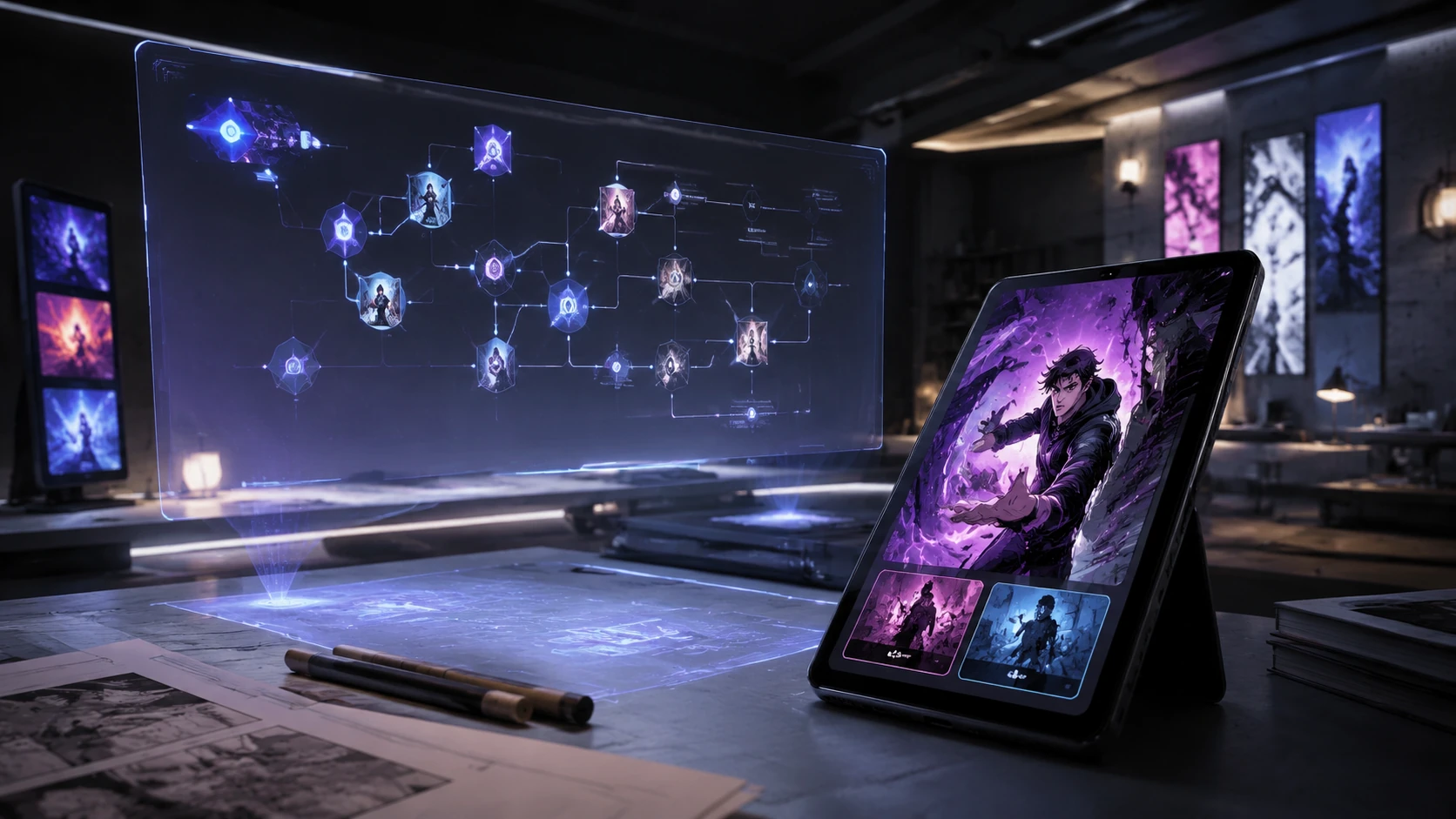
By mid-2026, the global webtoon market has reached a saturation point where 'standard' vertical scrolling is no longer enough to guarantee high retention rates. The industry has pivoted toward the 2026 Branching Narrative Standard (BNS), a technical framework that transforms passive comics into interactive, choice-driven experiences. Unlike early experiments with 'choose-your-own-adventure' formats, modern BNS-compliant webtoons use state-aware story engines that track reader decisions across multiple chapters, dynamically altering visual assets, dialogue, and even character relationships in real-time. This shift isn't just about novelty; it is a strategic response to the demand for 'Personalized IP,' where every reader’s journey through a series feels unique. For creators and studios, mastering the engineering behind these branching paths is the key to unlocking higher lifetime value (LTV) and deeper emotional investment from a global audience.
What is the 2026 Branching Narrative Standard (BNS)?
The BNS is a unified data architecture that allows webtoon platforms and creation tools to communicate through a shared logic layer. At its core, BNS moves away from the 'flat image' model of traditional webtoons and adopts a 'modular asset' approach. Instead of a single vertical strip, a BNS chapter is delivered as a package of conditional nodes. Each node contains visual layers (backgrounds, characters, effects) and a logic trigger that determines which asset to render based on the reader's previous interactions. This standard ensures that interactive comics are interoperable across different apps and devices without requiring custom code for every platform. It effectively treats the webtoon as a lightweight game engine, prioritizing seamless transitions and low-latency asset swapping to maintain the 'flow' of reading.
The Architecture of Choice: Engineering Logic Gates
Engineering a branching webtoon requires a fundamental shift in how scripts are written and visualized. Creators no longer work on a linear timeline; they build 'Narrative Clusters.' These clusters are defined by three primary types of logic gates that manage the reader's experience and prevent 'narrative collapse' (where the story becomes too complex to manage).
- Binary Gates: Simple A/B choices that provide immediate feedback, such as choosing a character's dialogue response or an action in a fight scene.
- State-Variable Gates: Long-term logic that tracks 'Affinity Points' or 'World Flags.' For example, choosing to help a secondary character in Chapter 5 may trigger a unique scene or a different ending in Chapter 50.
- Funneling Gates: Strategic points where divergent paths merge back into a central plot line to keep production costs manageable while still acknowledging the reader's previous choices.
State-Aware Storytelling and Variable Tracking
The most advanced 2026 webtoons utilize persistent state-tracking. This means the engine 'remembers' the reader's history. If a reader consistently chooses aggressive options, the visual tone—such as the color palette of the UI or the intensity of the soundscapes—can automatically shift to reflect that 'darker' path. This level of personalization creates a high 'Sunk Cost' for the reader, significantly reducing churn because their version of the story feels personal and irreplaceable.
Why Interactivity is the Ultimate Retention Engine
Data from the first half of 2026 shows that BNS-enabled titles have an average 'Re-read Rate' 3.5 times higher than linear series. Readers are frequently returning to the beginning of chapters to explore 'The Path Not Taken,' effectively multiplying the engagement time for a single piece of content. Furthermore, the psychological impact of agency—the feeling that the reader's choices matter—triggers higher dopamine releases during cliffhangers, making readers more likely to use micro-transactions to unlock the next 'Decision Point' immediately. This has led to the rise of 'Agency-Based Monetization,' where platforms charge not just for the chapter, but for the ability to access high-stakes alternative endings or premium character interactions.
Technical Implementation: The JSON-Based Plot Tree
On a technical level, a BNS webtoon is governed by a complex JSON manifest. This manifest maps every possible path, asset call, and variable trigger. Modern 2026 production pipelines use 'Narrative Orchestrators'—AI-assisted tools that audit these JSON files for logic loops and dead ends. When a reader reaches a choice point, the app doesn't download a new video or a massive image; it simply executes the next set of instructions in the JSON, calling specific SVG or WebP layers from the cloud. This 'Lazy Loading' of narrative paths ensures that even the most complex branching story remains fast and responsive on mobile devices with limited bandwidth.
Challenges: Narrative Bloat and Continuity Debt
The primary risk of the BNS model is 'Continuity Debt'—the exponential increase in work required to maintain multiple timelines. If a story branches too early and too often, the production team may find themselves drawing five different versions of every chapter, which is financially unsustainable for most studios. The 2026 solution is 'Visual Modularization.' By using 3D backgrounds and character models that can be re-posed and re-rendered via AI-assisted workflows, studios can generate alternative panels at a fraction of the cost of traditional manual drawing. However, maintaining narrative integrity across all branches remains a high-level skill, requiring 'Narrative Architects' to oversee the logic and prevent plot holes.
Conclusion: The Future of 'Active Reading'
The 2026 Branching Narrative Standard is moving the webtoon medium closer to immersive gaming while retaining the core appeal of visual storytelling. As AI continues to lower the cost of asset generation, the barriers to entry for interactive comics will continue to fall. For platforms, BNS is a powerful tool for data collection, providing direct insight into what readers value most in a story. For creators, it is a new frontier of creative expression, allowing them to build worlds that don't just exist to be seen, but to be lived in. The era of the passive scroll is ending; the era of the active navigator has begun.
FAQ
What is the Branching Narrative Standard (BNS)?
BNS is a 2026 technical framework for webtoons that allows for interactive, choice-driven stories using state-aware engines and modular assets.
Do I need to be a programmer to make a branching webtoon?
No. By 2026, most major webtoon creation tools (like COMICLS) include visual node editors that allow you to map logic gates without writing code.
How do branching narratives impact monetization?
Interactivity drives higher retention and re-read rates, allowing for 'Path-Unlock' monetization where readers pay to explore alternative endings or premium choices.
Does interactivity make webtoons slower to load?
The BNS uses JSON-based lazy loading, meaning only the assets for the reader's specific path are downloaded, keeping the experience fast and mobile-friendly.