The 2026 Audio-Comic Hybrid Standard: Engineering Narrated Webtoons for the Multi-Tasking
Learn how the 2026 shift toward audio-integrated webtoons is unlocking new revenue streams and accessibility for mobile-first creators.
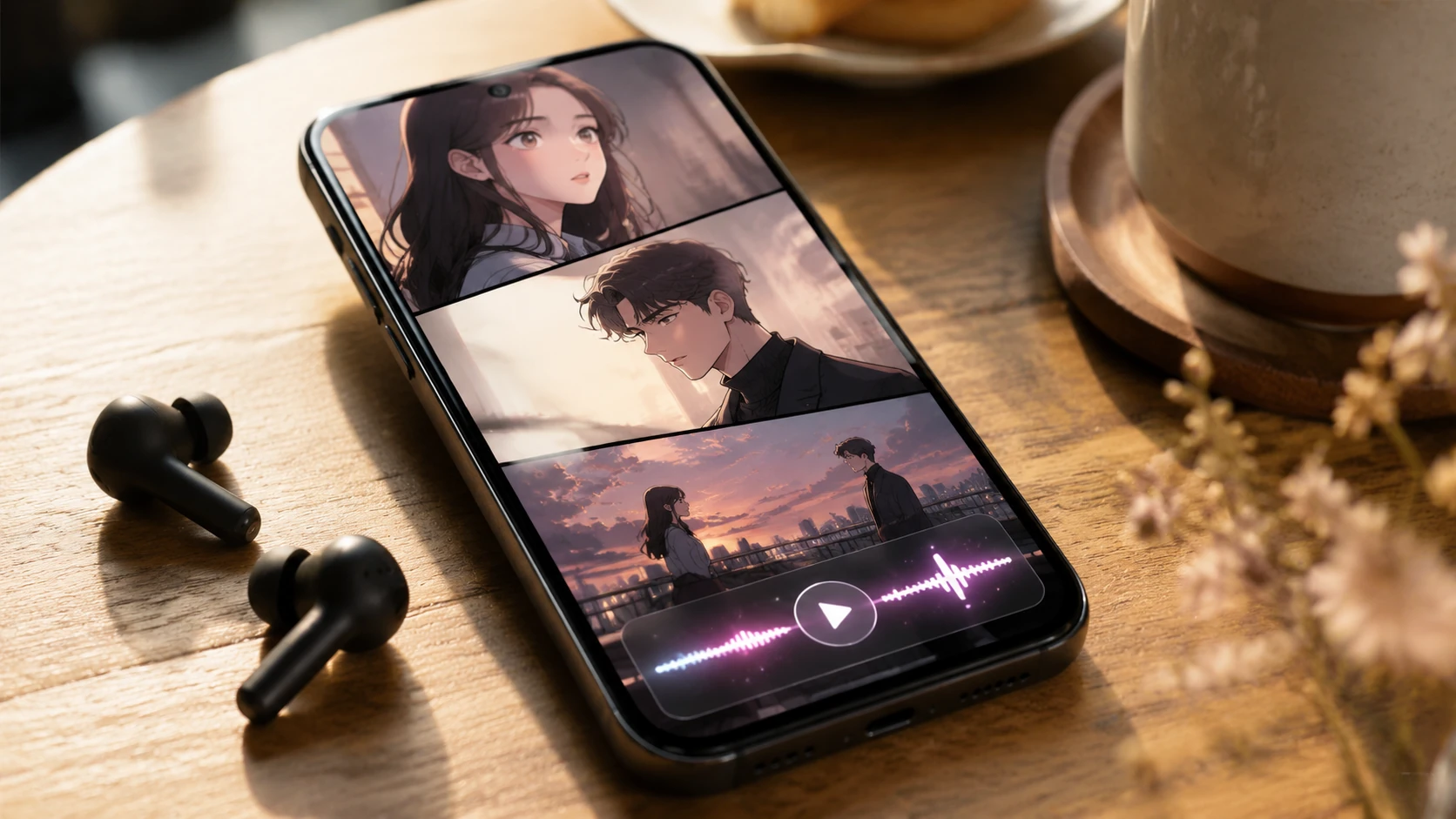
The year 2026 marks a pivotal transition in digital storytelling: the end of the 'silent' era for webtoons. As reader habits shift toward high-mobility and multi-tasking, the industry has responded with the 2026 Audio-Comic Hybrid Standard. This framework isn't merely about adding background music; it is a fundamental re-engineering of the vertical scroll experience to include synchronized, high-fidelity narration. Driven by the need to capture audiences during commutes, gym sessions, and chores, this technology allows readers to toggle between traditional reading and an 'Eyes-Free' mode. For creators, this shift represents a massive expansion of the addressable market, turning the visual-only medium of comics into a versatile audio-visual asset that competes directly with podcasts and audiobooks.
The Core Technology: Dynamic Script-to-Voice Sync
The backbone of the 2026 Audio-Comic Hybrid is the Dynamic Script-to-Voice (DSV) protocol. Unlike early attempts at text-to-speech, DSV uses metadata layers embedded within the comic's vertical file. These layers contain character-specific voice profiles, emotional tags, and timing markers that synchronize the scroll speed with the narration. When a reader activates audio mode, the app doesn't just play a file; it choreographs the visual panels to match the spoken word. This ensures that the 'cliffhanger reveal' or a dramatic punchline lands exactly when the audio reaches that specific panel, maintaining the narrative integrity of the visual pacing.
Synthetic Voice vs. Voice Acting in 2026
In 2026, the cost of high-quality narration has plummeted due to the 'Voice IP' model. Top-tier creators now license specific synthetic voice models that are trained to embody their characters consistently across hundreds of chapters. This technology has advanced beyond robotic monotones, utilizing 'Emotional Inflection Mapping' to adjust tone based on the punctuation and sentiment analysis of the dialogue script. While AAA titles still utilize human voice actors for 'Event Chapters,' the day-to-day serialization relies on these verified synthetic models to ensure scalability and daily-drop compatibility.
Engineering for the 'Hands-Free' Reader
The primary intent behind the Audio-Comic Hybrid is accessibility. Market data from early 2026 shows that 42% of webtoon engagement now occurs while the user is physically unable to hold a device—driving, cooking, or exercising. To serve this segment, the 2026 standard introduces 'Auto-Scroll Choreography.' The app monitors the audio playback speed and moves the canvas vertically at a variable rate. If a panel has a particularly dense visual detail, the audio script is engineered with a 'Visual Pause'—a brief moment of atmospheric sound that allows the reader’s peripheral vision (or a quick glance) to absorb the art before the narration resumes.
- Audio-Reactive Pan and Zoom: The camera automatically focuses on the speaking character's panel.
- Haptic Storytelling: Subtle vibrations sync with bass-heavy sound effects for tactile immersion.
- Ambient Depth: Layered spatial audio that changes based on the setting (e.g., echoes in a cave, muffled sound in rain).
New Revenue Streams: The Audio-Premium Tier
The shift to audio-visual hybrids has created a new monetization layer. Platforms are moving away from flat subscription models toward 'Immersive Pass' tiers. Readers can access the standard visual comic for free or a low fee, but the 'Full Immersion' experience—featuring character-specific narration, 3D spatial audio, and localized dubbing—is locked behind a premium wall. This allows creators to monetize their IP twice: once for the story and once for the 'performance' of that story. Furthermore, the 2026 standard allows for 'Audio-Exclusive' side stories or character monologues that provide deeper lore without requiring extensive new art production.
Implementation Guide for Independent Studios
For boutique studios, adopting the 2026 Audio-Comic Hybrid Standard doesn't require a massive budget. The workflow begins with 'Semantic Scripting'—tagging dialogue with character names and emotional states. These tags are then processed through an API-linked voice engine. The final step is 'Sync-Testing,' where the creator uses a preview tool to ensure the scroll speed doesn't outpace the listener. By focusing on a high-quality 'Narrative Anchor' (one consistent voice for the narrator), even solo creators can provide a compelling eyes-free experience that rivals major platform productions.
Common Pitfalls in Audio-Comic Engineering
- Over-crowding the audio: Adding too many sound effects can distract from the dialogue.
- Descriptive Redundancy: Avoid having the narrator describe exactly what is visible in the panel; instead, focus on internal thoughts or atmospheric context.
- Fixed-Speed Scrolling: Never use a single scroll speed for an entire chapter; it must be dynamic to match the dialogue length.
FAQ
Does audio-integration make webtoons slower to produce?
With the 2026 DSV protocol, the process is largely automated. Creators provide a tagged script, and the engine handles the voice generation and scroll-syncing, adding only about 5-10% to the total production time.
Can I use human voice actors with the 2026 standard?
Yes. The standard supports 'Hybrid Narration,' where human voices are used for lead characters and synthetic voices for background NPCs, allowing for high-quality production within a reasonable budget.
How does this affect the file size of the webtoon?
The 2026 standard uses highly compressed, streamable audio layers. Instead of one large file, audio is delivered in small packets as the reader scrolls, keeping initial load times low.