From Prose to Panels: The Definitive Guide to Novel-to-Webtoon Adaptation in 2026
Adapting a novel into a webtoon requires more than just adding art; it demands a fundamental shift in narrative architecture. This guide explores how creators can bridge the gap between descriptive prose and the dynamic, mobile-first world of vertical comics.
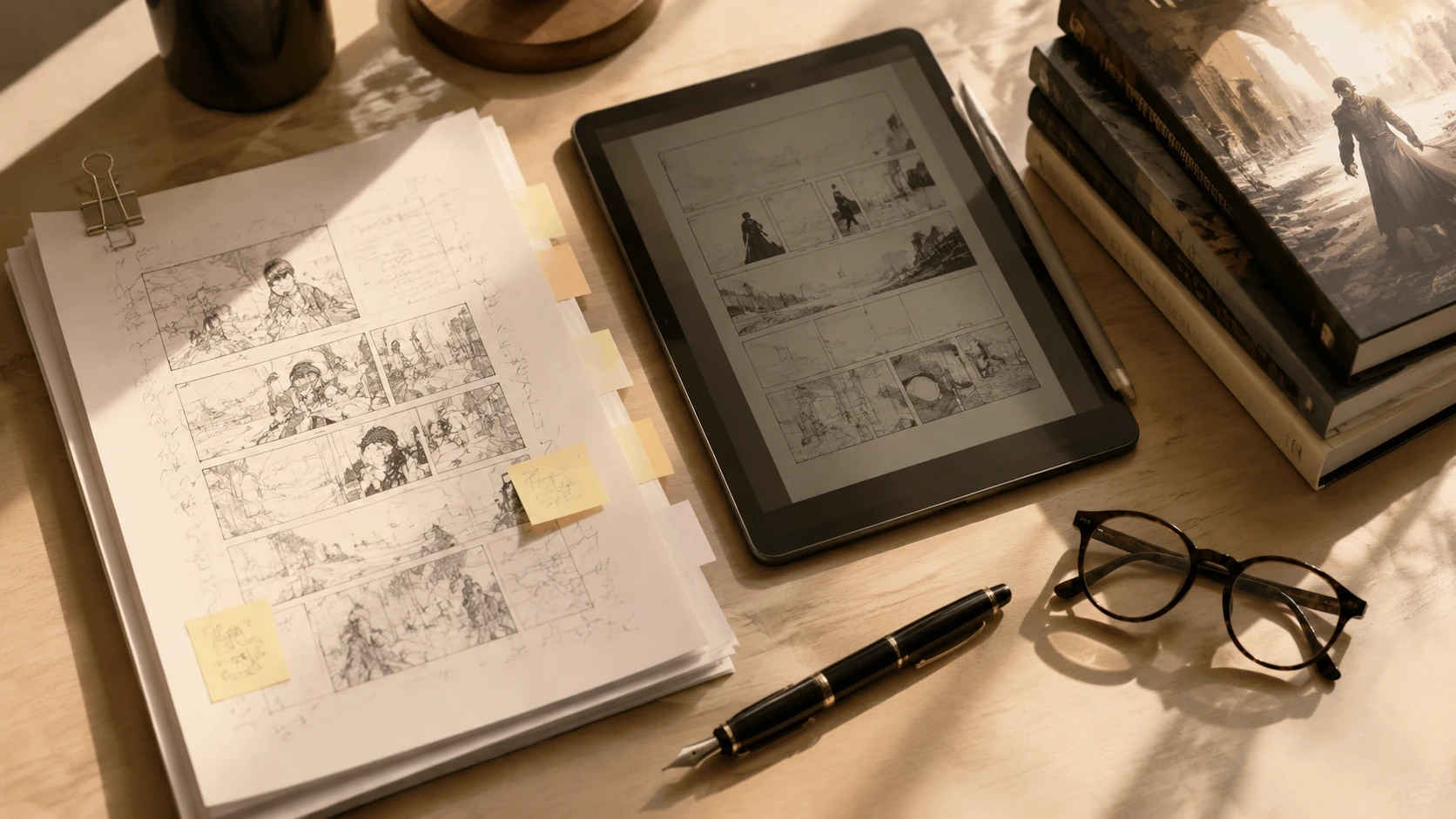
In 2026, the global entertainment market is no longer siloed by format. The 'One Source Multi-Use' (OSMU) model has matured, making the transition from web novel to webtoon the most lucrative path for independent creators and publishing houses alike. However, many adaptations fail by being too literal. To succeed, you must stop translating words and start translating experiences.
The Architecture of a Visual Script
A novel relies on a reader's imagination to fill in the blanks, while a webtoon relies on the eyes. The first step in adaptation is the 'Deconstruction Phase.' You must identify the core emotional beats of a chapter and strip away the internal monologue that doesn't drive the plot. In the vertical scroll format, every panel must serve a purpose: movement, emotion, or information.
- Dialogue Compression: Reduce 10 lines of prose dialogue to 3 impactful speech bubbles.
- Visual Cues: Use character expressions and environmental lighting to replace paragraphs of internal thought.
- Action Mapping: Break down one sentence of 'they fought' into five distinct, high-impact vertical panels.
Pacing the Pivot: The Vertical Advantage
Webtoon readers consume content with a rhythmic thumb-flick. While a novel chapter might have a slow burn, a webtoon episode needs a 'hook' every 15-20 panels. When adapting, you often need to rearrange the sequence of events to ensure that each episode ends on a cliffhanger that compels the reader to use their digital currency for the next 'Fast Pass' or 'Early Access' chapter.
Character Consistency and AI Prototyping
Consistency is the bedrock of E-E-A-T in the creator space. Readers form deep parasocial bonds with visual characters. In 2026, smart creators use AI-assisted character sheets to maintain anatomical and fashion consistency across hundreds of panels. Before hiring a full production team, use AI tools to generate 'style guides' based on your novel’s descriptions. This ensures the visual soul of the character matches the prose original.
Legal and Strategic IP Expansion
Before you begin the adaptation, ensure your intellectual property rights are clear. Are you retaining the 'derivative work' rights? In the 2026 landscape, the webtoon version often becomes the primary marketing vehicle for the original novel, creating a feedback loop of revenue. High-intent creators are now bundling digital novel access with webtoon subscriptions to maximize the Life Time Value (LTV) of each reader.
FAQ
How do I turn a novel into a webtoon script?
Focus on converting internal monologues into visual actions, breaking the story into 'beats' rather than paragraphs, and ensuring each episode ends with a visual cliffhanger.
Can I use AI to help with novel-to-webtoon adaptation?
Yes, AI is excellent for creating character style guides, storyboarding layouts, and generating initial environment concepts to maintain consistency across the series.
How long should a webtoon episode be compared to a novel chapter?
Typically, one webtoon episode consists of 60 to 100 panels. A standard 3,000-word novel chapter often yields about 1.5 webtoon episodes.